How Madrid came to eat the way it does: the people, migrations and accidents that shaped the plate.
Key eras
16th century, the boarding-house Madrid
When Philip II made Madrid the Spanish capital in 1561, the city was a small Castilian town of 30,000. The court attracted servants, bureaucrats and merchants, and Madrid's first food culture was the boarding-house (casa de huespedes) kitchen. The cocido madrileno of slow-cooked chickpeas and meat in a single pot was the daily fare for boarders, and the stew anchored the city's working-class kitchen for 400 years.
1725, Sobrino de Botin opens the wood ovens
In 1725, French chef Jean Botin and his Asturian wife opened a wood-fired tavern off Plaza Mayor. The wood oven (still standing in 2026) gave the city its first canonical roast tradition: cochinillo segoviano and cordero asado. The restaurant is Guinness-certified as the world's oldest continuously operating dining room. Hemingway named it as one of his favourite Madrid meals; the kitchen became the template for the Castilian asador.
1839, Lhardy and the Parisian counter
Emilio Huguenin Lhardy, a Swiss-French restaurateur, opened Lhardy on Carrera de San Jeronimo in 1839. The room introduced the Parisian-style charcuterie counter and the silver-urn consome service to Madrid, and the upstairs dining rooms became the canonical setting for the cocido madrileno. Queen Isabel II ate at Lhardy weekly; the wood panelling and silver urn remain unchanged in 2026.
1894 to 1955, the casa de comidas and the working-quarter taberna
Between the late 19th century and the post-Civil-War decades, Madrid's working quarters (Lavapies, La Latina, Embajadores) developed the casa de comidas tradition: cheap dining rooms serving callos, gallinejas, caracoles and bocadillos de calamares to factory workers and rastro market traders. Casa Ciriaco (1929), Casa Lucio (1974) and Malacatin (1895) anchored the tradition. The cuisine was shaped by cheap cuts, slow cooks and the offal canon.
1985 to 2010, the rise of the Madrid asador and the modern taberna
In the 1980s, the Mario Sandoval family revived the Castilian asador with a clean fine-dining template at Coque (1980), opened in Humanes and moved into central Madrid in 2017. Sacha Hormaechea introduced the tortilla vaga in 1972, the lazy-tortilla that defined Madrid's modernist take on the egg-and-potato canon. Sala de Despiece, opened by Javier Bonet in 2013, ran the room as a butcher's counter, anchoring Calle Ponzano as the city's modern-taberna corridor.
2014 to 2026, the DiverXO era and Madrid's Michelin moment
In 2014, David Munoz's DiverXO won its third Michelin star, becoming Madrid's first and (until 2024) only three-star dining room. Munoz's theatrical 14-canvas tasting menu, painted-pig plates and Asian-Spanish fusion reshaped what Madrid fine dining could be. The 2024 Michelin season added Coque, Deessa and DSTAgE to the Madrid two-star list; the city's fine-dining scene finally caught up with Barcelona and San Sebastian on the European stage.
Immigrant influences
- Asturian (1888 onward): Asturian migrants brought the sidreria tradition to Madrid, anchored by Casa Mingo on Paseo de la Florida since 1888. Roast chicken, natural cider poured from height, and fabada asturiana became permanent Madrileno fixtures.
- Galician (1950s onward): Galician migrants brought the pulperia tradition to Madrid, with pulpo a la gallega cooked over copper pots, Albarino wines and the Mariscos canon at Pescador, Casa do Companeiro and El Pulpito.
- Basque (1960s onward): Basque migrants brought the gilda pintxo and the Basque sidreria tradition; El Zerain on Calle de la Cruz still grills the chuleton de buey over coals and pours natural cider from the bottle.
- Andalusian (1960s onward): Andalusian migrants brought salmorejo and gazpacho to Madrid's summer carte, plus the sherry and Pedro Ximenez wine tradition centred at La Venencia (where Hemingway drank manzanilla from 1930).
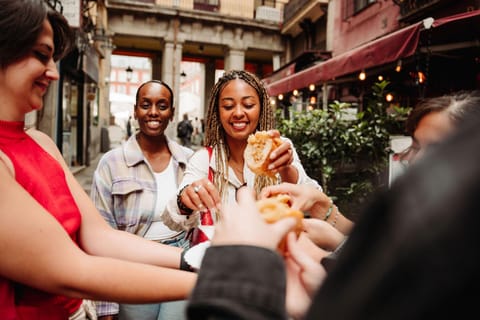
- Filipino (1898 onward): Filipino sailors who travelled through the Spanish Pacific empire brought the calamari sandwich tradition to Madrid in the 1950s; the bocadillo de calamares became the Plaza Mayor working-day lunch.
- Moroccan and Senegalese (1990s onward): North African and West African migrants reshaped Lavapies into Madrid's most diverse food quarter, with halal tagines, couscous and Senegalese rice plates at Mercado Anton Martin and surrounding tabernas.
Signature innovations
- Cocido madrileno: three-volcado service
- Bocadillo de calamares: the Plaza Mayor sandwich
- Sobrino de Botin: the 1725 wood oven still in use
- Lhardy silver-urn consome service since 1839
- Sacha Hormaechea's tortilla vaga (lazy tortilla)
- DiverXO's painted-pig theatrical tasting service
- Sala de Despiece: the butcher-counter taberna model
- Vermut de grifo: vermouth on tap from oak barrels
Food History in Madrid, FAQ
When is the best time to eat in Madrid?
Peak food season in Madrid is year-round.
What time do people eat in Madrid?
Local dining hours: lunch around 12:30, dinner from 19:30.
How does tipping work in Madrid?
service is typically included; small extra is welcome but not expected.
What is the one dish to try in Madrid?
Ask the next local you meet what they would order. Madrid rewards trust.