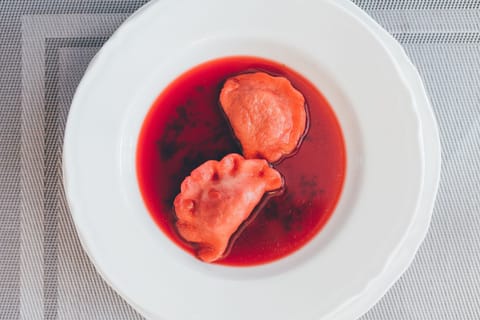
How Kraków came to eat the way it does: the people, migrations and accidents that shaped the plate.
Key eras
1364, the Wierzynek coronation feast
Mikołaj Wierzynek, councillor of Kraków, hosted the 1364 coronation feast for King Casimir III. Five visiting monarchs sat at the Rynek Główny banquet, eaten for 20 days. The Wierzynek restaurant still trades on Rynek Główny 16 and claims an unbroken line of Polish royal banquet service.
1496, the obwarzanek krakowski first licensed
A 1496 royal privilege from King Jan Olbracht granted Kraków's bakers exclusive rights to produce obwarzanek, the salted ring bread eaten during Lent. The ring's geographically protected status was registered with the EU in 2010; about 150,000 leave the city's red carts daily.
1896, the first bar mleczny
Stanisław Dłużewski opened Poland's first bar mleczny (milk bar) on Kraków's Floriańska in 1896 as a cheap dairy-led canteen for workers and students. The format spread across the country; after 1948 the state subsidised milk bars as worker canteens. Kraków preserved the densest cluster.
1949, Nowa Huta and the socialist canteen
Communist authorities built Nowa Huta from 1949 as a steelworks-anchored ideal-worker district east of Kraków. The new town's canteens, milk bars and pierogi rooms still trade on the same shop fronts. Stylowa on Plac Centralny is the editorial socialist-realist preserved canteen.
1989-2000s, the post-transition Kazimierz revival
After 1989 the long-abandoned Kazimierz Jewish quarter slowly revived. The 1993 filming of Schindler's List on Józefa, the 1998 founding of the Jewish Culture Festival, and the Plac Nowy zapiekanka rotunda's reopening in 1989 turned Kazimierz from ruin into the city's most-layered food district.
2020-now, Kraków earns Poland's first two-star kitchen
Bottiglieria 1881, Przemysław Klima's neo-Polish tasting-menu room in Kazimierz, earned Kraków's first Michelin star in 2020 (within a year of opening) and was promoted to two stars in 2023, becoming the first restaurant in Poland to hold two stars. Karakter, Filipa 18 and Amarylis followed; the new wave coexists with the milk bars.
Immigrant influences
- Jewish (Ashkenazi): Kazimierz held one of Europe's oldest Jewish quarters from 1495 to 1939. Gefilte fish, cholent, challah, knishes and the bajgiel shaped Kraków cooking; revival kitchens cook it now.
- Hungarian: Habsburg-era Hungarian migration after the 1772 partition brought Tokaji wine, paprika, gulasz and strudel to Kraków. Noworolski has poured Tokaji since 1910.
- Tatar: Polish-Lithuanian Tatars (Lipka) settled from the 17th century and shaped Polish meat cookery: tatar (raw beef tartare), pierogi z mięsem, kibinai pastries. Tartare runs on Old Town cartes.
- Italian: Bona Sforza, Italian wife of King Sigismund I from 1518, brought Italian gardeners and the vegetable canon (cauliflower, broccoli, fennel) into Polish kitchens. Salad greens are still called 'włoszczyzna'.
- Highlanders (Górale): Tatra-mountain highlanders moved to Kraków carrying oscypek smoked sheep cheese, kwaśnica cabbage soup, slow-roasted lamb and wood-fire grilling. Morskie Oko cooks the tradition in town.
- Ukrainian (post-2022): Polish-Ukrainian migration after 2022 added borshch counters, varenyky rooms and Crimean Tatar lamb-and-rice plates across Kraków. The crossover bridges both Eastern European traditions.
Signature innovations
- Obwarzanek krakowski, the salted ring bread under EU geographical protection since 2010
- Bar mleczny, the Polish milk bar canteen format invented on Floriańska in 1896
- Maczanka po krakowsku, the city's shredded-pork-in-marjoram-broth sandwich
- The pierogi-as-currency tradition: more than 20 fillings sold as standard at every counter
- The Plac Nowy zapiekanka rotunda, since 1989: the country's first all-night open-face baguette window
- Starka, the house-aged Polish vodka tradition, with cellar-aged vintages from 8 to 25 years
Food History in Kraków, FAQ
When is the best time to eat in Kraków?
Peak food season in Kraków is year-round.
What time do people eat in Kraków?
Local dining hours: lunch around 12:30, dinner from 19:30.
How does tipping work in Kraków?
service is typically included; small extra is welcome but not expected.
What is the one dish to try in Kraków?
Ask the next local you meet what they would order. Kraków rewards trust.