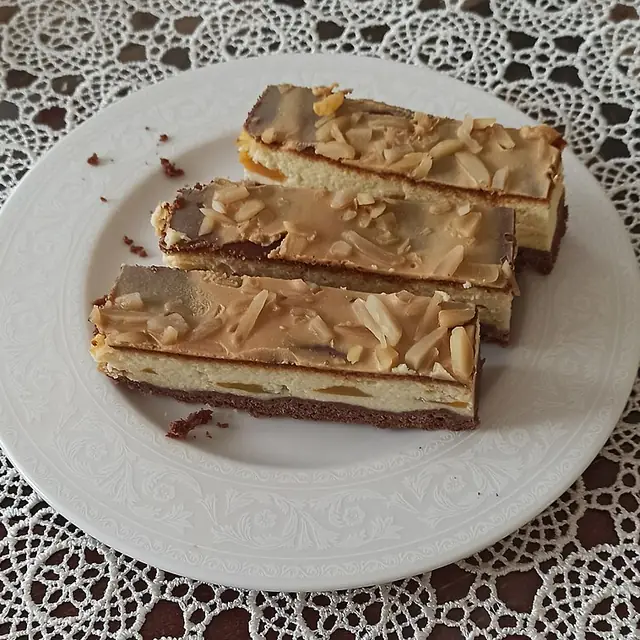
Sernik krakowski is the Krakow version of Polish baked cheesecake: dense farmer's-cheese filling, lattice of pastry strips on top, lemon zest in the curd; in Poland we have verified places to eat it in Kraków and Wrocław.
Sernik krakowski is the Krakow version of Polish baked cheesecake: dense farmer's-cheese filling, lattice of pastry strips on top, lemon zest in the curd. The city's daily pastry-counter standard.
Polish sernik (baked cheesecake) entered Polish home baking in the 19th century, using twaróg (farmer's cheese) instead of the German Quark or American cream cheese. The Krakow variant, sernik krakowski, distinguished itself by 1900 with a decorative lattice of pastry strips baked on top. The cake appeared in Maria Ochorowicz-Monatowa's 1910 cookbook as a Krakow speciality. The city's surviving counter sellers, Vanilla on Brzozowa and Noworolski in the Cloth Hall, serve the editorial Krakow version. The lattice pattern is the geographic ID; serniki from Warsaw, Poznań or Gdańsk are flat-topped.
Polish twaróg cheesecake: a dense, light-yellow baked cake made from fresh dry-curd farmer's cheese (twaróg) folded with butter, egg yolks, sugar, vanilla and raisins, on a thin shortbread base, often with a lattice top.
Sernik has been a Polish bakery staple since the medieval period, with twaróg (Polish dry-curd cheese) the structural ingredient that gives the dish its distinctive texture: lighter, drier, less sweet than American cheesecake, more cake-like than dense. The Kraków lattice-top version (sernik krakowski) is the most ornamented form; the Silesian Wrocław version is simpler with a flat top and often raisins or candied orange peel folded through. The cake became a Sunday dinner standard across the Polish home in the 19th century; modern Wrocław bakeries serve the canonical version.
Have you heard that the drinking vodka is the most common tradition of Poland? During this Private Vodka Tasting Tour you will try it and find out on your own.
Get ready for a pierogi adventure! Learn time-honored secrets, make dough and fillings from scratch, and enjoy your delicious creations with a local drink, guided by o...