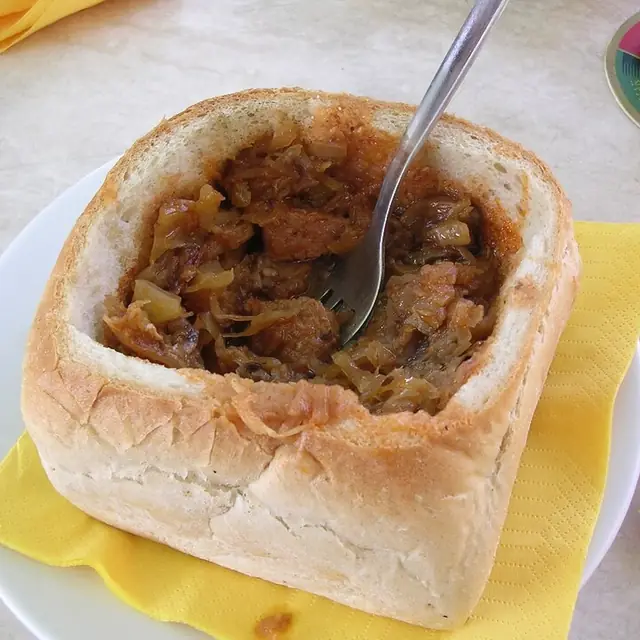
The Polish hunter's stew of sauerkraut, fresh cabbage, smoked kielbasa, pork shoulder, dried mushrooms and prunes, simmered for hours and reheated for days until the flavours deepen into the national winter dish.
Bigos has appeared in Polish kitchens since at least the 14th century, originally as a hunters' field stew made from whatever game and pickled cabbage the household had. Mickiewicz immortalised it in Pan Tadeusz. Every Gdańsk traditional kitchen, from Kubicki to Witómë, keeps a pot through the cold months.
Bigos is the slow-cooked hunter's stew of sauerkraut, fresh cabbage, smoked sausage, pork and dried mushroom: deep brown, vinegar-sharp, served by the bowl in winter across every Kraków bar mleczny and Polish bistro.
Bigos appears in Polish chronicles from the 14th century as the food of Polish royal hunting parties. The dish was traditionally cooked in a cauldron over a hunt-camp fire, re-cooked and reheated for days until the cabbage broke down completely. By the 17th century it was the Polish gentry's canonical winter meal. Mickiewicz's 1834 Pan Tadeusz devotes 21 lines of verse to bigos preparation. Every Kraków bar mleczny serves a daily-changing bigos pot; the dish improves with reheating over 3 to 4 days. Polakowski on Miodowa and the bar mleczny Pod Temidą serve the Kraków canteen versions.
Bigos, the hunters' stew, is the slow-cooked sauerkraut, fresh cabbage and mixed meats casserole that improves over three days of reheating. Polish winter on a single plate.
Bigos traces to the 14th-century hunting tradition of the Polish nobility, the original aristocratic 'hunters' stew' cooked on multi-day forest expeditions with whatever game came back. The 17th-century version added sauerkraut, which kept the stew preserved across the days of reheating; this is why bigos still tastes better on the third day than the first. Mickiewicz wrote bigos into the national epic 'Pan Tadeusz' in 1834. Today every Polish restaurant in Warsaw plates bigos, often as a Christmas leftover dish through January, ladled over rye bread.
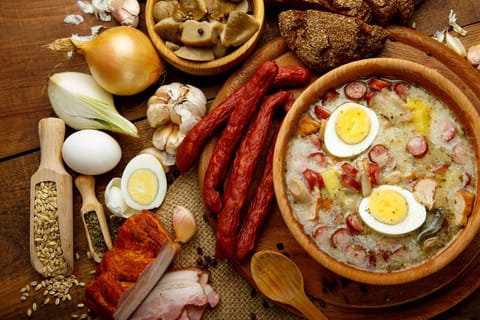
Savor the flavors of Poland on a food tasting tour of Gdansk. Discover what “gołąbki” and “żurek” are. Hear fascinating stories about the Poles and their relationship ...
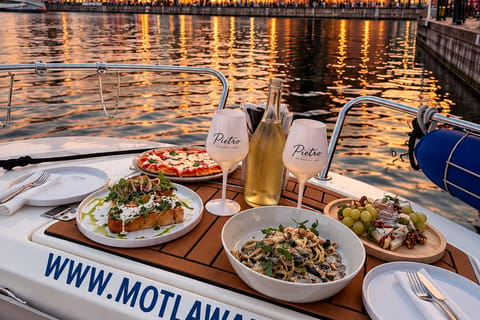
Enjoy a private dinner experience on the Motława River in Gdańsk. Savor a delicious Italian dinner, sip on a bottle of wine, and admire the iconic Gdańsk Crane and cit...

.jpg)