
Guided tour · 4 hours
Penang: Morning Food Tour with 15+ Tastings in George Town
Discover the favorite local brunch foods on a guided tour of the George Town district.
from$49 Check dates
The plates that define Penang: what they are, and where to eat the canonical version.
The plates that define Penang: what they are, where they came from, and where to eat the canonical version.
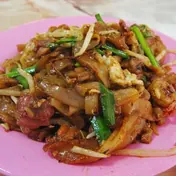
Flat rice noodles flash-fried in pork fat with prawns, cockles, egg, chives and dark soy, judged on wok hei, the smoky breath a charcoal-fired wok gives the plate.
Where to try it: Siam Road Char Koay Teow, Penang Road Famous Jin Kor Char Kuey Teow, Bee Hwa Cafe
Price: RM8-15
Char koay teow began as cheap calories for Penang's dockworkers and rickshaw pullers, fried by street hawkers on shoulder-pole stoves in the late 1800s. The Penang version distinguished itself with duck eggs, blood cockles and a restrained hand with sweet sauce, staying savoury where southern versions go sugary. Charcoal remains the connoisseur's dividing line: the 2026 Michelin guide lists Siam Road's charcoal cart, run by the founder's son, as the standard-bearer.
Watch out for: Shellfish, Egg, Soy
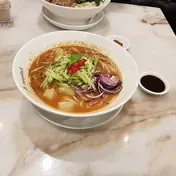
Thick rice noodles in a sour tamarind and mackerel broth, piled with cucumber, pineapple, mint, torch ginger and a spoon of pungent hae ko prawn paste.
Where to try it: Wan Dao Tou Assam Laksa, Penang Road Famous Laksa, My Own Cafe, Laksalicious
Price: RM6-12
Assam laksa is Penang's own answer to the coconut laksas of the south: a fish broth soured with tamarind (asam) and sharpened with torch ginger flower, a profile carried from Thai-influenced northern Malay kitchens into Chinese hawker stalls. Air Itam's stalls beside the wet market made the dish famous, and third-generation carts like Wan Dao Tou still build it on 50-year-old family recipes. The hae ko prawn paste stirred in at the table is the make-or-break step.
Watch out for: Fish, Shellfish
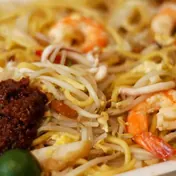
Penang's Hokkien mee is a deep-red prawn broth over yellow and rice noodles, topped with prawns, pork slices, egg and crisp shallots, chilli paste on the side.
Where to try it: 888 Hokkien Mee, Bridge Street Prawn Noodle
Price: RM7-14
Brought by Hokkien immigrants who wasted nothing, the soup extracts its colour and sweetness from prawn heads and shells pounded and simmered with pork bones. In Penang the name Hokkien mee means this prawn soup, while Kuala Lumpur uses the same name for black fried noodles, a divide locals police fiercely. Presgrave Street's 888 stall has kept its version to the 30-year mark, and morning stalls like Bridge Street serve it as a breakfast rather than a supper.
Watch out for: Shellfish, Egg, Soy
Guided tour · 4 hours
Discover the favorite local brunch foods on a guided tour of the George Town district.

Guided tour · 4 hours
Take a deep dive into Penang's rich food culture and history. Meet the people behind the food, salivate over 15+ tastings, and discover what makes up this island's vib...

Viator · 4 h
When it comes to food, the residents of Penang have it good. There’s few places which measure up to George Town’s culinary prowess. It might not be as visited as Bangk...
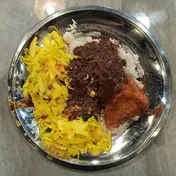
Steamed rice flooded with layered curries, banjir style, and paired with fried chicken, sotong or okra, served fast from rows of pots at Tamil Muslim canteens.
Where to try it: Line Clear Nasi Kandar, Deens Maju Nasi Kandar, Hameediyah
Price: RM8-25 depending on toppings
Nasi kandar takes its name from the kandar pole Tamil Muslim traders used to balance rice and curry pots as they walked George Town's docks in the 1800s. Hameediyah moved the trade indoors on Campbell Street in 1907 and is recorded by the Malaysia Book of Records as the country's oldest nasi kandar restaurant, while Line Clear's open-air alley off Jalan Penang, running around the clock, made the format a national obsession. Ordering is a spoken art: name your rice, your protein, and say banjir if you want every curry to flood the plate.
Watch out for: Varies by curry; commonly dairy and shellfish

Shaved ice over pandan rice-flour noodles, coconut milk and dark gula melaka, often with red beans, eaten standing in the street heat before it melts.
Where to try it: Penang Road Famous Teochew Chendul
Price: RM4-7
Cendol crossed the strait with Teochew and Peranakan traders and became a Penang street ritual in the 1930s, when Tan Teik Fuang set up on Lebuh Keng Kwee in 1936. The stall, now branded Penang Road Famous Teochew Chendul, still shaves ice over the same green pandan noodles, and the standing crowd on the lane is a George Town landmark in itself. The dish is a heat-management device as much as a dessert: coconut fat, palm sugar and ice against a 33-degree afternoon.
Watch out for: None typical; contains coconut
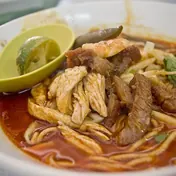
Penang curry mee arrives deceptively pale: coconut broth, noodles, cockles, prawns and tofu puffs, with a spoon of dark chilli paste served separately to stir in.
Where to try it: Hot Bowl White Curry Mee, Duck Blood Curry Mee, Bee Hwa Cafe
Price: RM6-12
Penang's curry mee splits the dish in two: a mild coconut-milk broth and a separately fried chilli paste, added at the table to taste. The style is credited to Air Itam's old sisters' stall generations back, and shops like Hot Bowl, at it since 1992, industrialised nothing, still cooking the paste daily. Traditional versions add cubes of congealed pork or duck blood, a texture Penang defends and outsiders learn to love; halal kitchens like Bee Hwa rebuild the bowl with chicken and seafood.
Watch out for: Shellfish, Soy
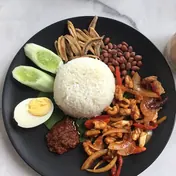
Coconut rice with sambal, fried anchovies, peanuts, cucumber and egg, eaten in Penang above all as a banana-leaf bungkus pyramid at breakfast.
Where to try it: Ali Nasi Lemak Daun Pisang, Du-An, Rasa Rasa
Price: RM2.50-15 from bungkus to plated
Malaysia's national dish is a Malay farmhouse breakfast, rice enriched with coconut milk and pandan, made portable in banana-leaf pyramids sold from baskets. Penang's version leans on a sharper, darker sambal and small side-packet economics; Ali's stall at Sri Weld Food Court has turned the RM2.50 bungkus into a Michelin-listed queue. Upmarket kitchens now plate it with rendang or fried chicken, but the banana-leaf parcel remains the standard by which the city judges.
Watch out for: Fish, Peanuts, Egg
A clear-broth counterpoint to the fried classic: flat rice noodles in chicken and pork stock with fish balls, shredded meat, garlic oil and a scatter of scallions.
Where to try it: Pitt Street Koay Teow Soup, Ah Boy Koay Teow Th'ng, Fook Cheow Cafe, Super Star Koay Teow Soup
Price: RM5-10
Koay teow th'ng, literally noodle soup in Teochew, is the gentle sibling in Penang's noodle canon, built on clarity where char koay teow is built on smoke. Teochew cooks judged each other on broth transparency and springy hand-made fish balls; stalls like Pitt Street have made theirs from sea eel daily for over 60 years, and Ah Boy on Lebuh Clarke carries a second-generation recipe. It is the bowl Penangites call comfort, breakfast and convalescence food in one.
Watch out for: Fish, Soy
Cubes of steamed rice cake fried hard on a flat griddle with egg, preserved radish, bean sprouts and dark soy, crisp-edged and chewy inside.
Where to try it: Sister Yao's Char Koay Kak
Price: RM4-8
Char koay kak is the Teochew fry-up Penang eats at breakfast: rice cakes cut into cubes and seared with lard, chai poh and egg until the edges char. It shares a wok grammar with char koay teow but stays a morning trade, cheaper and homelier. Sister Yao's stall on Macalister Lane, begun by their father in 1963 and now run by three sisters, took the dish into the Michelin guide with plates from RM4, proof that Penang's cheapest classics stand on merit.
Watch out for: Egg, Soy
A Nyonya chicken curry thick with candlenut, lemongrass and kaffir lime, gentler than Indian curry and finished with a squeeze of lime, eaten with rice or roti.
Where to try it: Auntie Gaik Lean's Old School Eatery, Richard Rivalee Nyonya Cuisine, Winn's Cafe
Price: RM18-35
Kari kapitan is a Peranakan signature whose name likely honours the Kapitan Cina, the community headmen of colonial Penang and Melaka, though kitchen legend prefers a cook telling his captain what was for dinner. The rempah of candlenut, galangal, turmeric and belacan marks it as Straits Chinese: Chinese technique married to Malay spice. Penang's Nyonya houses treat it as a benchmark; the starred kitchen at Auntie Gaik Lean's keeps it on the menu as a measure of the old repertoire.
Watch out for: Shellfish (belacan), Tree nuts (candlenut)
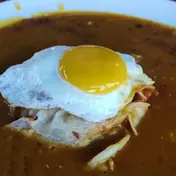
A laminated flatbread flipped paper-thin, folded and griddled to a crisp-soft flake, served with dhal and curry, at its best flooded, banjir, at a roadside stall.
Where to try it: Roti Canai Transfer Road
Price: RM1.50-6 with curry
Roti canai arrived with Indian Muslim migrants and became Malaysia's breakfast handshake: dough rested in ghee, spun to translucence, folded and pressed on a flat iron griddle. Penang's most famous version is a stall with no signboard on Transfer Road, at its pans for around half a century, where regulars order the roti drowned in curry before 11:00 or go without. The flip is theatre, but the rest matters more: long rests, generous fat and a griddle at the right heat.
Watch out for: Gluten, Dairy (ghee), Egg
Five-spice pork rolls wrapped in beancurd skin and deep-fried, sliced and served with a starchy braising sauce and chilli dip alongside prawn fritters and tofu.
Where to try it: Kheng Pin Cafe, Joo Hooi Cafe
Price: RM8-20 for a mixed plate
Lor bak is Penang Hokkien festival food gone daily: marinated pork rolled in tofu skin, once made for celebrations, now fried at kopitiam stalls as a shared starter plate. The name pairs lor, the thick five-spice gravy, with bak, meat, and a proper stall serves the rolls with that gravy, a chilli dip, and a supporting cast of prawn fritters, century egg and fried tofu. Kheng Pin Cafe's morning stall on Jalan Penang is the version locals measure everything else against.
Watch out for: Soy, Gluten, Egg, Shellfish in mixed plates
Penang's signature dishes include Char koay teow, Assam laksa, Hokkien mee (prawn mee), Nasi kandar, Cendol. See our signature dishes chapter for where to eat each.