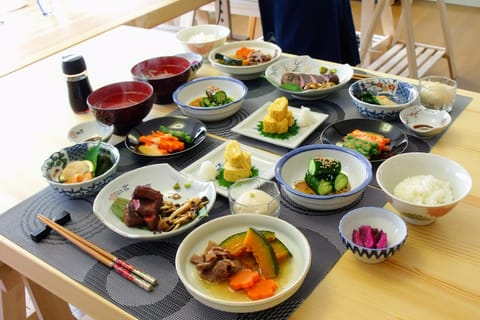
How Tokyo came to eat the way it does: the people, migrations and accidents that shaped the plate.
Key eras
1603 to 1868, Edo and the birth of fast food
Under the Tokugawa shogunate, Edo grew to a million people by 1721 and built the world's first urban fast-food culture. Hand-formed nigiri sushi, soba street stalls, tempura carts and unagi grilling counters all date to this era. Hanaya Yohei is credited with inventing modern nigiri in the 1820s at his Ryogoku cart.
1868 to 1923, Meiji modernisation and yoshoku
The Meiji Restoration ended the centuries-old beef taboo. Yoshoku, Japanese-Western cuisine, emerged in the 1870s: tonkatsu, korokke, omurice and curry rice all came from this period. Western-style cafes opened in Ginza by the 1880s, and Western department stores like Mitsukoshi began running food halls in their basements.
1923 to 1945, Kanto earthquake and wartime austerity
The 1923 Great Kanto Earthquake destroyed half the city's restaurants. Rebuilding brought concrete cafes and the first generation of kissaten coffee houses. By the late 1930s, wartime rationing collapsed the dining scene; soba and udon shops survived because flour was reserved for the military.
1945 to 1980, postwar boom and ramen's rise
American wheat aid in the late 1940s seeded the ramen explosion: Chinese soba carts in occupied Tokyo became sit-down shops by the 1950s. The 1958 launch of Nissin Instant Ramen made the dish national. Department-store depachika basements expanded; the conveyor-belt sushi format (kaiten-zushi) was franchised from Osaka in the 1970s.
1980s to 2000s, the bubble era and global recognition
The 1980s bubble economy poured money into French and Italian fine dining; Joël Robuchon and Alain Ducasse both opened Tokyo flagships in the 1990s. The 2007 launch of the Michelin Guide Tokyo gave the city more stars than Paris on day one, a position it has held nearly every year since.
2010 to now, modern Japanese and global crossover
Den, Florilege and Sazenka in Aoyama redefined modern Japanese in the 2010s. Tsuta in Sugamo became the first ramen with a Michelin star in 2015. The 2018 Toyosu Market move consolidated wholesale fish; the Olympics-era restaurant boom seeded the chef-led counter rooms that anchor the 2026 guide.
Immigrant influences
- Chinese: Late 19th-century Cantonese and Fujianese immigrants seeded Yokohama's Chukagai and Tokyo's Chinese-style soba shops, which evolved into ramen. Sichuan and Taiwanese rooms anchor Ikebukuro since the 1990s.
- Korean: Postwar Zainichi Korean communities built Tokyo's yakiniku culture. Shin-Okubo is the Koreatown for grilled beef, KFC-style chicken and Korean izakaya, doubled in size in the 2010s K-pop wave.
- Western (French and Italian): French haute cuisine took root in the 1960s through chef Shizuo Tsuji. By the 1990s, Joel Robuchon and Alain Ducasse both opened Tokyo flagships, shaping high-end Western dining.
- South Asian: Bangladeshi and Nepali restaurateurs opened the bulk of Tokyo's 1,000-plus Indian curry houses since the 1990s. The dal-bhat and tandoor scene around Nishi-Kasai is the densest in Japan.
- Southeast Asian: Vietnamese and Thai restaurants opened across Shibuya and Shinjuku from the 1980s. Thai canteens in Ebisu and Roppongi anchor the lunch-set scene for office workers today.
Signature innovations
- Edomae nigiri sushi, invented in 1820s Edo as a cart-cart fast food
- Tempura as a Portuguese-influenced fried food, reshaped in Edo into a counter craft
- Ramen, evolved from Chinese soba in postwar Tokyo into a national grammar
- Conveyor-belt sushi (kaiten-zushi), franchised to Tokyo from Osaka in the 1970s
- Depachika department-store basement food halls, the world's most curated food courts
- The kissaten coffee house, a 1920s Tokyo invention of slow pour-over and silent reading
- Instant ramen (1958), invented in Osaka but mass-produced for the Tokyo market
- The 2007 Michelin Guide Tokyo, which gave the city more stars than Paris on its first edition
Food History in Tokyo, FAQ
When is the best time to eat in Tokyo?
Peak food season in Tokyo is year-round.
What time do people eat in Tokyo?
Local dining hours: lunch around 12:30, dinner from 19:30.
How does tipping work in Tokyo?
service is typically included; small extra is welcome but not expected.
What is the one dish to try in Tokyo?
Ask the next local you meet what they would order. Tokyo rewards trust.