
How Osaka came to eat the way it does: the people, migrations and accidents that shaped the plate.
Key eras
-
Tenka no Daidokoro: Japan's Kitchen (Edo Period (1603-1868))
Osaka became the commercial hub of Edo-period Japan, with rice brokers and commodity traders clustering in the Dojima district. The city's title tenka no daidokoro, the kitchen of the country, came from this era: every sack of rice, every barrel of sake, and every bale of dried konbu shipped east to the Shogunate passed through Osaka's port and auction houses. Dashi was refined here, kombu trade from Hokkaido turned Osaka broth-making into the most technically advanced in Japan, and the oden tradition at counters like Takoume (founded 1844) was codified as a commercial street food form.
-
Western Cooking and the Yoshoku Tradition (Meiji and Taisho Periods (1868-1926))
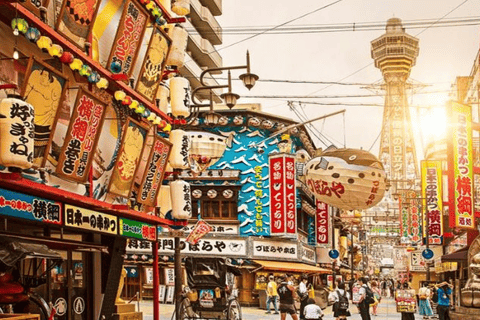
Osaka's merchant class was the first to adopt Western cooking ingredients: the omurice was invented at Hokkyokusei in Shinsaibashi in 1922, combining egg omelette with ketchup-seasoned fried rice. Yoshoku (Western-influenced Japanese cooking) took hold in the city's department stores and university canteens. The covered shopping arcades of Dotonbori and Shinsaibashisuji were built in this era, establishing the geography of Osaka's food commerce.
Taste it todayOmurice -
Reconstruction and Kuidaore Culture (Postwar Period (1945-1970))
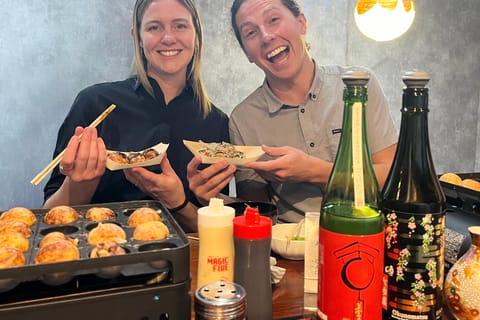
Osaka's postwar food culture was built on the spirit of kuidaore, eat until you drop, as a response to wartime scarcity. Horumon (offal cooking) entered the mainstream as cheap protein; the Shin-Umeda Shokudogai was built under the train tracks to feed reconstruction workers. Takoyaki became the city's defining street food during this period, standardised from its 1935 invention into a commercial form at hundreds of counters along Dotonbori and Shinsekai.
-
Michelin Recognition and the Global Osaka Kitchen (Contemporary Era (2000-present))
The Michelin Guide arrived in Osaka in 2009. By 2026 the city holds three three-star restaurants, twelve two-star entries, and sixty-six one-star restaurants. The restaurant density and quality-to-price ratio attracted international food tourism that reinforced rather than displaced the city's working-class food culture. The same Dotonbori canal that holds Michelin-starred kaiseki is still surrounded by ¥800 ramen counters and ¥140 kushikatsu standing bars.
Immigrant influences
- Korean diaspora (Zainichi Korean community)
- The Tsuruhashi Koreatown market is the legacy of Japan's largest Zainichi Korean community, settled in Osaka during the early 20th century.
- Chinese trading community
- Chinese traders settled in Osaka's Namba district during the Edo period. The influence is most visible in Osaka's Chinese-Japanese fusion cooking: the gyoza tradition (brought from northern China via Japanese soldiers returning after 1945), the use of toban-jan (chilli bean paste) in Osaka-style mapo tofu, and the Chinese noodle influence on Osaka ramen broth.
Signature innovations
- Takoyaki (1935): Invented by Tomekichi Endo in Osaka's Nishiku district in 1935, using a modified version of the akashiyaki egg-and-dashi ball as inspiration. The modern form uses a wheat-flour-and-dashi batter poured into a cast-iron mould with octopus pieces, spring onions, and tenkasu, cooked on both sides. Osaka now has over 800 dedicated takoyaki shops.Taste it todayTakoyaki
- Omurice (1922): Invented at Hokkyokusei restaurant in Shinsaibashi in 1922 by chef Yuzo Igawa, who asked a customer with a stomach complaint what he could eat and was told eggs and rice. The combination of thin omelette over ketchup-fried chicken rice became Osaka's most distinctive yoshoku contribution and is now served at over 3,000 restaurants in the city.Taste it todayOmurice
- Senbero drinking culture (1950s): The senbero ritual, three drinks and a small snack for ¥1000, originated in the Tenma and Tsuruhashi standing bars of the 1950s as a working-class response to Osaka's high bar costs. The tradition is strongest in Tenma's backstreet alleys and is the most widely practised daily drinking custom in the city.
Book food experiences in Osaka

