The plates that define Fukuoka: what they are, where they came from, and where to eat the canonical version.
Signature dishes
-
Hakata tonkotsu ramen ★ 4.9
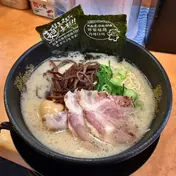
Hakata tonkotsu ramen is the cloudy pork-bone broth poured over thin straight noodles. Born in Fukuoka around 1941, it now anchors 800-plus ramen counters across the city's wards.
Where to try it: Hakata Issou Honten, Ippudo Daimyo Honten, Hakata Ramen Shin-Shin Tenjin Honten, Hakata Ikkousha Honten, Nagahama Number One Gion
Price: ¥800-1,500
The cloudy tonkotsu broth was born around 1941 at a dockside stall in Nagahama. Mitsugu Sugimoto's Sankyu and Hizo Tsuda's Ganso Nagahamaya are the most-cited origin candidates. The thin straight noodle, the kaedama refill, and a tare poured into the bowl before the broth all emerged together. Tonkotsu spread across Kyushu through the 1950s, with regional variants in Kumamoto (garlic-laced) and Kurume (richer). Today Hakata Issou, Ippudo Daimyo, Hakata Ikkousha and Shin-Shin run the canonical Fukuoka counters, and the Hakata format has since exported worldwide through chains like Ippudo and Ichiran.
Watch out for: Gluten, Soy, Pork, Egg
-
Motsunabe ★ 4.9
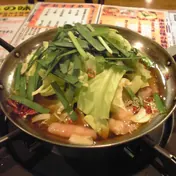
Motsunabe is the Hakata offal hotpot, simmered with garlic chives and cabbage in a miso or soy-sauce broth, finished with champon noodles. Yamanaka codified the miso style in 1984.
Where to try it: Hakata Motsunabe Yamanaka Akasaka, Motsunabe Rakutenchi Tenjin So-Honten, Hakata Motsunabe Yamanaka Hakata, Hakata Motsunabe Yamanaka Ohashi Honten
Price: ¥3,000-5,000 per person
Motsunabe came from Fukuoka's postwar Korean community, who brought the practice of cooking beef offal in a hotpot format. The dish stayed local until Yamanaka opened in Ohashi in 1984 and codified the miso-based version with garlic chives and cabbage; Rakutenchi followed with the soy-sauce style. Through the 1990s motsunabe boomed nationally as a Hakata regional specialty. The champon-noodle finish is a Yamanaka invention. The dish runs from October through March in most rooms; some carry it all year.
Watch out for: Soy, Gluten, Egg
-
Mizutaki ★ 4.8
Mizutaki is the Hakata chicken hotpot. A whole chicken is simmered in water and salt for six hours; the collagen breaks down into a creamy yellow broth served with ponzu and yuzu pepper.
Where to try it: Hakata Mizutaki Toriden Honten, Mizutaki Ryotei Hakata Hanamidori Tenjin, Hakata Hanamidori Hakata Ekimae, Hakata Mizutaki Toriden Yakuin
Price: ¥6,000-12,000 per person
Mizutaki traces to the late-19th-century Meiji era in Hakata, when Western influence brought the practice of simmering meat for stocks. The form codified at Suigetsu, founded 1905 in Hakata, and now runs through Toriden and Hakata Mizutaki Hanamidori. The cook is single-product fine dining: a whole chicken plus water and salt simmered six to seven hours, served with the broth as the first pour and the meat as the second course. Zosui rice porridge closes the meal. Today the dish is a Fukuoka winter signature though Toriden and Hanamidori run it year-round.
Watch out for: Egg, Soy
Book food experiences in Fukuoka


-
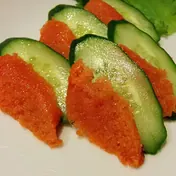
Mentaiko ★ 4.8
Mentaiko is spicy Alaskan pollock roe, cured with chilli, soy and dashi. Fukuya's 1949 Hakata recipe adapted Korean salted cod roe technique; eaten on rice or stuffed into bread rolls.
Where to try it: Fukuya Aji no Mentaiko Factory, Yamaya Canal City Hakata, Full Full Bakery
Price: ¥1,500-3,000 per 200g
Toshio Kawahara opened Fukuya in Hakata in 1949 and adapted the Korean salted cod roe technique (myeongnan-jeot) into the Japanese form: pollock roe cured in chilli, dashi, soy and sake. The product spread through Kyushu in the 1950s and exported across Japan in the 1980s and 1990s. Today Fukuya in Higashi-ku and Yamaya (founded 1974) are the two big factory shops. Mentaiko is eaten on white rice as mentaiko gohan, stuffed into French rolls at Full Full Bakery, or tossed through pasta and Hakata udon. The shape and seasoning carries Korean DNA but the dashi-cure is Japanese.
Watch out for: Fish, Soy, Wheat
-
Hakata tetsunabe gyoza ★ 4.5
Hakata tetsunabe gyoza is the iron-pan dumpling format. Bite-sized gyoza are packed in a circular cast-iron pan and pan-fried crisp on all sides, then served in the pan with vinegar and karashi mustard.
Where to try it: Hakata Gion Tetsunabe
Price: ¥900-1,500 per pan
Tetsunabe gyoza was codified at Hakata Gion Tetsunabe in Hakata's Gion district in the postwar period. The form is named for the cast-iron tetsunabe pan: small thin-skinned dumplings packed tightly in a circle, pan-fried in one pour, served in the pan still sizzling. The Hakata gyoza is smaller and thinner-skinned than the Tokyo or Osaka norm, and the pan is the dish: you eat directly from it with chopsticks. Today the format runs across many Hakata izakaya, but the Gion Tetsunabe original remains the canonical version.
Watch out for: Gluten, Pork, Soy
-
Goma saba ★ 4.7
Goma saba is raw Hakata mackerel with sesame paste, soy and ginger. Served as an appetiser at most Hakata izakaya; an autumn-to-winter classic in fine-dining counters across Akasaka and Yakuin.
Where to try it: Kawataro Nakasu Honten, Hakata Mizutaki Toriden Honten, Mizutaki Ryotei Hakata Hanamidori Tenjin
Price: ¥800-1,500 per plate
Goma saba came from Hakata's Genkai Sea fishing tradition, where bonito-grade mackerel is rare-tossed with sesame paste, soy, mirin and ginger. The dish was first written about in late-19th-century records but only spread nationally with the Hakata izakaya boom of the 1980s. It is a winter and shoulder-season dish; the mackerel must be the freshest possible. Toriden, Kawataro and the Yatai stalls all run a version. The dish exports nervously: mackerel oxidises fast and goma saba does not travel well outside Kyushu.
Watch out for: Fish, Soy, Sesame
-
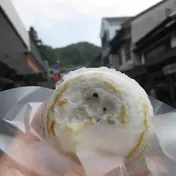
Umegae mochi ★ 4.6
Umegae mochi is a grilled rice cake stamped with a plum-blossom mark, filled with red bean paste. The Dazaifu pilgrimage souvenir, grilled to order at Kasanoya and a row of stalls since 1922.
Where to try it: Kasanoya Dazaifu
Price: ¥130 per piece, ¥1,300 for a box of 10
Umegae mochi traces to the 10th-century cult of Sugawara no Michizane, the scholar god enshrined at Dazaifu Tenmangu. The plum-mark grilled rice cake is the pilgrimage road's signature, with Kasanoya as the dominant operator since 1922. Glutinous and non-glutinous rice flours form the wrapper, with sweet azuki paste inside; the cake is grilled to order on a heavy iron press. Today around eight stalls run umegae mochi on the Dazaifu approach; Kasanoya and Terashita are the most-cited.
Watch out for: None
-
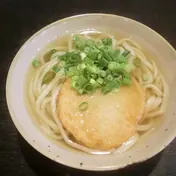
Hakata udon ★ 4.5
Hakata udon is the soft Fukuoka-style wheat noodle, served with a flying-fish-and-bonito broth. Goboten burdock-tempura is the canonical topping; the everyday alternative to ramen for Fukuoka lunch.
Where to try it: Daichi no Udon, Maki no Udon Hakata Bus Terminal, Manda Udon Tenjin, Ebisuya Udon Hakata Sumiyoshi
Price: ¥550-1,200
Hakata udon traces to the 13th century, when the priest Shoichi Kokushi brought milling technology back from China and a noodle culture spread through Hakata. The Fukuoka noodle is soft and yielding, polar opposite to the Sanuki udon (firm) of Shikoku. The broth is ago (flying fish) and bonito with light soy. Goboten (burdock-root tempura) is the canonical topping, made famous at Daichi no Udon and Ebisuya. Three big Fukuoka chains (Maki no Udon, Daichi no Udon, Manda Udon) cover the everyday market; Ebisuya runs the chef-led version at Sumiyoshi.
Watch out for: Gluten, Soy, Fish
-
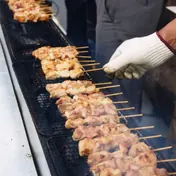
Yatai yakitori ★ 4.5
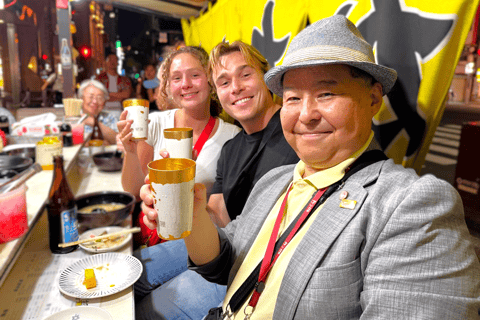
Yatai yakitori is the canalside grilled-chicken-skewer format. Charcoal grill at a 6-stool counter on the Nakasu canal, served with beer and conversation across the river from 18:00-02:00.
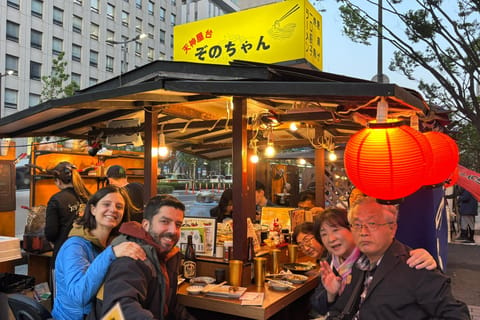
Where to try it: Nakasu Yataigai, Tenjin Yatai Row, Hide-Chan Yatai, Mamichan Yatai (Tenjin)
Price: ¥150-300 per skewer
Yatai yakitori traces to the Edo-period dockside stalls along the Nakagawa river, where charcoal grills were the simplest cook fire. The format codified after the Second World War, when the Fukuoka city government licensed yatai positions on the Nakasu canal and Tenjin grid. Today around 100 yatai run on the canal and Showa-dori, of which a third do yakitori as the primary order. The chicken is locally raised, the charcoal is binchotan or sub-binchotan, the seasoning is salt or tare; the format is fast.
Watch out for: Soy
-
Hakata sumo chanko ★ 4.2
Hakata sumo chanko is the deep-protein hotpot built around chicken, pork and fish balls, with cabbage and miso. A winter dish in motsunabe-style rooms and the rare crossover to Tokyo sumo-stable cuisine.
Where to try it: Hakata Motsunabe Yamanaka Akasaka, Motsunabe Rakutenchi Tenjin So-Honten
Price: ¥3,000-5,000 per person
Chanko-nabe traces to the Tokyo sumo stable cuisine of the late-Meiji era, but the Hakata form took on a regional spin in the 1980s and 1990s as motsunabe rooms expanded into multi-protein hotpots in winter. Today some Hakata izakaya run the chanko version through January and February. It is a rare crossover dish; the canonical Hakata hotpot remains motsunabe or mizutaki.
Watch out for: Soy, Fish, Gluten
-
Yobuko ikizukuri (live squid) ★ 4.6
Yobuko ika is the live squid ikizukuri of Saga's Yobuko port, an hour from Fukuoka. The squid is taken live from a tank, butterflied and sliced sashimi-style while still transparent.
Where to try it: Kawataro Nakasu Honten
Price: ¥3,500-7,000 market price
Yobuko is a small fishing port on the Genkai Sea in Saga prefecture, 75 minutes from Hakata. Its squid (kensaki ika in season, kogi ika otherwise) is famous for the live ikizukuri presentation: the fish is killed at the table, sliced and served in 90 seconds while the flesh is still transparent. The format codified in the 1970s as the Yobuko fishing fleet shifted from bulk supply to high-end tourism. Today around twelve restaurants in Yobuko run live-squid tanks; Kawataro and Ikahonke are the most-cited. Squid season runs March through November.
Watch out for: Shellfish, Soy
Signature Dishes in Fukuoka, FAQ
What food is Fukuoka known for?
Fukuoka's signature dishes include Hakata tonkotsu ramen, Motsunabe, Mizutaki, Mentaiko, Hakata tetsunabe gyoza. See our signature dishes chapter for where to eat each.