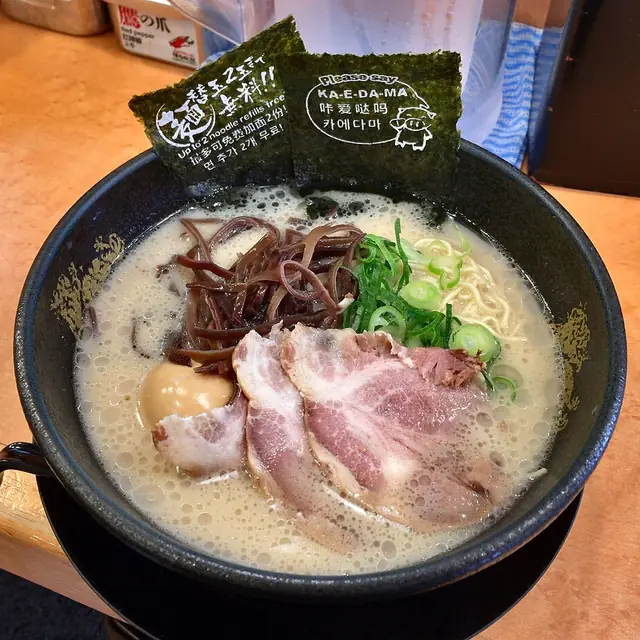
Hakata tonkotsu ramen is the cloudy pork-bone broth poured over thin straight noodles. Born in Fukuoka around 1941, it now anchors 800-plus ramen counters across the city's wards.
The cloudy tonkotsu broth was born around 1941 at a dockside stall in Nagahama. Mitsugu Sugimoto's Sankyu and Hizo Tsuda's Ganso Nagahamaya are the most-cited origin candidates. The thin straight noodle, the kaedama refill, and a tare poured into the bowl before the broth all emerged together. Tonkotsu spread across Kyushu through the 1950s, with regional variants in Kumamoto (garlic-laced) and Kurume (richer). Today Hakata Issou, Ippudo Daimyo, Hakata Ikkousha and Shin-Shin run the canonical Fukuoka counters, and the Hakata format has since exported worldwide through chains like Ippudo and Ichiran.
5 editor picks for Hakata tonkotsu ramen in Fukuoka, ranked by editorial score. All Fukuoka signature dishes · Hakata tonkotsu ramen across every city.
Hakata Issou Honten ★ 4.7
hakata · Hakata-ku, Fukuoka 812-0013, Japan
Hakata Issou opened in 2012 and built its reputation on the tonkotsu cappuccino, a foam-headed pork-bone broth distinct from the Hakata ramen norm.
Hakata Ramen Shin-Shin Tenjin Honten ★ 4.5
tenjin · Chuo-ku, Fukuoka 810-0001, Japan
Shin-Shin pours a cleaner, lighter tonkotsu than the Hakata norm, with the city's best yakimeshi side and a 3:00 close that anchors the Tenjin late-night map.
Hakata Ikkousha Honten ★ 4.5
hakata · Hakata-ku, Fukuoka 812-0011, Japan
Ikkousha's main store five minutes from Hakata Station pioneered the original-froth tonkotsu, a fat-and-water emulsion that runs creamy across the bowl.
Ippudo Daimyo Honten ★ 4.4
daimyo · Chuo-ku, Fukuoka 810-0041, Japan
Shigemi Kawahara opened the original Ippudo in a Daimyo back alley in 1985 and built the brand that exports Hakata tonkotsu worldwide. Refurbished 2018.
Nagahama Number One Gion ★ 4.3
hakata · Hakata-ku, Fukuoka 812-0038, Japan
Nagahama Number One grew from a 1971 yatai. The Gion branch sits two minutes from Gion subway and pours a 20-hour tonkotsu over ultra-thin noodles.