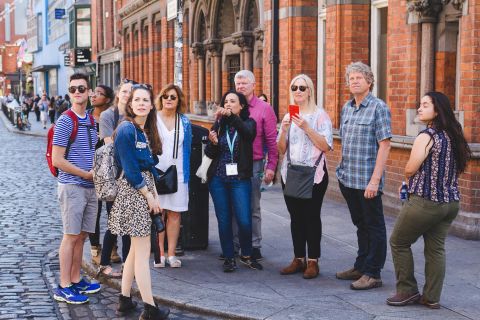
How Dublin came to eat the way it does: the people, migrations and accidents that shaped the plate.
Key eras
1759, Arthur Guinness signs the 9,000-year lease
Arthur Guinness signed a 9,000-year lease on the four-acre brewery at St James's Gate at the cost of 45 pounds a year. The first Guinness Extra Stout shipped from the Liffey quays in 1769; by the 1880s St James's Gate was the largest brewery in the world. The brewery still anchors Dublin 8 and the Storehouse is the city's most-visited paid attraction.
1840s, the Great Famine and the potato
An Gorta Mór killed roughly one million people and pushed another two million into emigration, hollowing the Irish working-class kitchen for a century. Dublin's tenement diet centred on the potato, the cabbage and what the Liberties' coddle salvaged from the day's leftover sausages and bacon. The dishes survived as comfort food; the famine memorial stands on Custom House Quay.
1927, Bewley's opens Grafton Street
Ernest Bewley opens Bewley's Oriental Cafe at 78-79 Grafton Street, three-floor with Harry Clarke stained-glass windows. Bewley's roasted its own coffee on Grafton Street and trained the city in cafe culture; the cafe closed twice over the 2000s but reopened restored in 2017. The Bewley's house blend is still the city's heritage Dublin coffee.
1981, Patrick Guilbaud opens on Merrion Street
French chef Patrick Guilbaud opens his eponymous Dublin dining room on James Street in 1981, the city's first serious post-war fine-dining French kitchen. The room relocated to The Merrion hotel in 1996 and earned two Michelin stars. The Guilbaud kitchen trained a generation of Irish chefs, including Mickael Viljanen who took the Chapter One Michelin two stars in 2023.
2006-2016, the Dublin restaurant decade
Post-Celtic Tiger Dublin built its modern restaurant scene in ten years: Etto on Merrion Row (2013), the Fumbally on Fumbally Lane (2012), Bastible on the South Circular Road (2015), 3fe on Grand Canal Street (2009). The Liberties moved from working-class to creative; the Northside got Mr Fox; Pichet earned the city's first Bib Gourmand.
2023-2026, the Michelin recalibration
Dublin hosted the 2026 Michelin Guide ceremony for the first time on 9 February 2026. Chapter One under Mickael Viljanen and Patrick Guilbaud held two stars; Forest Avenue earned a star after twelve and a half years; Borgo, BIGFAN and Forêt earned new Bib Gourmands. Liath in Blackrock, on the city's southern edge, earned its second star.
Immigrant influences
- Italian (Calabrian and Casalattico): Italian immigrants from Casalattico in Lazio arrived from the late 1880s onwards and built Dublin's chipper trade. Borza, Cafolla, Aprile and Macari families ran chippers from the 1900s; Leo Burdock and the Cremore chippers are the surviving names.
- Jewish (Lithuanian and Polish): Lithuanian and Polish Jewish immigrants arrived from the 1880s and built the Portobello Jewish quarter. The Bretzel Bakery on Lennox Street (1870) baked the city's bagels and rye; the Terenure Synagogue still anchors the small surviving community.
- Chinese (Cantonese and Fujianese): Dublin's Chinatown grew on Parnell Street and Capel Street from the 1980s. The 2010s wave from Fujian and Sichuan brought serious regional cooking: M and L, Chimac, Sichuan House and the contemporary BIGFAN on Aungier Street.
- Pakistani and Indian South Asian: Pakistani and Indian families arrived from the 1980s and built the halal Indian restaurant scene around George's Street, Capel Street and Rathmines. Shalimar, Kinara Kitchen and Pickle anchor the modern Dublin Indian dining room today.
- Polish and Eastern European: Polish immigration from the 2004 EU expansion built the city's Eastern European delis. Polonez Capel Street and Mojito Polish bakery serve the community; Smolak in Smithfield is the longest-running Polish butcher counter.
- Brazilian and Latin American: Brazilian students arrived from the early 2000s and built Camden Street's Latin American scene. La Cocina at Eatyard, Picaria and the Brazilian sandwich shops in Phibsborough are the working everyday venues.
Signature innovations
- Guinness Extra Stout shipped from St James's Gate, the world's reference dry stout since 1759
- Boxty pancake, Cavan-Roscommon origin, the Dublin tourist-trade signature plate from the 1990s
- Dublin coddle, the Liberties tenement supper of sausages, bacon, onions and potato
- The chipper cone, popularised by Italian-Irish chippers from the 1900s and still the Dublin late-night
- The Irish coffee cocktail, formalised in 1942 at Foynes airbase Co Limerick and adopted across Dublin's bars
Food History in Dublin, FAQ
When is the best time to eat in Dublin?
Peak food season in Dublin is year-round.
What time do people eat in Dublin?
Local dining hours: lunch around 12:30, dinner from 19:30.
How does tipping work in Dublin?
service is typically included; small extra is welcome but not expected.
What is the one dish to try in Dublin?
Ask the next local you meet what they would order. Dublin rewards trust.