

History
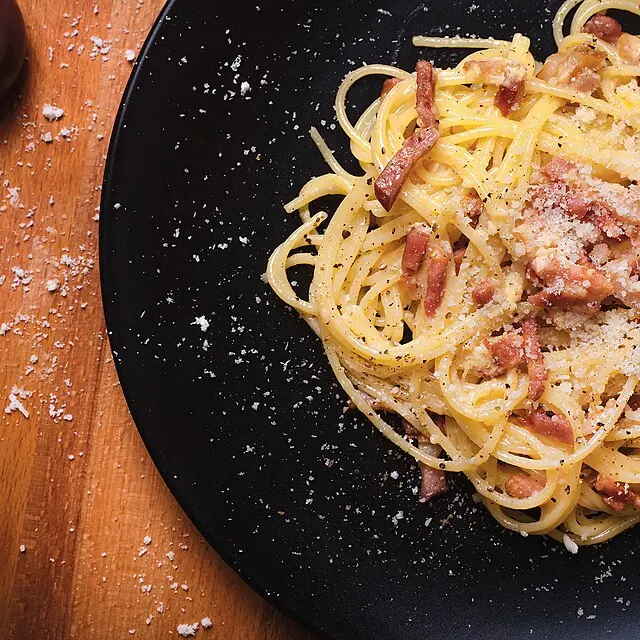
The name spaghetti alla carbonara is unrecorded before the Second World War, and the dish took its modern form in the middle of the 20th century. Several food historians place its birth after the Allied liberation of Rome in 1944, when bacon and eggs reached the city's cook shops. The first carbonara recipe published in Italy ran in La Cucina Italiana in 1954 with pancetta, garlic and Gruyere. Pecorino and guanciale entered recipes in the late 1950s and 1960s, and cream mostly disappeared in the 1990s.
Book a food experience
Tours, tastings and classes from the cities on this page, bookable on GetYourGuide.


Common allergens: Gluten, Egg, Dairy
Make it at home
Ingredients
- 200g rigatoni or spaghetti
- 100g guanciale, cut into 1cm batons (substitute pancetta if guanciale unavailable)
- 3 large egg yolks, plus 1 whole egg
- 70g pecorino romano, finely grated
- Freshly ground black pepper, generous
- Sea salt for the pasta water
Method
- Bring a large pot of salted water to a rolling boil. Add the pasta.
- Meanwhile, cook the guanciale in a dry pan over medium heat for 6 to 8 minutes until the fat renders and the meat is crisp at the edges.
- In a bowl, whisk the egg yolks plus whole egg with the grated pecorino and a generous grind of black pepper into a thick paste.
- When the pasta is al dente (1 minute before the package time), reserve a cup of pasta water and drain.
- Off the heat, transfer the drained pasta to the pan with the guanciale. Toss to coat in the rendered fat.
- Pour the egg-cheese paste over the pasta and toss vigorously off the heat, adding tablespoons of pasta water to loosen into a glossy emulsion. The eggs must not scramble.
- Serve immediately with extra pecorino and black pepper on top.
Tip from the editors. The pan must be off the heat before the egg mix touches the pasta or you make scrambled eggs. The carbonara should be glossy and creamy without cream; pasta water is the binder.
Where to eat carbonara
Carbonara in Rome
Salumeria Roscioli ★ 4.8
Salumeria Roscioli is a gourmet shop with a kitchen and a wine cellar of more than 2,800 labels. Classic Roman dishes, at Via dei Giubbonari 21.
TipOpen every day, 12:30-15:30 and again 19:00-23:30, with a break in the afternoon between the two services.
Felice a Testaccio ★ 4.6
Felice a Testaccio has been an institution of Roman cuisine since 1936, famous nationally and internationally. It is at Via Mastro Giorgio 29.
OrderThe cacio e pepe, finished at the table in the traditional way.
TipCancellations are not accepted by phone, email or social media, so plan the booking with care.
Armando al Pantheon ★ 4.8
Armando al Pantheon is a small restaurant just a few metres from the Pantheon, run by the Gargioli family since 1961. It stands at Salita dei Crescenzi 31.
OrderTry the specialities such as spring lamb, fresh anchovies and sour-cherry tart.
TipReservations are possible online only, so book through the website before you go.
Da Enzo al 29 ★ 4.4
Da Enzo al 29 is a small neighbourhood trattoria in Trastevere with few tables and dishes prepared on the spot, at Via dei Vascellari 29 in Rome.
OrderAbbacchio alla scottadito, griddled lamb chops, or the Romanesco artichoke fried when in season.
TipNo bookings are taken; guests are welcomed in order of arrival, so no one is rushed.
Antico Arco ★ 4.1
Antico Arco opened in 1996 on the Gianicolo hill, in a sober, refined space with a view over Rome, with chef Fundim Gjepali leading the kitchen.
TipThe cellar lists over 1,200 wine labels, with a selection devoted to Lazio grape varieties.
More cities are in research. Want carbonara covered somewhere specific? Tell us where you want to eat.