History

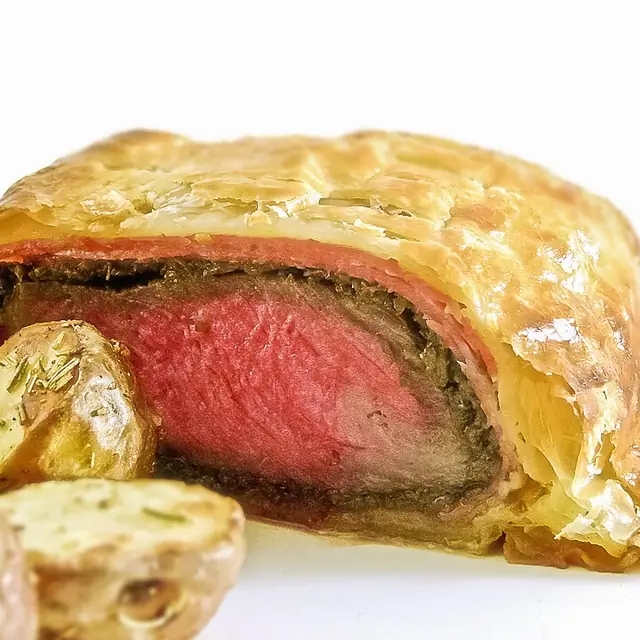
Beef Wellington's origin is disputed: most credibly it derives from late 19th-century French filet de boeuf en croute, anglicised in some accounts by celebrating Wellington's victory at Waterloo in 1815. The modern London Mayfair version codified through the 20th century at the Savoy and Connaught hotels, and became the defining dish of Restaurant Gordon Ramsay (3-star) on Royal Hospital Road, which he opened in 1998. The Ramsay version popularised the modern duxelles-and-Parma-ham wrap; the Hawksmoor steakhouses run a more casual version.
Common allergens: Gluten, Dairy, Egg

Make it at home

Yield 6Hands-on 1 hr 30 minTotal 3 hr 30 minDifficulty Advanced

Ingredients

  • 1.2kg centre-cut beef fillet (the eye of the fillet; tied at intervals with kitchen string to hold a uniform cylinder shape)
  • 2 tbsp Dijon mustard
  • 2 tbsp olive oil
  • Sea salt and freshly cracked black pepper
  • For the mushroom duxelles: 500g chestnut mushrooms (cleaned and finely chopped, or pulsed in a food processor), 100g shallots (finely diced), 4 garlic cloves (minced), 2 sprigs fresh thyme, 80ml dry white wine, 30g unsalted butter, 1 tbsp olive oil, sea salt and pepper
  • 12 slices Italian Parma ham or English air-cured ham (sliced very thin; about 200g)
  • Optional: 100g foie gras (sliced 5mm thick; the canonical Ramsay luxe touch, omit if not available or for cost)
  • 500g all-butter puff pastry block (sold chilled at quality supermarkets; or use frozen all-butter puff pastry sheets)
  • 1 large egg yolk plus 1 tbsp cream, beaten, for egg wash
  • Flour for rolling
  • Maldon sea salt and cracked pepper for the top
  • To serve: red wine jus (200ml beef stock reduced with 100ml red wine, 1 tbsp Madeira, 30g butter and a sprig of thyme to a glossy sauce; about 200ml), buttered fondant potatoes, baby spinach wilted in butter, glazed baby carrots

Method

  1. Sear the beef: rub the tied fillet with olive oil, salt and pepper. Heat a heavy frying pan over very high heat until smoking. Sear the beef on all sides for 60 seconds per side until deeply browned (about 4 minutes total). Lift onto a plate, immediately brush all over with the Dijon mustard, cool to room temperature, refrigerate 30 minutes.
  2. Make the duxelles: heat 30g butter and 1 tbsp olive oil in a wide pan, soften the shallots for 4 minutes; add the chopped mushrooms, garlic, thyme, salt and pepper. Cook over medium-high heat for 18 to 22 minutes, stirring often, until all liquid has evaporated and the duxelles is a thick dark paste (this is structural; any moisture in the duxelles will make soggy pastry). Add the white wine in the last 3 minutes. Cool completely on a flat plate.
  3. Roll the duxelles: lay a large sheet of cling film on the bench. Spread the cooled duxelles in a 30 by 25cm rectangle in the centre. Lay the Parma ham slices across the duxelles in slightly overlapping rows (covering the whole rectangle); the ham forms the moisture barrier between meat and pastry.
  4. If using foie gras, lay slices along the centre of the duxelles before adding the ham, or sandwich between the ham and the beef.
  5. Untie the beef. Lay the seared mustard-coated beef along the long edge of the duxelles rectangle.
  6. Using the cling film as a helper, roll the duxelles-and-ham tightly around the beef into a fat cylinder; twist the ends of the cling film firmly to compact (this is structural; tight wrapping eliminates air pockets). Refrigerate 30 minutes.
  7. Roll out the puff pastry on a floured bench to a 30 by 40cm rectangle, 5mm thick.
  8. Unwrap the chilled beef cylinder. Brush the pastry with egg wash. Lay the beef cylinder along one long edge of the pastry; roll up tightly, sealing the seam underneath. Trim and crimp the ends, brushing with egg wash to seal.
  9. Transfer the wrapped Wellington seam-side down to a parchment-lined baking sheet.
  10. Brush all over generously with egg wash. Score a decorative crosshatch pattern lightly into the top with the back of a knife (do not cut through the pastry). Refrigerate 30 minutes (the chill helps the pastry rise straight).
  11. Heat the oven to 220 degrees Celsius (200 fan).
  12. Sprinkle the chilled Wellington with Maldon sea salt and cracked pepper.
  13. Bake for 18 to 22 minutes for medium-rare (internal beef temperature 52 degrees Celsius), or 25 minutes for medium (58 degrees Celsius). The pastry should be deep golden brown all over.
  14. Rest the Wellington on the tray for 12 minutes before slicing; this is non-negotiable, the juices redistribute and the dish slices cleanly.
  15. Carve into 3cm thick slices with a sharp serrated knife. Pour a pool of red wine jus on each warm plate, lay a slice of Wellington over the jus, garnish with fondant potato, spinach and glazed carrots.

Tip from the editors. The duxelles must be cooked down to a dry paste; any moisture leads to soggy pastry. The cling-film chill step is the structural rule; without it, the Wellington bulges. Use all-butter puff pastry; vegetable-fat puff pastry never gives the same shatter.

Where to eat beef wellington

Beef Wellington in London

Restaurant Gordon Ramsay 3 ★ ★ 4.4

French fine diningChef Matt Abe£££££200south-kensington-chelseaBook 10 weeks ahead

Gordon Ramsay's Royal Hospital Road three-Michelin-starred kitchen in Chelsea London, opened 1998 and held its three stars longer than any other restaurant.

Order: The Pressed Foie Gras course and the lobster ravioli that have been on the menu since opening.

Tip: Lunch (Tuesday to Friday) at £140 is half the dinner tasting price with the same kitchen run.

Hide 1 ★ ★ 4.0

British gastropubChef Ollie Dabbous£££££170mayfairBook 6 weeks ahead

Ollie Dabbous's Piccadilly dining room overlooking Green Park in Mayfair London, opened 2018 and Michelin-starred, runs a Modern British menu across three.

Order: Whatever sea-buckthorn course is on, and the warm cheese tart that has stayed on the menu since opening.

Tip: The ground-floor Below cocktail bar takes walk-ins and serves the same kitchen as a la carte plates.

Sketch 3 ★ ★ 4.7

French bistroChef Pierre Gagnaire£££££245mayfairBook 8 weeks ahead

Mourad Mazouz and Pierre Gagnaire's Conduit Street dining rooms in Mayfair London, opened 2002, hold three Michelin stars in the Lecture Room and run a famed.

Order: The Pierre Gagnaire signature plate in the Lecture Room, or afternoon tea in the pink Gallery.

Tip: The Gallery serves the bistro menu and books a fortnight ahead; the three-starred Lecture Room is the eight-week wait.

More cities are in research. Want beef wellington covered somewhere specific? Tell us where you want to eat.

Browse all dishes →