Swiss cuisine is shaped by altitude, dairy, and the four-way split between German-speaking, French-speaking, Italian-speaking, and Romansh-speaking regions. The defining grammar is dairy-led: hard cow's-milk cheeses aged in alpine cellars, cream, butter, and the kind of slow-fermented bread that travels through long winters. Cured pork (Bündnerfleisch, viande des Grisons), potatoes, and grains do the heavy lifting. Outside the cities, the menu still answers to what a mountain farmer would eat after a day of work.
The Swiss dishes the world knows are fondue, raclette, and rosti, but those are regional specialties that became national symbols mostly in the 20th century, partly through tourism marketing. The deeper Swiss kitchen includes Zurich's geschnetzeltes (veal in cream sauce), Ticino's risotto and polenta with brasato, Vaud's papet vaudois (leek and potato stew with sausage), and Graubünden's capuns (chard-wrapped dumplings in cream). Each canton has its own sausage, cheese, and bread.
Dining is unhurried and formal by Anglo standards. Greetings matter, table manners are observed, and a long lunch on Sunday is still a real event. Prices are high, even in casual restaurants, but portions are honest and ingredient quality is reliably excellent.
Book a food experience
Tours, tastings and classes that match this page, bookable on GetYourGuide.
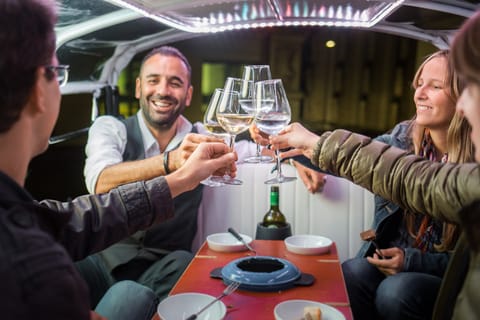
Hop aboard an electric tuk-tuk and discover Zurich in the company of a local driver. Treat yourself to culinary delights on board as you sip wine and...
La Cloche a Fromage on Rue des Tonneliers is a cheese lover's address, built around fondue, raclette and a vast cheese trolley of regional and French cheeses.
The canonical Zurich room: Hulda Zumsteg took over the Hotel de la Couronne in 1924 and the place still serves Swiss bourgeois under original Chagalls.
SignatureZuercher Geschnetzeltes, Tafelspitz, Mousse au chocolat
Gustav Zumsteg's 1965 bar with Robert Haussmann's interior and Diego Giacometti's light fixtures: late drinks, late plates, the city's most filmic room.
La Cloche a Fromage on Rue des Tonneliers is a cheese lover's address, built around fondue, raclette and a vast cheese trolley of regional and French cheeses.
Rosti country. Zurich's geschnetzeltes (veal strips in cream and mushroom sauce) over rosti is the canonical lunch. Bern is sausage and Berner Platte (a winter platter of salt-cured meats and sauerkraut). Lucerne adds chügelipastete, a vol-au-vent of veal and mushrooms in cream.
French-speaking (Geneva, Lausanne, Vaud, Valais)
Fondue and raclette territory. Vaud does papet vaudois (leek-and-potato stew with saucisson). Valais brings dried meat (viande séchée), rye bread, and apricot tarts. Lake Geneva fish, especially féra and perch fillets in butter, dominate the lakeside menus.
Italian-speaking (Ticino)
Risotto with merlot, polenta with brasato di manzo, luganighe sausages, and chestnut-based desserts. The grotto, a rustic stone tavern, is the regional restaurant format. Wines lean toward Merlot del Ticino.
Graubünden / Romansh
Capuns (chard rolls stuffed with spaetzli dough, sausage, and herbs, baked in cream), pizzoccheri-style buckwheat noodles, Bündnerfleisch (air-dried beef shaved paper-thin), and Nusstorte (caramelized walnut tart).
Defining swiss dishes
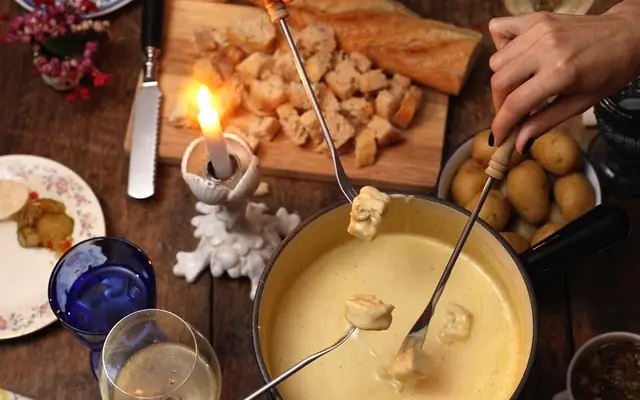
Fondue
Melted Gruyère and Vacherin Fribourgeois with white wine, garlic, and kirsch in a communal caquelon, scooped with cubed bread on long forks.
Raclette
Half-wheel of raclette cheese melted by heat lamp or open fire, scraped onto boiled potatoes with cornichons, pickled onions, and air-dried beef.
Rosti
Grated potato pan-fried into a crisp golden cake. Originally a Bernese farmer's breakfast, now eaten across the country as a side or base for fried eggs and cheese.
Zürcher Geschnetzeltes
Sliced veal in a cream, white-wine, and mushroom sauce, almost always served over rosti. The Zurich lunch.
Bündnerfleisch
Beef leg cured with salt, herbs, and red wine, then air-dried for months in alpine huts. Shaved paper-thin and served as an antipasto.
Älplermagronen
Alpine macaroni with potato, cream, onions, and grated cheese, finished with apple sauce. The mountain-pasture comfort dish.
Capuns
Chard leaves wrapped around a spaetzli dough enriched with dried sausage and herbs, simmered in milk and broth, baked under cheese.
Papet Vaudois
Slow-cooked leeks and potatoes topped with saucisson vaudois, a smoked pork sausage. The signature Vaud winter dish.
Birchermüesli
Raw rolled oats soaked in milk or yogurt with grated apple, nuts, and lemon. Invented around 1900 by Dr. Maximilian Bircher-Benner as a health regimen.
Nusstorte
Engadine caramelized-walnut tart in a shortcrust shell. Dense, long-keeping, ideal for alpine travel.
How to order
Fondue and raclette are winter dishes; many traditional restaurants stop serving them in summer. If a tourist trap offers fondue in July, the kitchen is performing for visitors, not feeding locals. Order rosti as a side with veal or sausage; ordering it alone is a tourist signal. Cheese plates are typically eaten after the main, before dessert, in the French manner. Tap water (Hahnenwasser, eau du robinet) is free and clean. Service charge is included; rounding up by a few francs is standard, not a percentage tip. Reservations matter, especially at lunch in business districts. Most kitchens close between lunch and dinner (around 14:00 to 18:30); turning up at 16:00 will find you a closed door outside city centers.
What to drink with it
Swiss whites pair the dairy: Chasselas (Fendant in Valais) with fondue and raclette is the canonical move, light and high-acid. Valais Petite Arvine and Heida go with cheese plates. Reds skew to Pinot Noir (Graubünden, Schaffhausen) and Merlot from Ticino. Kirsch is the digestif of choice, especially with fondue. Beer, mostly lager, is the casual-meal partner. Avoid red wine with melted cheese; the tannin and richness clash. Black tea after a heavy meal is also traditional.
Where to eat it
Zurich and Bern hold the most ambitious modern Swiss kitchens, with Magdalena and Kunststuben tradition in Zurich and a strong farm-to-table scene in Bern. Geneva and Lausanne for French-Swiss formality and lakeside fish. Lucerne and Lugano for tourism-driven but honest regional menus. Graubünden's mountain villages (St. Moritz, Pontresina, Sils) preserve the alpine kitchen at its most authentic. Outside Switzerland, Swiss cuisine travels poorly; even good German or Austrian restaurants rarely capture Bündner or Vaud cooking accurately.
A short history
Swiss regional cooking was codified during the 19th-century rise of alpine tourism, when hotels in Vaud, Valais, and Graubünden began serving farmer dishes to wealthy travelers from Britain, France, and Germany. Fondue's status as a national symbol was largely a 1930s marketing campaign by the Swiss Cheese Union to boost domestic cheese consumption. The four-language culinary divide remains structural, and most Swiss still consider themselves cooks of a canton first.
Frequently asked
Is Swiss food the same as German food?
No. German-speaking Swiss cooking shares some grammar with southern German and Austrian cuisine (sausage, potato, dumpling) but is distinct in its heavier dairy use, alpine cheese repertoire, and the rosti tradition. French-Swiss and Ticinese cooking are closer to their cross-border neighbors.
When is fondue season?
Roughly October through March. Eating fondue in summer is a tourist behavior; locals consider it heavy and out of season once the alpine air warms.
Is Swiss chocolate part of the cuisine?
Yes, but more as confectionery than dessert. Swiss chocolate (Cailler, Lindt, Sprüngli, Teuscher) is a serious industry with its own apprenticeships, and a box of pralines is a standard host gift.