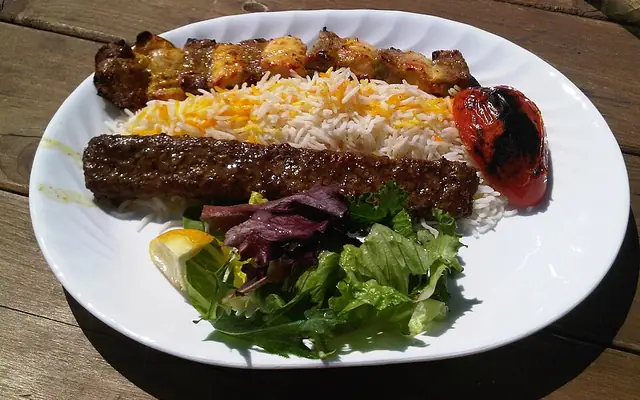
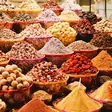
Persian cuisine, the cooking of Iran and its cultural sphere, is one of the oldest and most refined continuous food traditions in the world. Its grammar is distinct from the Arab Levantine kitchen: rice is the centerpiece, prepared with the care of a French sauce, with the prized tahdig (the golden crust at the bottom of the pot) as the defining technical flourish. Stews (khoresh) simmer for hours with fresh herbs by the bunch, dried limes, walnuts, pomegranate molasses, and saffron. Kebabs are grilled over wood charcoal, simply seasoned, and served with rice and grilled tomato. The flavor profile is sour, floral, and savory rather than spicy-hot.
A Persian meal is constructed around layers of contrast: the warm, fluffy basmati rice with the crackling tahdig; the long-cooked khoresh with the bright herb plate (sabzi khordan) of raw radish, mint, basil, scallion, and tarragon; the saffron-and-rosewater dessert against the savory rice. The use of dried fruit, nuts, and rose or orange blossom water in savory cooking is a Persian signature that the cuisine has exported throughout the region and into Mughal India.
Iranian cooking has remained largely insulated from international restaurant trends, which is part of its strength: the kitchens of Tehran, Isfahan, and Shiraz still cook recipes that would be recognizable to a 12th-century Persian poet. The diaspora kitchens of Los Angeles ('Tehrangeles'), London, and Toronto have carried the tradition forward. The Nowruz (Persian New Year) table, with its symbolic seven-item haft-sin spread and the herb-rice-and-fish lunch that follows, is the cuisine's most fully articulated ritual meal, and it lives on in essentially identical form in homes across Tehran, Stockholm, and Westwood. Few cuisines have preserved their core grammar through a millennium of empires, exile, and modernization as effectively as Persian cooking has.
Book a food experience
Tours, tastings and classes from the cities on this page, bookable on GetYourGuide.
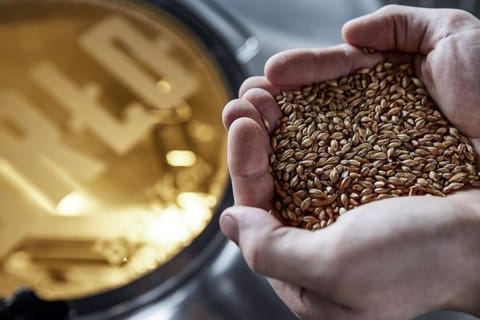
Visit a craft brewery in Berlin and embark on a guided tour of the unique facility housed in recycled containers. Discover how beer is made and try a...
Al Ustad Special Kabab has grilled Persian skewers in Bur Dubai, Dubai, since 1978, a family run kebab house a short walk from Al Fahidi metro station.
Pomegranate runs Persian cuisine in the West End since 2007: kabab koobideh, tahdig, saffron rice. One of a small handful of Persian rooms in the Carolinas.
€€€€DublinPersianSouth City CentreUntil Sun-Thu 02:00, Fri-Sat 04:00
Zaytoon on Parliament Street in Dublin 2, a halal Persian kebab and rice room serving until 04:00 Friday and Saturday, the city's late-night kebab reference.
TryLamb kebab plate
TipCounter and table seating; the kebab plate runs €14. Open until 04:00 Friday and Saturday for the late post-pub crowd.
Al Ustad Special Kabab has grilled Persian skewers in Bur Dubai, Dubai, since 1978, a family run kebab house a short walk from Al Fahidi metro station.
Pomegranate runs Persian cuisine in the West End since 2007: kabab koobideh, tahdig, saffron rice. One of a small handful of Persian rooms in the Carolinas.
Ariana's Persian Kitchen at Atlantis The Royal in Dubai is chef Ariana Bundy's Persian dining room, built on family recipes passed down through generations.
OrderThe fesenjoon chicken stew with pomegranate and walnut.
Shabestan is a Persian dining room on the second floor of the Radisson Blu in Deira, run by the third generation of one family and a Michelin Bib Gourmand.
SignatureMarinated grilled meats, Eggplant dip
TipBook the creek side window tables for the Dubai Creek and Old Dubai view across the water.
€€€€DublinPersianSouth City CentreUntil Sun-Thu 02:00, Fri-Sat 04:00
Zaytoon on Parliament Street in Dublin 2, a halal Persian kebab and rice room serving until 04:00 Friday and Saturday, the city's late-night kebab reference.
TryLamb kebab plate
TipCounter and table seating; the kebab plate runs €14. Open until 04:00 Friday and Saturday for the late post-pub crowd.
Chelo kebab as the urban standard, ghormeh sabzi and gheimeh as the household stews, rice with barberries and saffron (zereshk polo), and the strong tea culture of the bazaar teahouses.
Isfahan
Biryani (the Persian original, lamb-and-lung minced and grilled, unrelated to Indian biryani), beryani, khoresh mast (cold yogurt-saffron-meat dish), and gaz (saffron-pistachio nougat). Refined court cooking with Safavid legacy.
Shiraz and the south
Faloodeh (vermicelli-rose ice dessert), kalam polo (cabbage rice), and the only region of Iran with a serious historical wine culture (Shirazi wine pre-Islamic Revolution). Heavier use of citrus and tamarind.
Caspian / northern provinces
Mazandarani and Gilani cooking, rice and seafood and pomegranate-walnut stews (fesenjan), olive-walnut spreads, the most herb-heavy regional cooking in the country.
Persian diaspora (Los Angeles, London, Toronto)
Tehrangeles in Westwood is the largest Persian community outside Iran, with hundreds of Persian restaurants, bakeries, and grocers. The diaspora kitchen has preserved the cuisine through revolution and exile.
Defining persian dishes
Chelo kebab
The Iranian national dish: long flat skewer of seasoned ground lamb (koobideh) or marinated lamb chunks (barg), grilled over charcoal, served on saffron basmati rice with grilled tomato, raw onion, butter, and sumac.
Tahdig
The golden crust of rice (sometimes with bread or potato) at the bottom of the pot. Every Iranian cook is judged by their tahdig. Served broken into pieces alongside the fluffy rice.
Ghormeh sabzi
The most beloved Iranian stew: lamb, kidney beans, dried lime, and a huge quantity of fresh herbs (parsley, cilantro, fenugreek, chives) cooked down for hours. Often called the national stew.
Fesenjan
Pomegranate-walnut stew, traditionally with duck or chicken. Sweet, sour, deep brown, thick with ground walnuts and pomegranate molasses. A celebration dish.
Gheimeh
Lamb and yellow split pea stew with dried lime, tomato, and crispy fried potato batons on top. Comfort food across Iran.
Ash reshteh
Thick herb-and-noodle soup with beans, kashk (whey), and crispy fried onions and mint. Vegetarian, dense, the New Year (Nowruz) traditional dish.
Zereshk polo
Rice with saffron, barberries, and pistachio, served with chicken. The barberries are tart, ruby-red, and the visual signature of the dish.
Kashke bademjan
Eggplant dip with kashk (fermented whey), walnuts, fried mint, and crispy onions. The Persian answer to baba ghanoush, more complex and tangier.
Mirza ghasemi
Smoked eggplant with garlic, tomato, and egg from the Caspian region. Smoky, garlicky, served as a dip or side.
Joojeh kebab
Saffron and lemon marinated chicken kebab, less ground-meat-heavy than koobideh, often the entry-level kebab for newcomers.
Faloodeh
Iced dessert of vermicelli noodles in rose-water syrup with lime juice. Shiraz is the home; eaten especially in summer.
Sabzi khordan
The herb plate: raw radishes, scallions, mint, basil, tarragon, and feta or walnut, served at every meal. Eaten by hand, often wrapped in flatbread.
How to order
A Persian sit-down meal opens with sabzi khordan (the herb plate), bread, and feta or yogurt-cucumber (mast-o-khiar). Then a stew (khoresh) with rice for one or two people, plus a kebab platter to share. Saffron rice is always the foundation; ask about tahdig at any kebab house worth its salt, as it is sometimes prepared in limited quantities and goes early. End with a glass of Persian tea (sweetened by holding a sugar cube in the mouth) and saffron ice cream (bastani) or faloodeh.
The rookie mistakes: not eating the doogh (salted yogurt drink) at least once (it is the traditional kebab companion), under-ordering rice (Persian rice is the dish, not a side), expecting heat (Persian food is rarely spicy-hot), skipping the herb plate (it is not garnish, it is part of the meal), and using a fork on the tahdig (the crust is the prize, and it is broken into pieces and shared with everyone at the table). At a Tehran kebab house, the rice arrives first, in mountainous quantity, with a raw egg yolk and a pat of butter for stirring in; do not refuse this ritual.
What to drink with it
Doogh, the salted yogurt drink with dried mint, is the traditional kebab pairing and a near-essential. Black tea (chai), served strong in glass cups and sweetened by holding a sugar cube between the teeth, closes every meal. Pre-revolution Iran had a Shirazi wine tradition; today, alcohol is legally forbidden in Iran but Persian wines do appear in the diaspora restaurants of Los Angeles and London. Pomegranate juice, sour cherry juice (sharbat), and rose-flavored drinks are traditional non-alcoholic options.
Where to eat it
Tehran, Isfahan, and Shiraz are the great food cities of Iran, each with distinct regional traditions and centuries-deep restaurant cultures. The diaspora has built strong scenes in Los Angeles (the largest Persian community outside Iran, concentrated in Westwood), Toronto, London, Dubai, and Washington DC. Outside the diaspora, Tehrangeles in LA is the gold standard for visitors who cannot reach Iran itself.
A short history
Persian cuisine is one of the oldest documented food traditions on earth, with continuous court and household cooking going back to the Achaemenid Empire (550 to 330 BCE). The medieval Persian cookbooks shaped the cuisines of Mughal India, Ottoman Turkey, the Arab Abbasid court, and Andalusian Spain. The Safavid period (1501 to 1736) codified much of the modern dish vocabulary, and the diaspora following the 1979 revolution carried the cuisine globally.
Frequently asked
Is Persian food spicy?
No, not in the chile-pepper sense. The flavor profile is sour, floral, herbal, and savory. The 'heat' in Persian cooking is from spices like cumin, turmeric, and saffron, not chiles.
What is the difference between Iranian and Persian?
Persian is the cultural and linguistic descriptor; Iranian is the national descriptor. The cuisine is most often called Persian in English-language restaurants, partly to refer to the broader cultural tradition that predates the modern nation-state.
Is Persian biryani the same as Indian biryani?
No. Persian beryani (mostly an Isfahan specialty) is a minced lamb-and-lung dish grilled on flatbread. Indian biryani is a layered rice-and-meat preparation that descended from Mughal court cooking, which was itself heavily influenced by Persian techniques, but the dishes are unrelated in form.