
Appalachian cuisine is the cooking of the Appalachian Mountain region of the United States, stretching from western Pennsylvania through West Virginia, Virginia, Kentucky, Tennessee, North Carolina, and into northern Georgia and Alabama. It is one of the most distinctive American regional cuisines and one of the most poorly understood, often dismissed as 'hillbilly food' or reduced to a stereotype of cornbread and biscuits, when it is in fact a layered tradition descended from Scotch-Irish settler cooking, Cherokee and other indigenous foodways, African-American influence (smaller in proportion than Lowcountry or soul food, but real), German-Pennsylvania Dutch settlement in the northern reaches, and the mountain pantry that the geography imposed.
The defining grammar is hominy (lye-treated whole corn, the indigenous ancestor of grits), soup beans (pinto or great northern beans slow-cooked with smoked pork, the everyday Appalachian dinner), cornbread (Southern-style, skillet-baked, with cracklins or bacon fat), sorghum (a sweetener made from the sorghum cane, traditional in the mountains where sugar cane could not grow), cured pork (country ham, bacon, side meat), wild foods (ramps in spring, morel and chanterelle mushrooms, blackberries and pawpaws), pickled and canned summer produce (chow chow, pickled beans, sauerkraut, apple butter), and a buttermilk-and-biscuit breakfast that defines the region.
The contemporary Appalachian revival is led by chefs who have argued that the cuisine deserves the same respect as Lowcountry or New Orleans: Sean Brock at Audrey in Nashville, Travis Milton in southwest Virginia, the Hot Box in Asheville, and the broader work of Appalachian Food Summit organizers. The cuisine's ingredients (heirloom apples, sorghum, country ham, ramps, hominy, sea island peas in the Virginia overlap) are among the most distinctive and best-preserved in the country.
Book a food experience
Tours, tastings and classes that match this page, bookable on GetYourGuide.

Top picks
The best-scored Appalachian place in each of 1 cities.
J.C. Holdway ★ 4.8
J.C. Holdway on Union Avenue, Joseph Lenn's wood-fired Appalachian room since 2016 after his Blackberry Farm run, anchors Knoxville's chef-driven downtown.
OrderWhichever Appalachian-sourced wood-fired protein the kitchen is leading the night's menu.
TipReservations open about a month out on Resy and the Tuesday to Thursday dinners run quieter than weekend Saturdays.
Find a place
J.C. Holdway ★ 4.8
J.C. Holdway on Union Avenue, Joseph Lenn's wood-fired Appalachian room since 2016 after his Blackberry Farm run, anchors Knoxville's chef-driven downtown.
OrderWhichever Appalachian-sourced wood-fired protein the kitchen is leading the night's menu.
TipReservations open about a month out on Resy and the Tuesday to Thursday dinners run quieter than weekend Saturdays.
Appalachian by city


Regional variations
Central Appalachia (eastern Kentucky, West Virginia, southwest Virginia, east Tennessee)
The heart of the cuisine. Soup beans, cornbread, country ham, fried apples, hominy, pickled beans and corn, leather britches (dried beans cooked back to life). The most directly Scotch-Irish-rooted regional kitchen.
Southern Appalachia (western North Carolina, north Georgia)
Asheville and the surrounding mountains. More fine-dining-influenced, with chefs like John Fleer (Rhubarb) bringing Appalachian techniques into a contemporary frame. Heavier Cherokee influence; bean bread (a cornbread with beans baked in, derived from Cherokee tradition), ramp culture, foraging.
Northern Appalachia (western Pennsylvania, northern West Virginia)
Pennsylvania Dutch and Scotch-Irish overlap. Scrapple, pierogies in the steel-town belt, kielbasa, sauerkraut, apple butter, shoofly pie. The closest Appalachia gets to Mid-Atlantic German cooking.
Melungeon and African-Appalachian cooking
The historically isolated mixed-race communities of central Appalachia (Hancock County, Tennessee, especially) have their own cooking variations, and Black Appalachian families have contributed significantly to the cuisine, particularly through cured pork, biscuit traditions, and pickling.
Defining Appalachian dishes
- Soup beans and cornbread
- Pinto or great northern beans slow-cooked with a smoked ham hock or piece of fatback, onion, salt, and pepper, served with skillet cornbread for dunking. The everyday Appalachian dinner; a perfect bowl is a national-treasure-level dish that has been undervalued.
- Country ham
- Dry-cured, salt-and-smoke-aged ham, often hung for 9 to 18 months. Sliced thin, fried in a cast iron pan, served with red-eye gravy (deglazed with coffee) and biscuits. Smithfield, Edwards, and Benton's are the famous producers.
- Biscuits and gravy
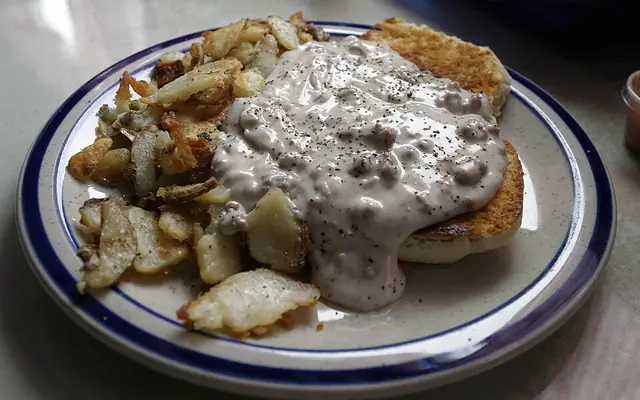
- Buttermilk biscuits split and topped with sausage cream gravy (white gravy made with the fat and crumbles of breakfast sausage). The Appalachian and broader Southern breakfast.
- Fried apples
- Tart apples (often Stayman or Winesap) sliced and cooked in butter and brown sugar until soft and golden. A breakfast side or a dessert spooned over cornbread or biscuits.
- Hominy
- Whole corn kernels treated with lye (nixtamalized), giving a chewy, distinct flavor. Eaten as a side, ground into grits, or hominy-and-pork stew.
- Leather britches (shuck beans)
- Green beans strung on thread and dried whole, then later rehydrated and cooked with pork. The Appalachian preservation technique that yields a distinctive deep-bean flavor unmatched by fresh beans.
- Ramps
- The wild leek of the southern Appalachians, foraged in early spring (March to May) from the mountain forests. Pickled, scrambled with eggs, used in dumplings or cornbread. The defining wild green of the region.
- Chow chow
- A pickled relish of cabbage, green tomatoes, onion, peppers, and corn, sweet-and-sour-spiced. Eaten on soup beans, hot dogs, and as a side.
- Stack cake
- Six to twelve thin layers of cake or molasses-spiced cookie, with cooked dried-apple filling between each layer. Originally a wedding cake where each guest brought a layer; an Appalachian celebration dessert.
- Sorghum molasses
- Syrup boiled from sorghum cane, used as a sweetener for biscuits, cornbread, and as a topping. The mountain alternative to sugar cane syrup.
- Pawpaw
- The largest native fruit of North America, with custard-like flesh that tastes like a mango-banana cross. Ripens in September; rarely sold commercially because it does not ship well. The Appalachian wild fruit treasure.
- Cushaw squash
- A long, crooked, green-and-white winter squash native to the Appalachian growing tradition. Used in cushaw pie (similar to pumpkin pie but creamier) and savory side dishes.
How to order
A traditional Appalachian sit-down meal starts with biscuits or cornbread (often with butter and apple butter, sorghum, or honey on the table). Soup beans is the most common main, with country ham, fried chicken, meatloaf, or smothered pork chops as alternates. Sides are stewed apples, fried okra, pickled beans, hominy, cole slaw, and stewed greens. At a contemporary Appalachian restaurant like Audrey or Rhubarb, the menu reads more chef-driven (foraged ramps with cornbread, country ham country-fried with stone-ground grits, leather britches with smoked trout) but the ingredient grammar is unchanged.
The rookie mistakes: under-ordering biscuits (the bread is part of every meal), confusing soup beans with chili (it is bean soup with smoked pork, not a tomato-and-chile dish), missing the ramps season (March to May, narrow window), reducing Appalachian food to 'hillbilly food' (it is one of the most distinctive American regional cuisines), and skipping sorghum (the syrup over hot biscuits is the breakfast that defines the mountains). At a meat-and-three or country-cooking restaurant, the sides are often the best part of the menu, and ordering an extra side instead of an extra meat is a marker of someone who knows the cuisine.
What to drink with it
Sweet tea, buttermilk, and coffee are the table drinks. Bourbon and rye whiskey are the regional spirits: Kentucky and Tennessee bourbon (Maker's Mark, Buffalo Trace, George Dickel) and the increasingly serious craft distilleries in western North Carolina and Virginia (Copper Barrel, Catoctin Creek). Country ham with apple brandy, biscuits with sorghum coffee, or a glass of cold buttermilk with a hot bowl of soup beans. Apple cider (especially in autumn) and pawpaw beer (a small craft phenomenon) are the regional fruit drinks. Wine is increasingly available, with Virginia and North Carolina mountain wineries (RdV, Linden, Biltmore) producing serious Cabernet Franc and Petit Manseng.
Where to eat it
Nashville is now the modern fine-dining home of Appalachian, with Sean Brock's Audrey leading. Asheville for Rhubarb (John Fleer) and the foraging-led Hot Box. Knoxville for the contemporary scene at Knox Mason and J.C. Holdway. Lexington and Louisville (Kentucky) for the bourbon-country overlap with Appalachian. The traditional home-cooking is best encountered at meat-and-three or family-style restaurants in eastern Kentucky, southwest Virginia, and West Virginia (the Hillbilly Hot Dogs and country-cooking diners that anchor the region). Outside the US, the cuisine has not exported.
A short history
Appalachian cuisine emerged from Scotch-Irish settler migration into the Appalachian Mountains from the early 18th century, layered on Cherokee and other indigenous foodways (the corn-bean-squash 'three sisters' agriculture is fundamental), and influenced by Pennsylvania Dutch German settlement to the north and by African-American communities throughout the region. The mountain geography (isolated valleys, short growing seasons, dependence on preserved foods) shaped the pantry. The 20th-century narrative of Appalachian poverty obscured the cuisine; the 21st-century revival has reasserted it as one of the most distinctive American regional traditions.
Frequently asked
Is Appalachian food the same as Southern food?
Overlap, not equivalence. Appalachian shares biscuits, cornbread, country ham, and fried chicken with the broader Southern tradition, but it has its own specific pantry (hominy, soup beans, sorghum, ramps, leather britches, pawpaw) and was shaped by mountain geography rather than the plantation South. It is closer to Scotch-Irish-Cherokee-mountain than to plantation-Southern.
What are ramps?
The wild leek (Allium tricoccum) that grows in the hardwood forests of the southern Appalachians. Foraged in early spring (typically March through May), they have a strong garlic-onion flavor and are the most prized wild green in the region. Many Appalachian communities have ramp festivals; commercial cultivation is difficult, so most ramps are still foraged.
What is sorghum syrup?
A sweetener made from boiling the juice of the sorghum cane (related to sugar cane but better suited to the Appalachian climate). Thicker than maple syrup, less sweet than molasses, with a distinctive mineral flavor. The traditional mountain sweetener for biscuits, cornbread, and stack cake.
More cities are in research. Want Appalachian covered somewhere specific? Tell us where you want to eat.