How Buenos Aires came to eat the way it does: the people, migrations and accidents that shaped the plate.
Key eras
-
1810-1860, Pampas asado and the gaucho
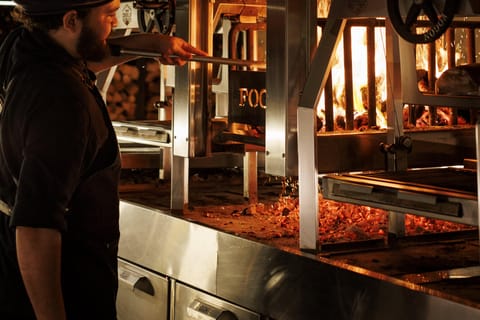
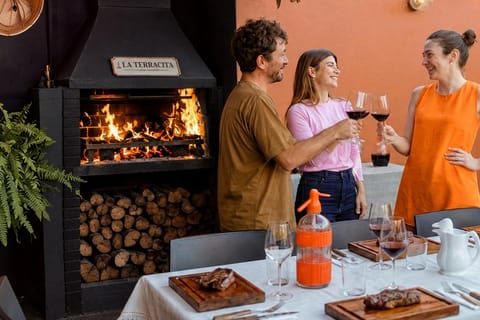
Independence-era Buenos Aires ate around the gaucho hearth. Whole-animal asado al asador over open coals, chimichurri, mate poured around the fire; the Pampas cattle estancia is where Argentine beef culture was built across the open plains.
-
1880-1930, Italian and Spanish mass immigration
Between 1880 and 1930, roughly four million European immigrants arrived in Argentina, more than half of them Italian. They brought pasta, pizza al molde, milanesa (which became napolitana with tomato and mozzarella), and the bodegon as a dining format. Spaniards opened tortilla-and-paella rooms; together they wrote the Buenos Aires menu.
Taste it todayPizza al molde -
1858 onward, Cafes Notables
Cafe Tortoni opened in 1858 and built the Buenos Aires cafe tradition. By the 1880s every barrio had a notable cafe with marble counters, bow-tied servers and politicians, writers and tango composers at the same tables. The Cafes Notables register today protects more than 70 of them.
-
1934-1960s, Pizza al molde and milanesa napolitana
El Cuartito opened 1934 on Talcahuano; Guerrin opened 1932 on Corrientes. Thick-crust pizza al molde with Argentine mozzarella and a chickpea-flour faina on the side became the city's defining cheap meal. Milanesa napolitana (breaded cutlet with tomato, ham and mozzarella) was invented at Restaurant Napoli on Bouchard facing Luna Park in the late 1940s and named after the restaurant, not Naples.
-
1990s-2000s, the parrilla revival
After the 2001 economic crisis, a generation of chefs reinvested in Argentine beef sourcing. Don Julio (taken over 1999 by Pablo Rivero), La Cabrera (2002 under Gaston Riveira) and others showed grass-fed Argentine cattle could rank with anything in the world; Don Julio reached #1 on Latin America's 50 Best in 2020, regained the top spot in 2024 and slid to #3 in 2025.
-
2010s, the fine-dining era
Tegui (German Martitegui), Aramburu (Gonzalo Aramburu), Mishiguene (Tomas Kalika) and Anchoita (Enrique Pineyro) led a tasting-menu era. The trend culminated in November 2023 when the Michelin Guide finally arrived in Buenos Aires, awarding two stars to Aramburu and one star each to Don Julio, Trescha and three Mendoza restaurants, plus Green Stars for sustainable sourcing.
-
2014 onward, the new wave
A wave of small chef-driven projects opened in Palermo and Villa Crespo: Gran Dabbang (2014, Mariano Ramon's Indian-Asian Argentine), La Carniceria and Nino Gordo (Pedro Pena and German Sitz), Julia (Julio Baez, 2019), Anafe (Najmanovich and Arcucci) and Trescha (Tomas Treschanski, 2023). The new wave shipped a Buenos Aires that ate vegetables, fermented its bread and ran tasting menus for 11 guests.
Immigrant influences
- Italian (Genoese, Calabrese, Neapolitan)
- Pasta (tallarines, sorrentinos, noquis), pizza al molde, fugazzeta, milanesa, helado in the gelato style. Italian-Argentine bodegones still serve the same Sunday menus their grandparents wrote.
- Spanish (Galician, Asturian, Basque)
- Tortilla espanola, paella, jamon serrano, bacalao a la vizcaina, vermouth-aperitif culture. Spanish bodegones like Miramar in San Cristobal kept the format alive.Taste it todayMiramar
- Jewish (Ashkenazi and Sephardi)
- Pastrami sandwiches, gefilte fish, latkes, kichel; Sephardic Levantine breads and stews. Once barrio is the historic Jewish quarter and Tomas Kalika's Mishiguene refined the canon.Taste it todayMishiguene
- Lebanese, Syrian, Armenian (Levantine)
- Shawarma, hummus, kibbeh, tabbouleh; the Levantine bakeries on Cordoba and Pueyrredon. Lebanese-Argentine families were among the first big non-European immigrant groups.
- Chinese and Taiwanese (Belgrano Chinatown)
- Wok-stir-fry restaurants, dim sum, Asian grocers along Arribenos; the country's only proper Chinatown opened in Belgrano in the 1980s.
- Bolivian, Peruvian, Paraguayan (Andean and Andean-Amazonian)
- Llamita-empanadas, ceviche, lomo saltado, anticuchos. Most arrived after 1980; their food is concentrated in markets like the Once and Liniers Bolivian zones.
Signature innovations
- Milanesa napolitana (invented at Restaurant Napoli on Bouchard, late 1940s)Taste it todayMilanesa Napolitana
- Pizza al molde (Argentine deep-pan pizza, El Cuartito 1934, Guerrin 1932)
- Fugazzeta and fugazzeta rellena (cheese-stuffed onion pizza, Argentine-Italian)Taste it todayFugazzeta
- Dulce de leche scaled industrially (Estancia La Salamandra, La Serenisima)Taste it todayDulce de Leche
- Alfajor Marplatense (Havanna 1948, Mar del Plata)Taste it todayAlfajor
- The bodegon as a dining format (wood-panelled, family-run, multi-course)
- Cafes Notables register and protection (1990s)
- Asian-parrilla fusion (Nino Gordo 2017, Sitz and Pena)Taste it todayNino Gordo
- Provoleta (Natalio Alba, Cordoba 1940; the Argentine grilled-cheese disc)Taste it todayProvoleta
- Yerba mate as the daily ritual beverage (6.5 kg per capita per year)
Book food experiences in Buenos Aires