Key eras
The delta river port
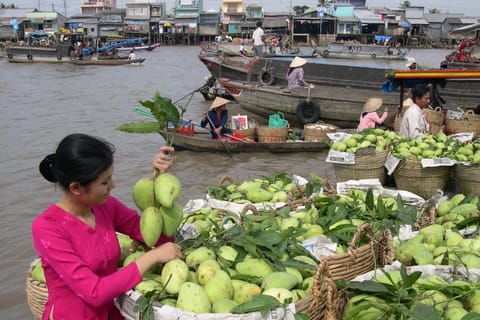
Before it was Saigon, this was a low-lying river port on the edge of the Mekong Delta, Khmer and then Viet, feeding on the delta's rice, river fish and the fermented-fish sauces that still anchor Southern cooking. Sugar, coconut and tropical fruit were abundant, which is why Southern Vietnamese food skews sweeter than the north to this day.
French Cochinchina, 1859 to 1954
Under French colonial rule Saigon absorbed the baguette, pate, butter, coffee and the flan, then quietly reinvented them. The baguette became the banh mi, lighter and part rice flour; drip coffee met local ice and condensed milk to become ca phe sua da. The colonial villas and cafe culture of downtown District 1 date from this era and still shape how the city eats and drinks.
Cho Lon and the Chinese kitchens
Waves of Cantonese and Teochew migrants built Cho Lon, the twin city that became Districts 5 and 6, into one of Asia's great Chinatowns. Their kitchens gave Saigon hu tieu noodle soups, roast meats, dim sum, sweet che soups and the wok-driven cooking that fills the market stalls of Cho Lon, a cuisine distinct from the Vietnamese food a few districts away.
War, austerity and Doi Moi
The post-1975 years brought rationing and the bao cap subsidy period, when coffee was cut with additives and eating out shrank to survival. The 1986 Doi Moi reforms reopened the private food economy, and the street stalls, com tam grills and family restaurants that define modern Saigon flourished again through the 1990s and 2000s.
The Michelin arrival, 2023
The Michelin Guide reached Vietnam in 2023, and Ho Chi Minh City won its first stars, led by Anan Saigon. By 2025 the city held five one-star restaurants alongside a long Bib Gourmand list of pho, com tam and banh mi stalls, formalising a food scene that had always run on the street.