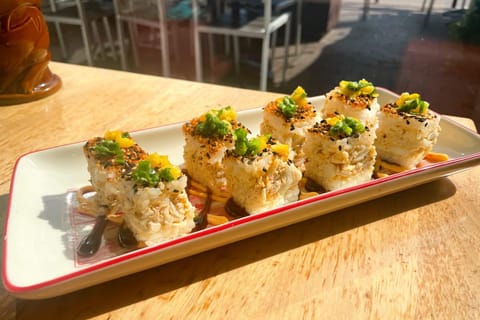
How Washington DC came to eat the way it does: the people, migrations and accidents that shaped the plate.

Key eras

1856, the founding of Old Ebbitt Grill

Old Ebbitt Grill opened in 1856 as a boarding house near the White House and became the city's oldest saloon. By the late 1800s it was the unofficial bar of every president from Grant to McKinley. The Ebbitt's modern incarnation at 675 15th Street NW serves more than 1.5 million guests annually across four bars and remains the canonical DC power-lunch room, still pulling 1000 crab cakes a week from the kitchen.

1893, the Old Bay seasoning blend

Old Bay seasoning was developed in Baltimore in 1939 by German-Jewish refugee Gustav Brunn. The blend of celery salt, paprika, mustard, bay leaves, black pepper and red pepper became the Chesapeake region's defining seasoning. By the 1950s it had spread south to Washington DC and remains the dusting on shrimp boils, crab cakes and fries citywide. McCormick acquired the brand in 1990; the recipe is unchanged.

1958, Ben's Chili Bowl and the half-smoke

Ben and Virginia Ali opened Ben's Chili Bowl at 1213 U Street NW in August 1958, in a former silent-movie house, and built the chili half-smoke into DC's defining sandwich. The U Street riots of April 1968 left Ben's as one of the few neighbourhood businesses still standing; the room fed protestors, fire crews and reporters around the clock. Anthony Bourdain, Barack Obama and most US senators have eaten one.

1980s, the Ethiopian Little Ethiopia migration

Washington DC has the largest Ethiopian population outside Addis Ababa. The community arrived after the 1974 revolution and settled along Ninth Street NW in Shaw through the 1980s. The unofficial Little Ethiopia designation came in 2005 after a coalition of business owners petitioned the city. Etete, Dukem, Habesha and a dozen other rooms anchor the corridor; Sheba Ethiopian opened the original DC Ethiopian dining room in 1979.

1993, Jose Andres opens Jaleo

Jose Andres opened Jaleo on 7th Street NW in Penn Quarter in 1993 with restaurateur Rob Wilder. The Spanish tapas room codified DC's modern small-plates dining template and launched ThinkFoodGroup, which now operates Zaytinya (2002), Cafe Atlantico (now China Chilcano), Oyamel, Minibar and barmini across Penn Quarter. The Jose Andres effect made the corridor into the country's densest cluster of single-chef tasting rooms outside New York.

2017, Michelin Guide Washington DC

The Michelin Guide began covering Washington DC in 2017, the third US city after New York and San Francisco. The first DC edition awarded twelve restaurants stars, including Minibar (two stars), Pineapple and Pearls (two stars), The Inn at Little Washington nearby (three stars), Tail Up Goat, Rose's Luxury, Bresca, Kinship, The Dabney, Plume, Sushi Taro, Komi and Masseria. The starred count has grown across editions; the 2024 guide lists more than twenty starred rooms across the metro area.

Immigrant influences

  • Ethiopian (Shaw, Adams Morgan): Largest Ethiopian population outside Addis Ababa. Doro wat, kitfo, tibs, the spongy injera bread. Etete since 2004, Dukem since 1997, Habesha, Awash. The unofficial Little Ethiopia designation on 9th Street NW arrived 2005.
  • Salvadoran (Mount Pleasant, Columbia Heights, Wheaton): Largest Salvadoran population in the United States. Pupuserias across Mount Pleasant Street, Don Juan's, El Sol de America, Los Hermanos. Curtido, pupusas, Salvadoran tamales, the 16th-and-Mount-Pleasant corner enclave.
  • Vietnamese (Eden Center, Arlington, Falls Church): Third-largest Vietnamese-American population in the United States. Eden Center in Falls Church since 1984, Pho 14 in Columbia Heights, Pho Viet on 14th, Pho 75 in Rosslyn. Pho, banh mi, bun, the metro-area Vietnamese diaspora anchored at Eden.
  • African-American Great Migration (U Street, Anacostia): Half-smoke at Ben's Chili Bowl since 1958. Mumbo sauce, Florida Avenue Grill since 1944, Henry's Soul Cafe since 1968, Oohh's & Aahh's. Capital City Mumbo Sauce bottling. The U Street corridor as Black Broadway from the 1920s through the 1950s.
  • Chinese (Chinatown, Falls Church): Penn Quarter Chinatown enclave since 1930s, much shrunk by 1990s sports-arena development. Tony Cheng's, Wok and Roll. The larger Chinese population shifted to the Eden Center corridor and to Rockville Maryland over time.
  • Spanish (Penn Quarter via Jose Andres): Jose Andres opened Jaleo in 1993, then Zaytinya 2002, then Minibar at Penn Quarter. The ThinkFoodGroup empire codified DC's modern Spanish tapas template and built the city's tasting-menu corridor in Penn Quarter.
  • Afghan (Northern Virginia, Arlington): Largest Afghan population on the East Coast. Kabob Palace in Crystal City, Helmand Restaurant in Baltimore (Hamid Karzai's family), Lapis in Adams Morgan. Mantu dumplings, ashak, kabuli pulao, lamb kebabs.
  • Caribbean (Trinidadian, Jamaican, Haitian): Caribbean Day each summer in Mount Pleasant. Negril Eatery, Roti Mediterranean Grill. Roti, jerk chicken, fried plantain, ackee and saltfish. The 16th Street NW corridor through Mount Pleasant runs Caribbean alongside Salvadoran.

Signature innovations

  • The half-smoke, served at Ben's Chili Bowl since 1958.
  • Mumbo sauce, the city's defining red-orange sweet-tangy carryout condiment.
  • The jumbo slice, an 18-inch foldable late-night pizza format from 18th Street.
  • Senate bean soup, on the US Senate cafeteria menu every day since 1903.
  • The Chesapeake blue crab cake, finished with Old Bay (Baltimore 1939).
  • Modernist tasting at Minibar by Jose Andres since 2003.
  • The Jaleo template (1993) that built DC's small-plates dining grammar.
  • Little Ethiopia on 9th Street NW, officially designated 2005.

Food History in Washington DC, FAQ

When is the best time to eat in Washington DC?

Peak food season in Washington DC is year-round.

What time do people eat in Washington DC?

Local dining hours: lunch around 12:30, dinner from 19:30.

How does tipping work in Washington DC?

service is typically included; small extra is welcome but not expected.

What is the one dish to try in Washington DC?

Ask the next local you meet what they would order. Washington DC rewards trust.

← Back to Washington DC food guide