Signature dishes
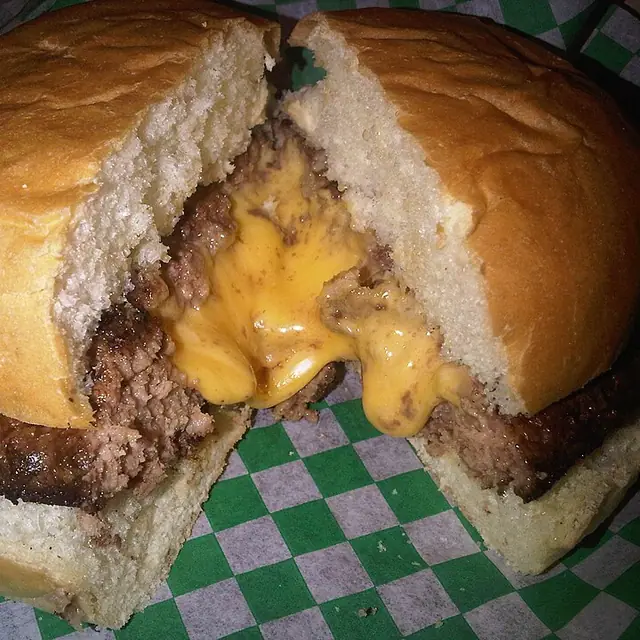
The Jucy Lucy is Minneapolis's defining burger: two ground-beef patties pressed around a cube of American cheese, then griddled until the centre melts into a molten core that scalds the unwary on first bite.
Where: Matt's Bar, 5-8 Club, Blue Door Pub
Price: $10-14

Walleye is Minnesota's state fish and the Twin Cities' default white-fleshed entree. The fillet is mild, sweet and firm, pan-fried with a flour-cornmeal crust or grilled on cedar.
Where: Indigena by Owamni, Restaurant Alma, Sea Salt Eatery
Price: $22-38
Lemongrass-and-galangal pork sausage griddled to order at a Hmong market stall, paired with som tam papaya salad pounded fresh with chili, lime, peanuts and tomato.
Where: Hmongtown Marketplace, Vinai
Price: $12-22
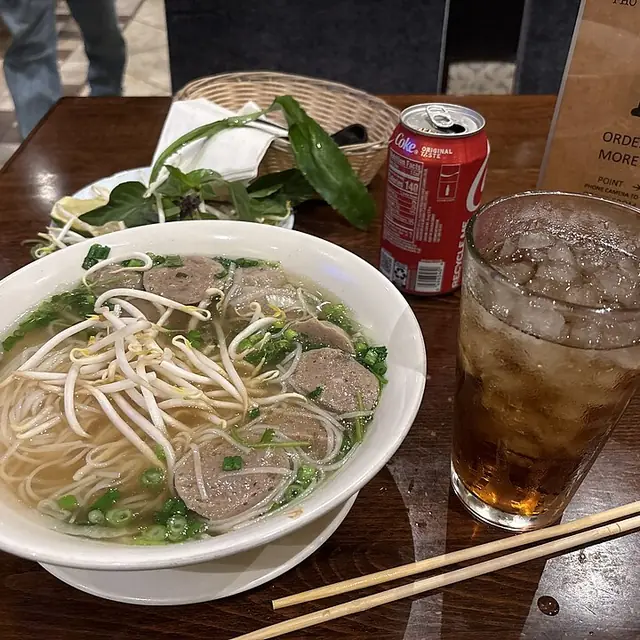
Pho tai is rare-beef pho: paper-thin raw eye-of-round laid over rice noodles, cooked at the table by ladles of clove and star anise broth simmered overnight from beef bones.
Where: Quang Restaurant, Pham's Deli
Price: $13-18
Ann Kim's wood-fired pizza takes the Neapolitan blueprint (90 seconds at 800F on thin sourdough) and layers Korean-influenced toppings: gochujang, kimchi, sesame, braised pork belly.
Where: Pizzeria Lola
Price: $18-26
Cedar-braised bison over manoomin (hand-harvested wild rice) is the canonical Indigenous Minneapolis dish: gamy bison shoulder slow-cooked over wood, plated with smoky lake-grown rice.
Where: Indigena by Owamni
Price: $32-44
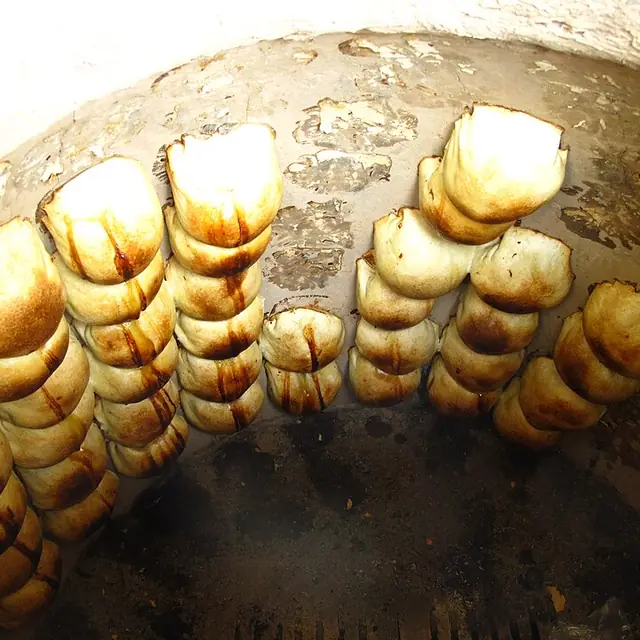
East African sambusa is the Twin Cities' defining street snack: triangle-folded pastry filled with cumin-spiced beef, scallion and green chili, deep-fried to a glassy crackle.
Where: Afro Deli, Quruxlow Restaurant
Price: $2-4 each
The kielbasa plate at a Northeast Polish deli runs simple: smoked sausage made that morning, sauerkraut, horseradish-mustard, dark rye and a pickled beet. Heavy, salty, faintly smoky.
Where: Kramarczuk's East European Deli
Price: $14-18
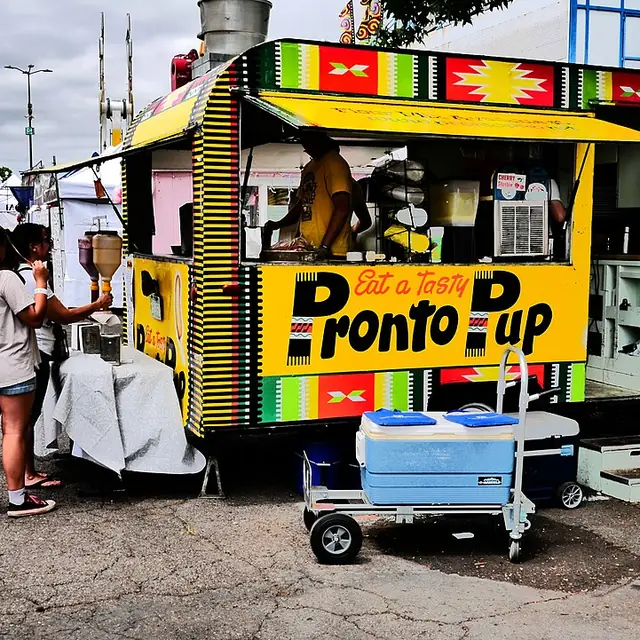
The Pronto Pup is the original cornmeal-battered hot dog on a stick, dipped fresh and deep-fried on the spot, sweeter and crunchier than the standard corn dog. Yellow mustard only.
Where: Pronto Pups, Sweet Martha's Cookie Jar
Price: $5-7
Lefse is a paper-thin Norwegian potato flatbread rolled around butter and sugar; krumkake is a waffle-iron cone of vanilla-cardamom batter, often piped full of cream and eaten with coffee.
Where: Ingebretsen's Nordic Marketplace
Price: $4-9 per piece
Vietnamese baguette layered with pate, mayo, grilled lemongrass pork or pork roll, pickled daikon and carrot, cucumber, cilantro and jalapeno. The Nicollet Avenue Eat Street tradition since the 1980s.
Where: Quang Restaurant, Hai Hai, Mercado Central, Midtown Global Market
Price: $6-10
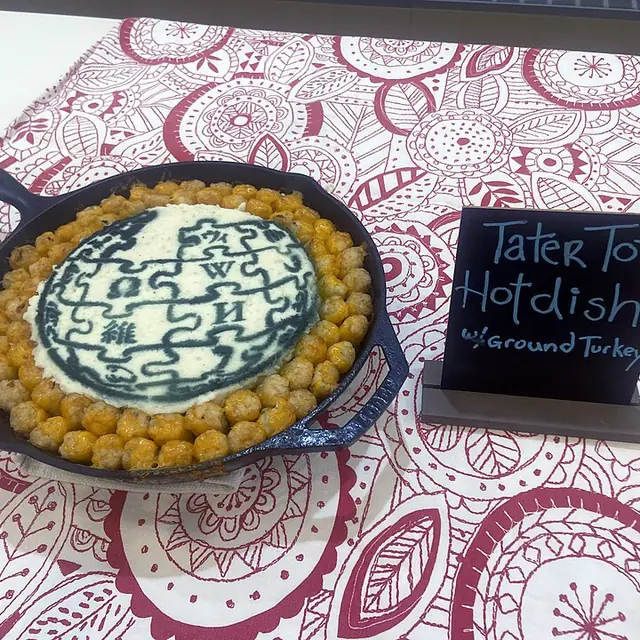
Minnesota's canonical casserole: ground beef, cream-of-mushroom soup, mixed frozen vegetables, all baked under a crown of tater tot potato nuggets until the topping crisps deep golden.
Where: Hen House Eatery, Blue Door Pub, Cafe Latte, Matt's Bar
Price: $11-18
Jucy Lucy
The Jucy Lucy is Minneapolis's defining burger: two ground-beef patties pressed around a cube of American cheese, then griddled until the centre melts into a molten core that scalds the unwary on first bite.
History: Two south Minneapolis bars on Cedar Avenue and 35th Street both claim the patent. Matt's Bar opened in 1954 and spells it Jucy Lucy without the second i, swearing a customer asked for the cheese inside the meat in 1954 and the bartender called it a juicy lucy. The 5-8 Club spells it Juicy Lucy and dates the dish to a regular who built it in their kitchen in the early 1950s. Both insist they invented it. The dispute has run on local news for decades. Either way, the burger is fully grown-in-Minneapolis: griddled flat, no bun toast, American cheese only, served with chips and a pickle spear.
Where to try it: Matt's Bar, 5-8 Club, Blue Door Pub
Watch out for: Gluten, Dairy
Walleye
Walleye is Minnesota's state fish and the Twin Cities' default white-fleshed entree. The fillet is mild, sweet and firm, pan-fried with a flour-cornmeal crust or grilled on cedar.
History: Walleye anchors Minnesota dining the way lobster does coastal Maine. The fish has been the centerpiece of shore lunches across the state's 10,000-plus lakes for more than a century, and the Department of Natural Resources stocks more than 200 million walleye fry annually. In Minneapolis-Saint Paul kitchens, walleye landed on resort menus first then onto downtown plates after WWII. Today Indigena by Owamni serves it cedar-planked over wild rice as part of Sean Sherman's Indigenous program, Restaurant Alma plates a seasonal preparation, and Sea Salt Eatery does a beer-battered version that gets a line down the path at Minnehaha Falls every summer.
Where to try it: Indigena by Owamni, Restaurant Alma, Sea Salt Eatery
Watch out for: Fish, Gluten (in battered preparations)
Hmong sausage and papaya salad
Lemongrass-and-galangal pork sausage griddled to order at a Hmong market stall, paired with som tam papaya salad pounded fresh with chili, lime, peanuts and tomato.
History: Saint Paul holds the largest urban Hmong population in the United States, about 80,000 in the metro, descended from Lao and Vietnamese refugees who arrived after 1975. The Hmongtown Marketplace on Como Avenue and the original Hmong Village on East Johnson Parkway became the city's twin Hmong food halls in the 2000s. Chef Yia Vang's Vinai opened in Northeast Minneapolis in 2024 and was nominated for a James Beard Best New Restaurant award in 2025; Vang's pork sausage and papaya salad combo has set the canonical version of the dish for Twin Cities diners.
Where to try it: Hmongtown Marketplace, Vinai
Watch out for: Fish (fish sauce), Peanuts (in salad)
Pho tai
Pho tai is rare-beef pho: paper-thin raw eye-of-round laid over rice noodles, cooked at the table by ladles of clove and star anise broth simmered overnight from beef bones.
History: The Twin Cities Vietnamese community grew steadily after 1975 and now numbers around 30,000 in the metro, concentrated along University Avenue in Saint Paul and around Eat Street on Nicollet in Minneapolis. Quang opened on Nicollet in 1989 as a four-table bakery run by Lung Tran and grew across the street into the full restaurant; five of Tran's children still run the line. The pho-tai cult is real: Twin Cities reviewers regularly debate Quang versus Pham's Deli at Midtown Global Market versus Pho Tau Bay, with Quang holding the popular vote for the cleanest broth and the biggest portion.
Where to try it: Quang Restaurant, Pham's Deli
Watch out for: Gluten, Soy
Wood-fired Korean-American pizza
Ann Kim's wood-fired pizza takes the Neapolitan blueprint (90 seconds at 800F on thin sourdough) and layers Korean-influenced toppings: gochujang, kimchi, sesame, braised pork belly.
History: Chef Ann Kim opened Pizzeria Lola in Linden Hills in 2010 and ran Young Joni in Northeast from 2016 to September 2025, then earned the James Beard Best Chef Midwest award in 2019, the first Korean-American to win that category. Her La Parisienne wood-fired pie with prosciutto, cream and arugula sat next to korean fried-chicken pies on the same menu, and the formula spread across the Twin Cities. Wood-fired pizza in Minneapolis now reads as the Ann Kim style: thin Neapolitan crust, Asian-influenced toppings, run hot. Pizzeria Lola carries the lineage.
Where to try it: Pizzeria Lola
Watch out for: Gluten, Dairy, Soy
Cedar-braised bison with wild rice
Cedar-braised bison over manoomin (hand-harvested wild rice) is the canonical Indigenous Minneapolis dish: gamy bison shoulder slow-cooked over wood, plated with smoky lake-grown rice.
History: The Twin Cities sit on Dakota land. Indigenous foodways were largely absent from the city's published restaurants until Sean Sherman, Oglala Lakota, opened Owamni on the Mississippi at Mill District in 2021, then relocated and rebranded the kitchen as Indigena by Owamni inside the Guthrie Theater in June 2026. The kitchen runs a strict no-Old-World-ingredient program: no wheat, no dairy, no sugarcane, no chicken or pork. Bison, salmon, manoomin, sumac and tepary beans replace the European pantry. Owamni won the James Beard Best New Restaurant award in 2022. Manoomin is harvested by Anishinaabe families on lakes north of Mille Lacs each September.
Where to try it: Indigena by Owamni
Sambusa
East African sambusa is the Twin Cities' defining street snack: triangle-folded pastry filled with cumin-spiced beef, scallion and green chili, deep-fried to a glassy crackle.
History: The Twin Cities hold the largest Somali population in the United States, roughly 80,000 in the metro, anchored in the Cedar-Riverside neighborhood west of downtown Minneapolis since the early 1990s. Sambusas, the East African cousin of the South Asian samosa, came with the diaspora and now sit at every Somali deli counter in the city. Afro Deli, opened on Riverside Avenue in 2010, set the bar for the Twin Cities version: thinner pastry than the South Asian samosa, beef seasoned with cumin and cardamom, served with green hot sauce. Quruxlow on East Lake Street runs a Halal kitchen of the same caliber.
Where to try it: Afro Deli, Quruxlow Restaurant
Watch out for: Gluten
Polish kielbasa plate
The kielbasa plate at a Northeast Polish deli runs simple: smoked sausage made that morning, sauerkraut, horseradish-mustard, dark rye and a pickled beet. Heavy, salty, faintly smoky.
History: Northeast Minneapolis was the city's Polish quarter from the 1880s onward; the Holy Cross church on University Avenue NE still holds Polish-language mass. Kramarczuk's East European Deli opened on Hennepin Avenue NE in 1954 as a smoked-sausage shop and has run a cafeteria-style counter behind the butcher case ever since, with the same family at the helm across three generations from founders Wasyl and Anna through son Orest to grandson Nick. The kielbasa plate has anchored the menu for 70 years and is the closest thing Northeast has to a community dish; the deli won the James Beard America's Classics award in 2013.
Where to try it: Kramarczuk's East European Deli
Watch out for: Gluten, Dairy
Pronto Pup
The Pronto Pup is the original cornmeal-battered hot dog on a stick, dipped fresh and deep-fried on the spot, sweeter and crunchier than the standard corn dog. Yellow mustard only.
History: Pronto Pups arrived at the Minnesota State Fair in 1947 from Oregon, where the brand had been invented by George and Versa Boyington at Rockaway Beach in 1939. Jack Karnis brought the stand to the fair that first year and sold 106,000 pups; the Karnis family has run it without missing a fair since, and Greg Karnis now operates eight booths racking up over $2 million in 12 days. The fair runs the last 12 days of August into Labor Day; the Pronto Pup line averages a 15 minute wait at peak hours despite multiple sales windows running constantly.
Where to try it: Pronto Pups, Sweet Martha's Cookie Jar
Watch out for: Gluten, Dairy
Lefse and krumkake
Lefse is a paper-thin Norwegian potato flatbread rolled around butter and sugar; krumkake is a waffle-iron cone of vanilla-cardamom batter, often piped full of cream and eaten with coffee.
History: Norwegian and Swedish immigration to Minnesota peaked between 1880 and 1920; by 1900 Minneapolis-Saint Paul held the largest Norwegian-American population outside Oslo. The lefse and krumkake tradition came with them. Ingebretsen's Nordic Marketplace opened on East Lake Street in 1921 as a Norwegian meat shop and has run the city's defining Scandinavian bakery counter ever since. The store still sells lefse rolling pins, krumkake irons and the cardamom-scented sandbakkelse tins for home baking. Saint Olaf College in Northfield runs an annual Christmas Lutefisk and Lefse Dinner.
Where to try it: Ingebretsen's Nordic Marketplace
Watch out for: Gluten, Dairy, Eggs
Minneapolis Vietnamese banh mi
Vietnamese baguette layered with pate, mayo, grilled lemongrass pork or pork roll, pickled daikon and carrot, cucumber, cilantro and jalapeno. The Nicollet Avenue Eat Street tradition since the 1980s.
History: The Vietnamese refugee community that settled along Nicollet Avenue (now 'Eat Street') from the late 1970s established Minneapolis's banh mi tradition. Quang Restaurant has anchored Eat Street since 1989 and remains the canonical Minneapolis operator. The Minneapolis banh mi follows the Saigon template: French baguette with Vietnamese fillings, sold for $5 to $9 across the city. It remains Minneapolis's classic cheap-eats lunch.
Where to try it: Quang Restaurant, Hai Hai, Mercado Central, Midtown Global Market
Watch out for: Gluten, Egg, Soy
Tater tot hotdish
Minnesota's canonical casserole: ground beef, cream-of-mushroom soup, mixed frozen vegetables, all baked under a crown of tater tot potato nuggets until the topping crisps deep golden.
History: Tater tot hotdish is the Minnesota community-dinner, church-supper and family-Sunday casserole, with origins in the post-war Lutheran kitchens of the 1950s when Ore-Ida invented tater tots and Campbell's cream-of-mushroom soup became universal. The dish embodies the Minnesota 'hotdish' tradition: layered, cream-bound, baked. Hen House Eatery, the Blue Door Pub and the State Fair plate elevated versions, while every church basement in the city serves the original at potlucks.
Where to try it: Hen House Eatery, Blue Door Pub, Cafe Latte, Matt's Bar
Watch out for: Gluten, Dairy