How Detroit came to eat the way it does: the people, migrations and accidents that shaped the plate.

Key eras

1701, Cadillac founds Detroit

Antoine de la Mothe Cadillac founded Detroit on the strait between Lake Erie and Lake Huron in July 1701 as Fort Pontchartrain du Detroit. French Canadian settlers brought ribbon-farm agriculture down to the river, voyageur cuisine and Indigenous Three Sisters (corn, beans, squash) traded with the Anishinaabe. The French ribbon farms persisted into the 1800s and shaped neighborhood names like Beaubien and Riopelle.

1862, Vernors and the soda-fountain era

Dr James Vernor began aging his ginger ale base in oak barrels in 1862 before serving as a Civil War lieutenant; he returned to find the syrup deliciously different and opened his Woodward Avenue drug store soda fountain in 1866. The Boston cooler (Vernors over vanilla ice cream) emerged from Detroit soda fountains in the early 1900s; Vernors trademarked the term in 1967 and it remains the canonical Michigan summer drink.

1875, Sanders Confectionery on Woodward

Frederick Sanders Schmidt opened his first Detroit candy store at Woodward and Gratiot on June 17, 1875, after his Chicago shop burned in the Great Fire of 1871. The hot fudge cream puff and the bumpy cake followed in the 1910s. Sanders ran 57 retail stores at peak in the 1950s and remains the canonical Michigan birthday-dessert maker.

1891, Eastern Market on Russell Street

Detroit's primary farmers market moved from Cadillac Square to its present site at Russell Street and Mack Avenue in 1891, after operating as a hay-and-wood market on the location for decades. The market grew into the largest historic outdoor public market in the country, 43 acres over six sheds, and still hosts the Saturday produce row plus Sunday street market and weekday flower Tuesdays.

1917-1924, Greek immigrants invent the Coney dog

Around 1917 Greek immigrant Gust Keros opened American Coney Island at 114 W Lafayette. His brother William opened Lafayette Coney Island next door in 1924. The two storefronts still stand side by side downtown, serving rival versions of the chili-style hot dog they pioneered. Detroit Coneys differ from New York hot dogs and Cincinnati chili: natural-casing dog from Dearborn, steamed bun, beanless meat sauce.

1946, Buddy's Rendezvous and the square pizza

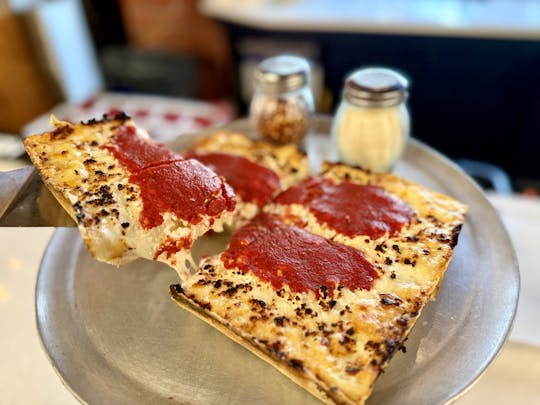
Gus Guerra pressed the first Detroit-style pizza into a forge-blue steel pan at Buddy's Rendezvous on Six Mile and Conant in 1946. The rectangular pans were borrowed from auto-parts factories where they held machine parts during shifts. The style spread to Cloverleaf (1953), Loui's (1977) and Niki's (1980); by the 2020s it had reached national chain menus while keeping its Detroit cheese-edge identity.

1980s onwards, Lebanese immigration to Dearborn

Dearborn hosts the largest Arab-American population in the US, founded around the Ford Rouge plant from the 1910s onward and expanded by Lebanese immigration after the 1975 civil war and the 1990s Iraq wars. The West Warren Avenue corridor runs Lebanese restaurants and bakeries for two miles solid. Al Ameer (1989) won the James Beard America's Classic in 2016, the first Michigan venue to do so.

2010s onwards, modern Detroit revival

Slows Bar BQ opened on Michigan Avenue in September 2005 and put Corktown back on the food map. Selden Standard (2014) won Detroit Free Press Restaurant of the Year 2015 and led the Cass Corridor revival. Standby (2015) brought serious cocktails downtown; Takoi (2016) put modern Thai in Corktown; San Morello (2018) and Marrow in the Market (2025) anchored the modern fine-dining wave.

Immigrant influences

  • Greek: Greek immigrants invented the Coney dog around 1917 (American and Lafayette Coney Island, Lafayette Boulevard). Greektown on Monroe Street hosts Pegasus Taverna (1981) and Astoria Pastry Shop (1971), the canonical Greek cluster.
  • Polish: Polish immigrants settled Hamtramck around the Dodge Main auto plant in the 1880s. New Palace Bakery (1908), Polish Village Cafe (1975) and Srodek's run the canonical pierogi, kielbasa and paczki kitchens; Paczki Day on Fat Tuesday is the city's biggest pastry day.
  • Lebanese (Dearborn): Dearborn hosts the largest Arab-American population in the US, built around the Ford Rouge plant from the 1910s. West Warren Avenue runs Lebanese kitchens for two miles; Al Ameer won the 2016 James Beard America's Classic, the first Michigan recipient.
  • Mexican: Mexicantown along Bagley Street and West Vernor Highway runs taquerias since the 1920s, anchored by Mexican Village (1958) and Honey Bee Market (1956). The Cinco de Mayo parade is the neighborhood's biggest day.
  • Yemeni: Yemeni immigration grew through the 2000s as Polish flight opened Hamtramck. Yemen Cafe on Joseph Campau anchors the city's halal counter for lamb mandi and saltah; the dish is now a Detroit signature.
  • African American Great Migration: The Great Migration brought Southern Black families to Detroit between 1910 and 1970 for auto-plant jobs. Soul food kitchens (Beans & Cornbread, now Cornbread Restaurant & Bar) and Black-owned bakeries (Good Cakes and Bakes, Lush Yummies Pie Co.) anchor the cuisine today.
  • Italian (Eastern Market and Windsor): Italian immigrants settled around Eastern Market in the 1900s; Supino Pizzeria (2008) carries the East Coast pizza tradition. Windsor's Erie Street Little Italy across the river runs cannoli and pasta bakeries with no border on weekend afternoons.

Signature innovations

  • Detroit-style pizza (1946): Gus Guerra at Buddy's Rendezvous made the first square pizza in blue-steel auto-parts pans.
  • The Coney dog (1917-1924): Greek brothers Gust and William Keros opened American and Lafayette Coney Island side by side downtown.
  • Boston cooler (Vernors over vanilla ice cream): a Detroit soda-fountain invention of the early 1900s, trademarked by Vernors in 1967.
  • Sanders bumpy cake and hot fudge cream puff: invented at Sanders Confectionery in downtown Detroit in the 1910s.
  • Eastern Market (1891): the largest historic outdoor public market in the United States, 43 acres, six sheds, still running Saturdays.
  • Paczki Day in Hamtramck: the canonical Fat Tuesday Polish bakery day, news-covered annually since the 1950s.
← Back to Detroit food guide