5 hours
From Dubai: Private Dinner in the Dunes in Mleiha
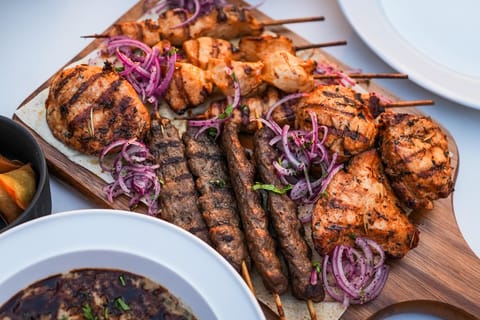
Experience the magic of the Arabian desert on a private dinner safari to Mleiha.
from$229 Check dates
How Dubai came to eat the way it does: the people, migrations and accidents that shaped the plate.
How Dubai came to eat the way it does: the people, migrations and accidents that shaped the plate.
Dubai ate off the Creek and the desert behind it. Pearl-diving crews sailed out from May to September on a diet of dates, rice, dried fish and camel milk, and the town traded that catch for Indian rice, Persian spice and Omani limes. Fresh vegetables barely existed, so the pantry that still defines Emirati cooking, loomi, cardamom, saffron and clarified butter, arrived by dhow rather than by farm.
Sheikh Maktoum bin Hasher Al Maktoum waived import and export duty around 1901 and offered merchants land, and traders left Lingah on the Persian coast for Bur Dubai rather than pay Tehran's new tariffs. They built the wind-tower houses of Al Bastakiya, named for the Bastak region they came from, and brought saffron rice, grilled fish and the flatbread-and-tea habits still sold along the Creek today.
Japanese cultured pearls and the Depression destroyed the Gulf pearl trade within a decade, and Dubai spent thirty years as a small re-export port living on smuggled gold and fish. Household cooking narrowed to what kept: harees, madrooba, machboos and salted fish, stretched with dates. Almost every dish now sold as heritage Emirati food was codified in this period of scarcity, not in a period of plenty.
Offshore surveys found the Fateh field in 1966 and the first cargo of Dubai crude shipped in September 1969. The building boom that followed drew workers from Kerala, Tamil Nadu, Punjab, Sindh and Bangladesh, and they built the city's real restaurant economy: the cafeteria, a one-window kitchen selling paratha, shawarma and karak. Ravi opened in Satwa in 1978 and is still there.
Emirates began flying in 1985 and the licensing rules that confined alcohol to hotels turned hotel basements and top floors into the city's restaurant district. Burj Al Arab opened in 1999 and the template set: an imported European or Japanese brand, a view, and an all-inclusive Friday brunch. Dining out in Dubai became something you did inside a hotel, and that geography has not changed.
Alserkal Avenue turned an Al Quoz warehouse row into the city's independent cafe and bakery district, and local operators stopped franchising other people's ideas. The Michelin Guide arrived in 2022 with eleven starred restaurants, and in May 2025 Tresind Studio and FZN by Bjorn Frantzen took three stars each, the first in the country and, for Tresind, the first for Indian cooking anywhere.
5 hours
Experience the magic of the Arabian desert on a private dinner safari to Mleiha.
Day trip · 10 hours
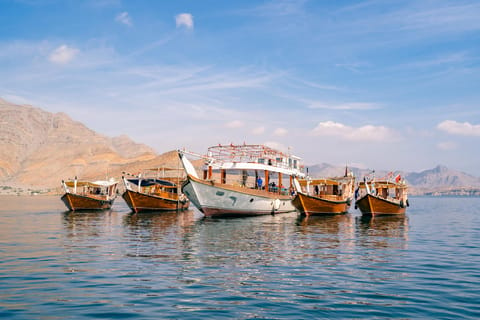
Embark on a breathtaking journey from Dubai to Oman’s stunning Musandam Peninsula with our Khasab Full-Day Dhow Cruise, now including seamless round-trip transfers (SH...
1.5 hours
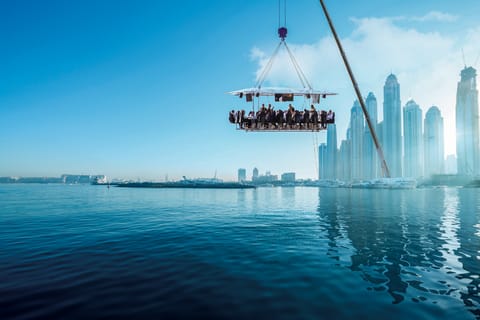
Feast on a 3-course meal of your choice 50 meters above the streets of Dubai, and enjoy a unique dining experience in the sky. Eat at a table suspended by a crane abov...