
History
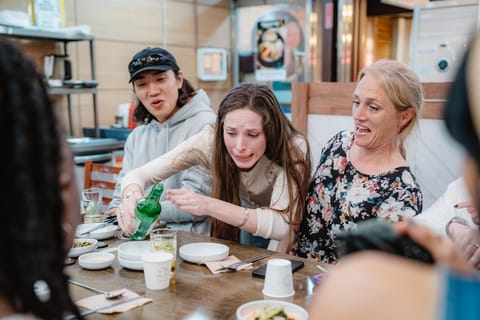
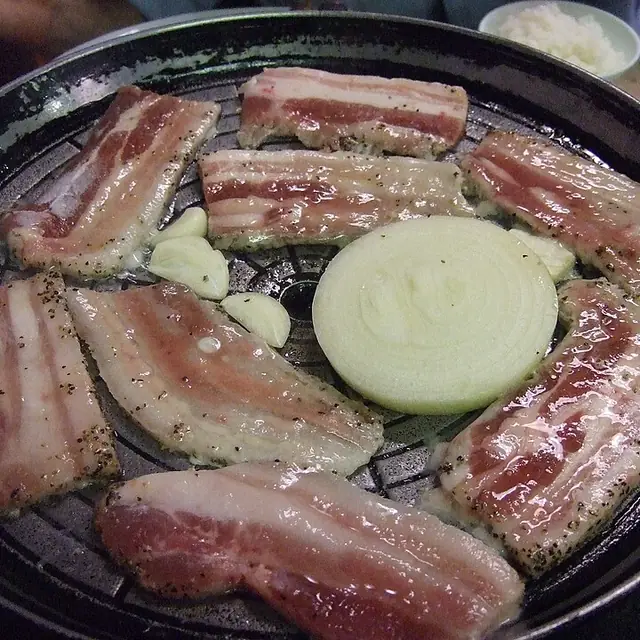
Samgyeopsal (literally three-layer flesh) refers to the three layers of fat and meat visible in a thick-cut pork belly slice. It became a staple of Korean restaurant culture in the 1980s when refrigeration made fresh pork belly widely available outside rural areas. The dish is inseparable from the social ritual of the Korean grill table: small gas burners or charcoal grills built into every table, shared with a group, the meat cut with scissors when cooked. Jeju Island's heuk dwaeji (black pork) produces a particularly celebrated samgyeopsal: the Jeju black pig, a heritage breed, has higher fat marbling and a distinctive flavour compared to mainland pork.
Book a food experience
Tours, tastings and classes from the cities on this page, bookable on GetYourGuide.

Common allergens: Sesame in dipping sauce, Soy in ssamjang
Make it at home
Ingredients
- 600g thick-cut pork belly (1.5 to 2cm thickness), skin removed
- 20 perilla leaves (or butter lettuce as substitute)
- 8 cloves garlic, thinly sliced
- 2 tablespoons doenjang (fermented soybean paste)
- 1 tablespoon gochujang
- 1 teaspoon sesame oil
- Salt and sesame oil for dipping
Method
- Make ssamjang by mixing doenjang, gochujang, sesame oil and a small amount of minced garlic. Set aside.
- Place pork belly slices on a hot grill (cast iron pan or barbecue). Cook over high heat until the fat crisps and the meat browns on both sides, about 3 to 4 minutes per side.
- Cut the cooked pork into bite-sized pieces with scissors directly on the grill.
- To eat: place a piece of pork on a perilla leaf, add a slice of garlic, a small amount of ssamjang, then wrap and eat in one bite.
- Dip some pieces into sesame oil mixed with a pinch of salt for a simpler alternative flavour.
Tip from the editors. Do not press the pork down while cooking; let the fat render naturally. The fat cap should be cooked until it crisps before you eat the first piece.
Where to eat samgyeopsal
Samgyeopsal in Seoul
Ungteori Saenggogi Hongdae ★ 4.1
Ungteori is Hongdae's busiest fresh-cut all-you-can-eat samgyeopsal house, with never-frozen pork belly and neck delivered daily and a flat-price spread.
OrderAll-you-can-eat fresh samgyeopsal and moksal grilled at the table with kimchi and lettuce wraps included.
TipThe fixed-price AYCE works out cheaper than ordering by the cut once two people split sides; come before 18:30 to skip the queue.
More places near Ungteori Saenggogi Hongdae
Not on this list, but close by, nearest first. Every one is in our guide with its address, hours and what to order.
- Pig Company Hongdae Korean BBQ, about 250 m away
- Miro Sikdang Korean, about 500 m away
- Anthracite Coffee Hapjeong (Brunch) Brunch, about 1.1 km away
- Mangwon Market Market, about 1.7 km away
- Mangwon Market Banchan Counters Korean, about 1.7 km away
- Fritz Coffee Company Dohwa (Brunch) Brunch, about 2.8 km away
More cities are in research. Want samgyeopsal covered somewhere specific? Tell us where you want to eat.