
History

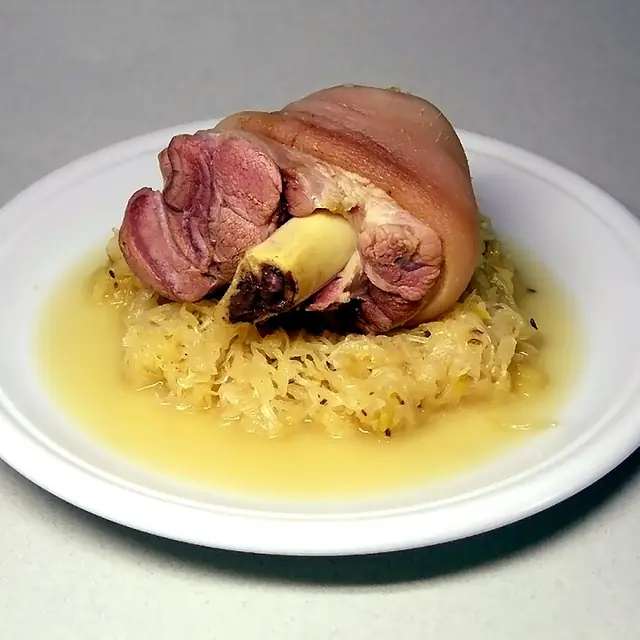
Eisbein arrived in Gdańsk with the German Hanseatic merchants during the late medieval period and survived through the Free City era between 1920 and 1939. Kubicki opened in 1918 and has refused to alter its eisbein recipe since; the dish is the room's century-long signature and the most-photographed plate on the menu. The brine cure runs 48 hours, the slow boil another four, and the finishing roast adds a crisp top. Served whole with sauerkraut, mashed peas and a dollop of mustard.

Common allergens: Gluten, Mustard

Make it at home

Yield 4Hands-on 30 minTotal 4 hr 30 minDifficulty Intermediate

Ingredients

  • 2 large pork hocks, bone in (about 1.2kg each), skin on and scored
  • 2 tbsp coarse sea salt
  • 1 tbsp caraway seeds
  • 1 tbsp whole black peppercorns
  • 6 whole allspice berries
  • 3 bay leaves
  • 2 onions, halved
  • 1 head garlic, halved horizontally
  • 1 carrot, roughly chopped
  • 500ml dark beer (Polish porter such as Żywiec Porter)
  • 2 tbsp honey
  • 2 tbsp grain mustard
  • 1 tsp ground caraway
  • 800g sauerkraut, drained
  • 800g floury potatoes, boiled and mashed with butter, to serve
  • Grain mustard and horseradish, to serve

Method

  1. Rub the hocks all over with the salt and refrigerate uncovered overnight to dry the skin.
  2. Rinse off the salt and pat dry. Place the hocks in a large pot with the caraway seeds, peppercorns, allspice, bay, onions, garlic and carrot. Cover with cold water.
  3. Bring to a bare simmer and poach gently for 2 1/2 hours until a skewer slides easily into the meat. Lift out and reserve 250ml of the cooking liquor.
  4. Heat the oven to 200C. Place the hocks in a roasting tin, skin-side up. Pour the beer and the reserved cooking liquor into the tin around the meat.
  5. Whisk the honey, grain mustard and ground caraway and brush over the skin.
  6. Roast for 60 to 75 minutes, basting every 15 minutes with the beer-honey juices, until the skin is deep mahogany and crackling.
  7. While the hocks roast, simmer the sauerkraut gently in a pan for 25 minutes with a ladle of the cooking liquor and a teaspoon of caraway.
  8. Rest the hocks 10 minutes. Slice the meat from the bone in thick slabs.
  9. Plate with the sauerkraut, mashed potato, a spoon of grain mustard and grated horseradish on the side. Pour over the reduced pan juices.

Tip from the editors. Skin-on, bone-in golonka is non-negotiable; the skin renders the lacquer and the bone enriches the braise. Polish porter beats lager every time for the dark colour and toffee notes.

Where to eat eisbein (pork knuckle)

Eisbein (Pork knuckle) in Gdańsk

Restauracja Kubicki ★ 4.3

Polish$$main-town

Restauracja Kubicki in Gdańsk has run since 1918 on Wartka Street, the oldest surviving room in town. Book the window tables for the Motława view at sunset.

Signature: Eisbein (pork knuckle), Marinated matias herring

Order: The eisbein, the kitchen's century-old never-altered dish.

Tip: Book the window tables for the Motława view at sunset Walk-ins usually OK.

Goldwasser ★ 4.1

Polish$$main-town

Goldwasser in Gdańsk sits in a 15th-century tenement on Długie Pobrzeże, named for the liqueur first distilled in the city in 1598. Located in Main Town.

Signature: Duck, Edible-gold steak

Order: Duck with red cabbage, with a glass of Original Danziger Goldwasser as the closer.

Tip: The Motława-side terrace from May to September is the best seat in the room.

Brovarnia ★ 4.8

BreweryTraditional Pomeranian pils, dark and seasonal$$Sun-Thu 13:00-23:00; Fri-Sat 13:00-24:00Mon-Sun 12:00-23:00

Brovarnia in Gdańsk is the oldest active brewery in Pomerania, inside Hotel Gdańsk's 17th-century granary on Szafarnia. Booking recommended.

Tip: Brewery tours run by request; ask reception when you book the restaurant.

More cities are in research. Want eisbein (pork knuckle) covered somewhere specific? Tell us where you want to eat.

Browse all dishes →