
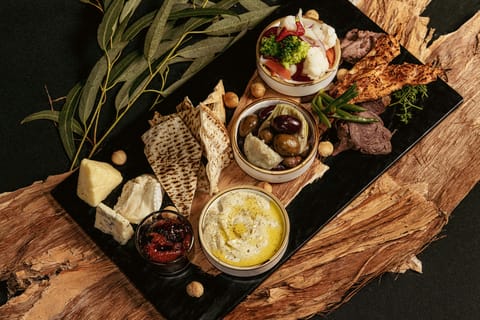
History
Sydney's Bayswater Brasserie, opened in 1982, is arguably the first Modern Australian restaurant, and the term first appeared in print in the 1993 Sydney Morning Herald Good Food Guide. Tetsuya Wakuda opened Tetsuya's in Rozelle in 1989 and moved it to the city in 2000; it closed after a final service on 31 July 2024. Peter Gilmore cooked at Quay from 2001 until it closed on 14 February 2026. Saint Peter, opened by Josh Niland on Oxford Street in 2016, now serves a ten-course dinner menu at the Grand National Hotel.
Book a food experience
Tours, tastings and classes that match this page, bookable on GetYourGuide.

Common allergens: Various (per menu)
Make it at home
Ingredients
- Native dukkah for the table: 50g hazelnuts, 1 tbsp coriander seeds, 1 tbsp sesame seeds, 1 tsp wattleseed, 1 tsp lemon myrtle powder, 0.5 tsp native pepperberry, salt
- First course (oyster): 12 Sydney rock oysters with finger lime pearls
- Main course (lamb): 800g rack of Mulwarra lamb, native pepperberry crust
- Crust: 2 tbsp native pepperberry, 1 tsp wattleseed, 1 tbsp Dijon, 50g panko, 2 tbsp olive oil
- Pan accompaniment: 200g saltbush leaves, blistered in olive oil
- Dessert: 4 native finger limes, 200g good vanilla ice cream, 50g toasted muntries (native cranberry)
Method
- For the dukkah: toast hazelnuts, coriander and sesame in a dry pan until fragrant. Cool, then pulse in a processor with wattleseed, lemon myrtle and pepperberry. Season.
- Open the oysters and serve on crushed ice with finger lime pearls.
- Heat the oven to 200 degrees Celsius. Pulse the pepperberry, wattleseed, Dijon, panko and olive oil into a paste.
- Sear the lamb rack in a hot pan, then spread the native-ingredient crust over the meat side.
- Roast for 18-22 minutes for medium-rare (internal 55 degrees Celsius). Rest for 8 minutes.
- Blister the saltbush in olive oil for 30 seconds until just wilted.
- Slice the rack, sprinkle with dukkah, serve over the saltbush.
- For dessert, halve the finger limes, scoop the pearls over the ice cream, scatter with toasted muntries.
Tip from the editors. Wattleseed and lemon myrtle powder are sold by specialist native-food suppliers; the dukkah keeps in a jar for two weeks and lifts any cheese board.
Where to eat modern australian tasting menu
Modern Australian Tasting Menu in Sydney
Saint Peter ★ 4.8
Saint Peter is a seafood restaurant at 161 Underwood Street, Paddington, with three hats in the Good Food Guide and a bar for drop-in meals.
BookReleased six months in advance, new availability daily ahead
More places near Saint Peter
Not on this list, but close by, nearest first. Every one is in our guide with its address, hours and what to order.
- Fred's Modern European, about 150 m away
- 10 William Street Italian, about 250 m away
- Porcine French, about 400 m away
- Christo's Five Way Pizzeria Pizza, about 600 m away
- Bills Darlinghurst All-day Breakfast, about 1.2 km away
- Bills Ricotta Hotcakes Budget eating, about 1.2 km away
More cities are in research. Want modern australian tasting menu covered somewhere specific? Tell us where you want to eat.