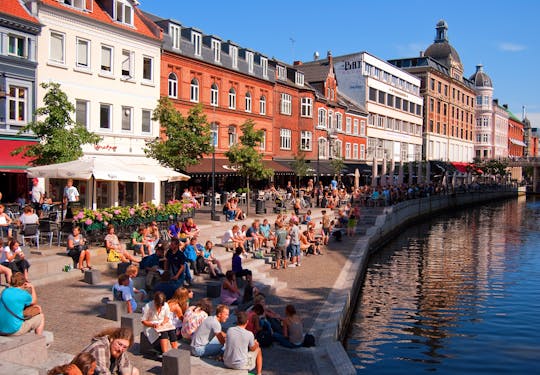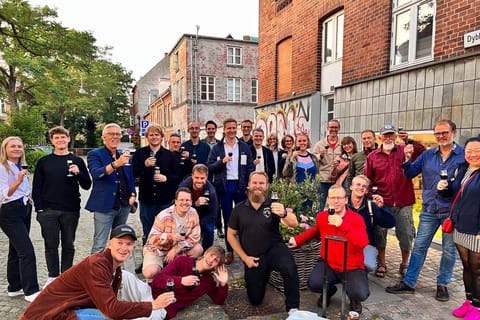
How Aarhus came to eat the way it does: the people, migrations and accidents that shaped the plate.
Key eras
Viking Age to 1200s: rye bread and the Baltic trade
The Aarhus settlement (Aros) was a trading post on the Jutland peninsula where fish, grain and salted meat moved along the Baltic coast. Rye bread baked on flat stones was the staple of the inland Jutland diet; the estuary provided herring and eel that were salted and traded north.
1400s to 1700s: guild kitchens and the Latin Quarter
The establishment of Aarhus Cathedral and its surrounding Latin Quarter brought ecclesiastical kitchens and merchant guild halls to the streets now covered by Latinerkvarteret. The first konditorier (pastry shops) and bakers established themselves on Guldsmedgade and Klostergade in the 16th century.
1800s: the open-face sandwich becomes an institution
The smørrebrød tradition codified in the 19th century as the industrial working class needed portable, filling lunches. The dark rye bread topped with pickled herring, leverpostej, roast beef or fried fish became the defining meal of Jutland urban life and remains the most culturally loaded food in Aarhus.
1898 to 1950: Schweizerbageriet and the konditori era
Schweizerbageriet opened in 1898 on M.P. Bruuns Gade and became the anchor of the Aarhus pastry tradition. The wienerbrød, kanelsnurre and lagkage it produced shaped the Danish pastry canon as much as any Copenhagen bakery. The konditori culture peaked in the post-war decade when every neighbourhood had a cake shop.
1990: the first microbrewery opens
Bryggeriet Sct. Clemens opened in 1990 in a medieval cellar beneath the Latin Quarter, becoming Denmark's first modern brewpub. It preceded the national craft beer wave by 15 years and established Aarhus as a brewing city before the movement had a name.
2015 to 2022: Aarhus joins the Michelin map
Wassim Hallal took over Frederikshøj in 2009 and earned its first Michelin star in 2015, with a second star arriving in 2022 to make it the only two-star restaurant in Aarhus. Substans had also held one Michelin star from 2015, and Domestic earned its first star in 2017, establishing the city as Denmark's second Michelin cluster after Copenhagen.
2012: La Cabra and the specialty coffee revolution
La Cabra opened in the Latin Quarter in 2012 and became the most influential specialty coffee roaster in Denmark. The light Nordic roast style it championed, combined with direct-trade sourcing and barista competition success, made Aarhus a global reference point for specialty coffee culture and seeded a dozen successor cafes across the city.
2016 to present: street food, fermentation and the Green Star generation
Aarhus Street Food opened in the repurposed bus garage on Ny Banegårdsgade in August 2016 and democratised the city's food scene. Haervaerk earned a Michelin Green Star for its fermentation-led zero-waste kitchen. Restaurant Moment and Gastrome reinforced the Michelin landscape outside the city centre. The Food Festival grew to become Scandinavia's largest food event by 2019.
Immigrant influences
- Palestinian and Middle Eastern (from 1980s): The Palestinian community in Aarhus, many arriving from the 1980s onwards, established the falafel and shawarma culture that now feeds the city at lunch. Faour on Klostergade is the most prominent expression of this tradition; Bazar Vest in Brabrand is the larger marketplace setting where Middle Eastern food culture is most visible.
- Turkish (from 1970s): Turkish labour migration to Aarhus in the 1970s brought the doner kebab and the lahmacun to Jutland. The Turkish bakers and grocers at Bazar Vest are the most visible legacy; the doner kebab is now the city's dominant late-night street food.
- Vietnamese (from 1980s): A Vietnamese refugee community arrived in Aarhus in the late 1970s and early 1980s and established the first Asian restaurants in the city. The pho tradition represented by Pho C&P on Sonder Alle is the most direct living legacy.
- Somali (from 1990s): Somali immigration from the 1990s brought sambusa, canjeero and spiced rice preparations to Aarhus. The Somali food stalls at Bazar Vest are the most accessible expression of this cuisine in the city.
Signature innovations
- La Cabra's 2012 Nordic light roast methodology, which redefined specialty coffee in Denmark and influenced the global Scandinavian roast movement
- Bryggeriet Sct. Clemens (1990), Denmark's first modern brewpub, launching the craft beer wave in Jutland
- Haervaerk's fermentation-centred zero-waste kitchen, earning the Michelin Green Star and establishing Aarhus as a reference for sustainability in fine dining
- The Aarhus Food Festival at Tangkrogen, scaled to become Scandinavia's largest food gathering by combining professional gastronomy with public food culture
- Domestic's New Nordic tasting menu using exclusively Danish and Scandinavian ingredients, pushing the locavore principle further than most Michelin-starred kitchens in the world