Yucatecan cuisine is one of Mexico's most distinct regional kitchens, formed over centuries of Mayan, Spanish, Lebanese, and Caribbean exchange on a flat limestone peninsula that for most of its history had stronger trade links to Havana and New Orleans than to Mexico City. The flavor signature is unmistakable: sour orange (naranja agria), achiote paste, banana leaf, recado spice mixes, and the habanero chile, which is endemic here and almost unused elsewhere in Mexico.
The techniques tell the same story. Pib, the underground pit oven inherited from the Maya, slow-cooks pork wrapped in banana leaf into the peninsula's most famous dish. Recados, paste-form spice blends in red, black, and other colors, do the work that mole does in central Mexico. Lime soup, sopa de lima, builds a citrus broth that exists nowhere else in the country.
Merida is the capital of the cuisine and the easiest place to encounter it at every level, from market loncherias serving panuchos for breakfast to the modern dining rooms of Roberto Solis at Nectar and Pablo Salas's regional projects. Valladolid, Campeche, and the smaller pueblos all hold their own variants. Outside the peninsula, Yucatecan food appears occasionally in Mexico City and Los Angeles, but the cuisine is so tied to the local citrus, the local chile, and the local cook that it rarely travels intact.
Book a food experience
Tours, tastings and classes from the cities on this page, bookable on GetYourGuide.
Embark on an exciting bus ride to the local home and learn how to cook up a traditional menu. Visit the main market to pick out fresh ingredients for...
Taste Mexico. Eat like a local.
The original Cancun food tour. The Taco Attack takes you through Downtown Cancun's most authentic flavors, morning or...
Chef Bruce Ucan's Mayan Cafe in Louisville cooks Yucatecan plates with Kentucky farm produce, the East Market NuLu room locals recommend to first-timers.
OrderThe tok-sel lima beans wok-seared with pumpkin seeds, the dish locals rave about.
TipBook on Resy. The new patio bar takes walk-ins for a quick plate and a mezcal before dinner service.
Chef Gilberto Cetina's Chichen Itza in Mercado La Paloma, Los Angeles serves Yucatecan dishes from a market counter. At 3655 S Grand Ave. Booking recommended.
Why locals goYucatecan cooking from a counter inside a market most tourists pass by. The cochinita pibil panuchos cost less than $12 and are the city's reference.
TipCloses at 17:00 daily, no dinner; come at 12:30 weekdays when there is no line and the cochinita has just come off the rotisserie.
Lonchería El Pocito on Calle 31 Norte in Cancún cooks Yucatecan home dishes such as poc chuc, panuchos, sopa de lima and queso relleno from a chalkboard menu.
OrderQueso relleno in tomato broth, papadzules, and the black-bean and pork tamal.
TipLunch crowds clear the chalkboard, so arrive early; the restaurant opened in 1988 under the name La Cabañita.
La Barra de Huniik is the chef's-counter sibling at Roberto Solís's Huniik in Mérida, a six-seat omakase-style room, one Michelin star plus Service Award.
SignatureChef's-counter tasting, Yucatecan small plates, Mezcal pairings
Chef Bruce Ucan's Mayan Cafe in Louisville cooks Yucatecan plates with Kentucky farm produce, the East Market NuLu room locals recommend to first-timers.
OrderThe tok-sel lima beans wok-seared with pumpkin seeds, the dish locals rave about.
TipBook on Resy. The new patio bar takes walk-ins for a quick plate and a mezcal before dinner service.
Chef Gilberto Cetina's Chichen Itza in Mercado La Paloma, Los Angeles serves Yucatecan dishes from a market counter. At 3655 S Grand Ave. Booking recommended.
Why locals goYucatecan cooking from a counter inside a market most tourists pass by. The cochinita pibil panuchos cost less than $12 and are the city's reference.
TipCloses at 17:00 daily, no dinner; come at 12:30 weekdays when there is no line and the cochinita has just come off the rotisserie.
Lonchería El Pocito on Calle 31 Norte in Cancún cooks Yucatecan home dishes such as poc chuc, panuchos, sopa de lima and queso relleno from a chalkboard menu.
OrderQueso relleno in tomato broth, papadzules, and the black-bean and pork tamal.
TipLunch crowds clear the chalkboard, so arrive early; the restaurant opened in 1988 under the name La Cabañita.
TUCH Cantina Yucateca on Avenida Huayacán in Cancún serves Yucatecan plates and drinks, with live music Wednesday to Sunday and botana free with each drink.
OrderA cantarito de tequila with the free botana, then cochinita pibil or panuchos from the menu.
DrinkCantarito de tequila
FoodFree botana with every drink
TipThe botana arrives free with your drinks, so order drinks first; the cantina opens at 13:00 every day and runs to 02:00.
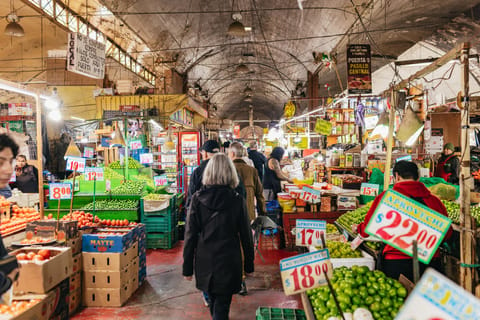
Mercado 23 fondas are the lunch counters of the Mercado Javier Rojo Gómez in downtown Cancún, cooking cochinita pibil, salbutes, papadzules and relleno negro.
OrderCochinita pibil tacos or a plate of salbutes, then papadzules or relleno negro if the fonda has them.
TipGo between 08:00 and 11:00, when the best food is served; the market slows down by 14:00. Bring small peso notes.
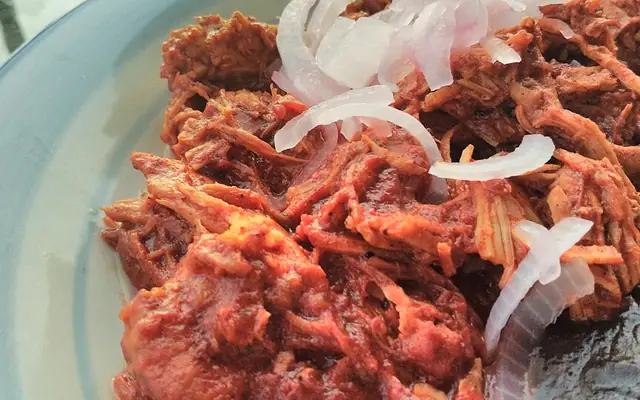
Pork shoulder marinated in achiote and sour orange, wrapped in banana leaf, slow-roasted in a pib (underground pit). Served shredded with pickled red onion (cebolla morada) and habanero salsa, often on a soft corn tortilla.
Sopa de lima
Bright citrus broth made with charred lima agria (a peninsula-specific lime), shredded turkey or chicken, and crisp tortilla strips. The defining Yucatecan soup.
Panuchos
Refried-bean-stuffed fried tortillas topped with cochinita or turkey, pickled red onion, avocado, and habanero. The peninsula breakfast and street snack.
Salbutes
Puffed fried tortillas topped with shredded turkey or chicken, lettuce, tomato, avocado, and pickled onion. The Yucatecan cousin of the panucho, without the bean filling.
Poc chuc
Pork loin marinated in sour orange and grilled over charcoal, served with pickled onion, black beans, rice, and tortillas. The grill counterpart to cochinita.
Papadzules
Soft corn tortillas filled with hard-boiled egg, bathed in a pumpkin-seed (pepita) sauce, topped with tomato salsa. A pre-Columbian dish older than the Spanish arrival.
Queso relleno
Hollowed Edam (Dutch) cheese stuffed with seasoned ground meat (picadillo), served with two sauces: a tomato kol and a white kol. A Caribbean-Dutch-Mayan fusion dish unique to the region.
Relleno negro
Turkey or pork in a deep-black sauce of charred chiles (chilmole or recado negro), spices, and stuffing. The black recado is the most labor-intensive of the Yucatecan spice pastes.
Huevos motulenos
Fried eggs on a tortilla with black bean puree, ham, peas, tomato sauce, and queso fresco. The defining Yucatecan breakfast, named for the town of Motul.
How to order
At a Merida loncheria or market stall, panuchos and salbutes by the half-dozen, a sopa de lima for the table, and a horchata or aguas frescas. At a sit-down restaurant, cochinita pibil and poc chuc are the diagnostic orders: a good Yucatecan kitchen will get both right. Order pickled red onion (cebolla morada) and a habanero salsa (xnipec, the Yucatecan habanero-sour-orange salsa) alongside everything. The cuisine is rarely soup-and-main; it's small plates and shared mains.
The rookie mistake is treating habanero as Mexican-generic spice. It's much hotter than the central Mexican chiles (300,000-plus Scoville units versus the jalapeno at 5,000) and used as a condiment, not a sauce-base. A tiny spoonful of xnipec is plenty. The other mistake is asking for cochinita pibil outside Sunday morning: traditionally it's a Sunday dish, although tourist-facing Merida restaurants serve it daily.
What to drink with it
Cerveza is the workhorse pour, especially Montejo, the local Yucatecan lager. Mezcal travels from Oaxaca but isn't the regional spirit. Xtabentun, a Mayan anise-and-honey liqueur (the only spirit traditional to the peninsula), is the after-dinner drink. Horchata, agua de chaya (made from the chaya leaf, a Mayan green), and agua de jamaica (hibiscus) are the universal non-alcoholic pours. Wine is not a Yucatecan tradition, although modern Merida rooms (Nectar, Kuuk) hold serious pairings drawn from Baja and beyond.
Where to eat it
Merida is the only city to eat Yucatecan cooking at every tier, from market stalls (Mercado Lucas de Galvez, Santiago neighborhood loncherias) to mid-tier rooms (La Chaya Maya, Los Almendros, Manjar Blanco) to the modern fine-dining cohort (Nectar, Kuuk, Roberto Solis projects). Valladolid and Campeche hold regional variants. Outside the peninsula, Yuc in Mexico City and a handful of LA-area Yucatecan rooms (Chichen Itza Restaurant in LA's MacArthur Park is the most-recognized stateside) carry the cuisine.
A short history
Yucatecan cuisine descends from the Maya civilization, the Spanish conquest (1542), and 19th-century Lebanese and Cuban immigration. The peninsula's isolation from the rest of Mexico, by jungle and by political history, preserved a kitchen closer to its Mayan roots than any other Mexican regional cuisine. The cochinita pibil and the pib oven are direct Mayan inheritances. UNESCO's 2010 inscription of Mexican cuisine specifically called out Yucatecan cooking as one of the most distinct regional kitchens.
Frequently asked
Is Yucatecan food the same as Mexican food?
It's a Mexican regional cuisine, but distinct enough that locals often distinguish it. The chile is habanero, not jalapeno or chipotle; the marinade base is sour orange and achiote, not chipotle or pasilla; the cooking method is pit-oven, not griddle; the citrus and Mayan ingredients (chaya, hoja de platano) are specific to the peninsula.
What is achiote?
A spice paste made from annatto seeds, native to the Yucatan and tropical Americas. It gives cochinita pibil and recado rojo their bright red-orange color and a mild, earthy flavor. Sold as solid bricks in markets; mixed with sour orange and spices to make the marinade.
Why is habanero used here and almost nowhere else in Mexico?
The habanero is the native chile of the Yucatan and Caribbean. Its heat (10 to 50 times that of a jalapeno) and fruity-floral notes match the citrus-and-achiote palette of Yucatecan cooking. Central Mexican cuisine evolved with different native chiles (poblano, ancho, chipotle, pasilla) and rarely uses habanero.