


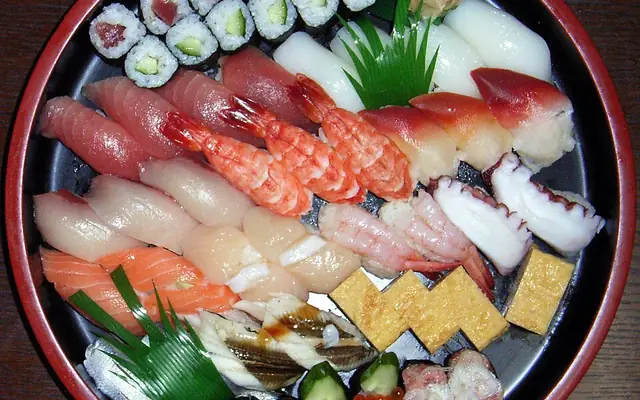
Sushi is one dish in name and a hundred in practice. The defining element is shari (vinegared rice), not the fish; the rice's temperature, vinegar blend, sugar level, and salt are the chef's signature, and a sushi shokunin (artisan) may train for ten years before being trusted to make rice on their own. The fish (neta) is butchered, aged, cured, or seared as the season and species demand. The wasabi is grated fresh from the rhizome. Soy is brushed by the chef. Each piece is engineered.
The modern global sushi tradition is descended from edomae, the Tokyo style that emerged in the early 19th century when Edo (now Tokyo) fishmongers began curing fish in salt, vinegar, and soy to preserve it before refrigeration. Edomae sushi is hand-formed nigiri served at a counter, with the chef placing each piece directly in front of the diner. The older Kansai style, oshizushi, presses sushi in wooden molds rather than shaping by hand and is rarer outside Osaka and Kyoto.
The sushi counter at a serious omakase shop is the most concentrated food experience in Japan. Twelve to twenty pieces, paced over 60 to 90 minutes, no menu, no choice, no English needed. The chef reads the diner's eating speed and adjusts. The bill at a top Tokyo counter can run 30000 to 80000 yen per person; the experience is closer to a kaiseki than to the conveyor-belt sushi most travelers know.
Book a food experience
Tours, tastings and classes that match this page, bookable on GetYourGuide.
Top picks
The best-scored Japanese sushi place in each of 12 cities.
Sushi Miyakawa ★ 4.9
Sushi Miyakawa is a Japanese sushi restaurant at Chuo-ku, Sapporo 064-0824, Japan, with two seatings, 17:00 and 19:30. The course takes about two hours.
OrderThe set course, which takes about two hours.
TipReservations open at 11:00 on the first business day of each month, up to the end of the next month; foreign visitors can book via TABLEALL.
Hoze ★ 4.9
Hoze is a six-seat sushi counter at Stigbergsliden 17 serving an omakase of six otsumami, 10-11 morsels of sushi, miso soup and a baked custard egg.
OrderThe omakase, from six otsumami to sushi, miso soup and tamago.
TipThe omakase starts at 17:45 unless stated otherwise, so please be on time for your seating.
Yoshitomo ★ 4.9
Yoshitomo is an upscale neighborhood sushi restaurant in Omaha's Benson district serving Japanese small plates, nigiri and maki sushi with sake and beer.
OrderNigiri or maki sushi, paired with something from the extensive Japanese sake list.
Takashi ★ 4.9
Takashi is a Japanese sushi restaurant at 18 W Market St that takes limited reservations for large parties and otherwise seats guests first come-first serve.
SignatureOmakase nigiri, Tempura
TipReservation spots normally fill up a week in advance, so call 801-519-9595 to check availability.
Pavilion ★ 4.9
Pavilion is a Japanese sushi restaurant at 5201 Shaw Ave, St. Louis, MO 63110.
Sukiyabashi Jiro Honten ★ 4.8
Sukiyabashi Jiro Main Shop is in the basement of the Tsukamoto Sogyo Building at 4-2-15 Ginza, Chuo-ku, Tokyo, where it was founded in 1965.
BookHotel concierge only ahead
TipReservations are taken by phone, and overseas guests can only book through the concierge of the hotel where they are staying.
Sushi Masuda ★ 4.8
Sushi Masuda is a six-seat omakase sushi counter in Oceanic Plaza at 1066 West Hastings Street, open Wednesday to Sunday evenings, with free parking.
TipReservations open on the 1st of every month at 5:00pm PST for the following month; the course is for ages 13 and up.
Kosen 1 ★ ★ 4.8
Kosen at 307 W Palm Ave in Tampa Heights is a Michelin-Starred omakase restaurant, offering a refined Japanese 20+ course experience at a 12-seat counter.
OrderOmakase nigiri such as ishidai topped with house-made kosho and kombu-cured red rockfish.
TipTantō, the Japanese-inspired cocktail lounge, is tucked away alongside the 12-seat chef's counter.
Hiden 1 ★ ★ 4.8
Hiden is a Japanese omakase counter at 313 NW 25th St in Wynwood, run by Chef Seijun Okano and hidden behind a door with a time-sensitive passcode.
OrderChef Seijun Okano's omakase, with fish flown in from Japan pressed into vinegar-tinged rice.
TipThe front door is not easy to find and slides open only with a time-sensitive passcode, so confirm how to get in before you go.
Wataru ★ 4.8
Wataru at 2400 NE 65th St in Seattle's Ravenna is an 8-seat omakase counter serving typically around 17 courses, seated at 4:30 PM and 7:30 PM.
Why locals goWataru is on the ground floor of the Saxe Building in Ravenna, with a restrained wood sushi bar and décor rarely seen in the United States.
TipReservations open at 12:00 AM on the 1st of each month for the following month; the 4:30 PM seating is generally easier to book than the 7:30 PM.
Mujo ★ 4.8
Mujō is an omakase-only, one MICHELIN star edomae-style sushiya at 691 14th St NW Suite C, with a daily-changing menu and fish flown in directly from Japan.
OrderSmall plates followed by a progression of seasonal nigiri.
TipReservations are released 1 month in advance at 10am on the first day of the month, via OpenTable; allow approximately 2.5 hours for dinner.
Sushi Den ★ 4.8
Sushi Den is a sushi and Japanese restaurant at 1487 South Pearl St, open since Christmas 1984, with fish directly sourced from the Japanese fish market.
OrderThe set course sushi at the counter: 12 pieces of premium Catch of the Day fish.
TipWalk-ins are welcome, and the set course dinner is served only at the sushi counter, with no reservations and no substitutions.
Find a place
Sushi Miyakawa ★ 4.9
Sushi Miyakawa is a Japanese sushi restaurant at Chuo-ku, Sapporo 064-0824, Japan, with two seatings, 17:00 and 19:30. The course takes about two hours.
OrderThe set course, which takes about two hours.
TipReservations open at 11:00 on the first business day of each month, up to the end of the next month; foreign visitors can book via TABLEALL.
Hoze ★ 4.9
Hoze is a six-seat sushi counter at Stigbergsliden 17 serving an omakase of six otsumami, 10-11 morsels of sushi, miso soup and a baked custard egg.
OrderThe omakase, from six otsumami to sushi, miso soup and tamago.
TipThe omakase starts at 17:45 unless stated otherwise, so please be on time for your seating.
Yoshitomo ★ 4.9
Yoshitomo is an upscale neighborhood sushi restaurant in Omaha's Benson district serving Japanese small plates, nigiri and maki sushi with sake and beer.
OrderNigiri or maki sushi, paired with something from the extensive Japanese sake list.
Takashi ★ 4.9
Takashi is a Japanese sushi restaurant at 18 W Market St that takes limited reservations for large parties and otherwise seats guests first come-first serve.
SignatureOmakase nigiri, Tempura
TipReservation spots normally fill up a week in advance, so call 801-519-9595 to check availability.
Pavilion ★ 4.9
Pavilion is a Japanese sushi restaurant at 5201 Shaw Ave, St. Louis, MO 63110.
Sukiyabashi Jiro Honten ★ 4.8
Sukiyabashi Jiro Main Shop is in the basement of the Tsukamoto Sogyo Building at 4-2-15 Ginza, Chuo-ku, Tokyo, where it was founded in 1965.
BookHotel concierge only ahead
TipReservations are taken by phone, and overseas guests can only book through the concierge of the hotel where they are staying.
Sushi Masuda ★ 4.8
Sushi Masuda is a six-seat omakase sushi counter in Oceanic Plaza at 1066 West Hastings Street, open Wednesday to Sunday evenings, with free parking.
TipReservations open on the 1st of every month at 5:00pm PST for the following month; the course is for ages 13 and up.
Masayoshi 1 ★ ★ 4.8
Masayoshi is a Michelin-starred omakase sushi restaurant at 4376 Fraser Street, with 24 seats and seatings at 6pm and 8:30pm Monday to Saturday.
OrderThe nigiri omakase, about 20 courses: $260 at the sushi bar, $245 at a table.
TipBook the sushi bar for an unobstructed view of Chef Masayoshi at work; changes need at least 3 days notice.
Kosen 1 ★ ★ 4.8
Kosen at 307 W Palm Ave in Tampa Heights is a Michelin-Starred omakase restaurant, offering a refined Japanese 20+ course experience at a 12-seat counter.
OrderOmakase nigiri such as ishidai topped with house-made kosho and kombu-cured red rockfish.
TipTantō, the Japanese-inspired cocktail lounge, is tucked away alongside the 12-seat chef's counter.
Koya 1 ★ ★ 4.8
Koya at 807 W Platt St is an intimate 8-seat tasting-menu-only restaurant by Noble Rice, with bluefin tuna and uni flown in weekly from Toyosu Market.
OrderThe tasting menu, including the A5 olive wagyu with fried capers and aged parmesan.
TipReservations open on the 15th at 10:00am each month for the following month; see the Tock Reservation page for dates and times.
Hiden 1 ★ ★ 4.8
Hiden is a Japanese omakase counter at 313 NW 25th St in Wynwood, run by Chef Seijun Okano and hidden behind a door with a time-sensitive passcode.
OrderChef Seijun Okano's omakase, with fish flown in from Japan pressed into vinegar-tinged rice.
TipThe front door is not easy to find and slides open only with a time-sensitive passcode, so confirm how to get in before you go.
Naoe ★ 4.8
Naoe is an intimate 5-seat omakase restaurant at 661 Brickell Key Dr, located off to the side of the center of Miami on the island of Brickell Key.
Book6 to 8 weeks ahead
TipAdvanced reservations are required, and you park in the Courvoisier Centre garage, where Naoe validates the first three hours.
Wataru ★ 4.8
Wataru at 2400 NE 65th St in Seattle's Ravenna is an 8-seat omakase counter serving typically around 17 courses, seated at 4:30 PM and 7:30 PM.
Why locals goWataru is on the ground floor of the Saxe Building in Ravenna, with a restrained wood sushi bar and décor rarely seen in the United States.
TipReservations open at 12:00 AM on the 1st of each month for the following month; the 4:30 PM seating is generally easier to book than the 7:30 PM.
Mujo ★ 4.8
Mujō is an omakase-only, one MICHELIN star edomae-style sushiya at 691 14th St NW Suite C, with a daily-changing menu and fish flown in directly from Japan.
OrderSmall plates followed by a progression of seasonal nigiri.
TipReservations are released 1 month in advance at 10am on the first day of the month, via OpenTable; allow approximately 2.5 hours for dinner.
Sushi Den ★ 4.8
Sushi Den is a sushi and Japanese restaurant at 1487 South Pearl St, open since Christmas 1984, with fish directly sourced from the Japanese fish market.
OrderThe set course sushi at the counter: 12 pieces of premium Catch of the Day fish.
TipWalk-ins are welcome, and the set course dinner is served only at the sushi counter, with no reservations and no substitutions.
Sushi Sakai ★ 4.8
Sushi Sakai is an Edomae sushi restaurant at 3-20 Nishinakasu in Fukuoka, awarded three stars by the Michelin Guide, seating up to twelve guests.
OrderThe chef's course of twelve sushi and eight appetizers.
TipClosed Sundays, Mondays and national holidays. Reserve through the restaurant's own reservations page.
Soichi Sushi ★ 4.8
Soichi Sushi is a Japanese omakase restaurant at 2121 Adams Ave, open Wednesday to Sunday evenings, with a meal customized for each guest by Chef Soichi.
SignatureOmakase, Local yellowtail sashimi, Hokkaido scallop
TipOpen Wednesday to Sunday from 4:30 PM to 9:30 PM; physical cards or digital certificates can be bought online or in-store.
Ichiban ★ 4.8
Ichiban Sushi & Japanese Cuisine at 1449 University Ave in Hillcrest is a Japanese owned and operated restaurant serving authentic dishes since 1981.
OrderFresh sushi, sashimi and specialty rolls
TipThe 7 day a week Happy Hour sushi is a crowd favorite, with selected special rolls 1/2 off including the California Roll.
Fumiki's Sushi Kappo ★ 4.8
Fumiki's in Robertson seats just 8 at its counter for a seasonal omakase course of around 18 dishes, joining Kyoto kaiseki with Edomae sushi.
Why locals goAn 8 seat counter in a shop at 17 Barrett Street, Robertson, serving courses only, with full upfront payment required to reserve seats.
Uptown Sushi ★ 4.8
Uptown Sushi at 1131-14 Uptown Park Blvd is a sushi restaurant at the corner of Interstate 610 S. and Post Oak Blvd., with rolls from Spicy Tuna to Godzilla.
OrderThe Dragon Roll or the Spicy Tuna Roll.
Poke Fresh ★ 4.8
Poke Fresh at 507 Dallas St offers poke bowls, sushi, ramen and bubble tea, with each poke bowl fully customizable, plus a modern, colorful kitchen.
Why locals goA modern and colorful kitchen serving poke bowls, ramen, sushi and sashimi plus smoothies and desserts.
TipOpen weekdays only, 09:00 to 18:30, and closed on Saturday and Sunday.
Kadence 1 ★ ★ 4.8
Kadence is an eight-seat sushi and kappo omakase counter in Orlando's Audubon Park, run by Mark and Jennifer Berdin and given a Michelin Star in 2025.
Royal Sushi & Izakaya ★ 4.8
Royal Sushi & Izakaya is a Japanese spot at 780-782 S 2nd St with fried, steamed, seared and raw dishes and an omakase counter hidden in the back.
OrderHamachi with ponzu, grilled cod, or a chirashi bowl.
TipThe Michelin Guide calls the izakaya walk-in only, so hope for a booth or bar seat; reservations are available on Resy.
Sushi Sho Hawaii ★ 4.8
Sushi Sho Hawaii, at 383 Kalaimoku Street in The Ritz-Carlton Residences, serves omakase sushi where edomae-style techniques meet Hawaiian ingredients.
OrderThe omakase sushi, in the edomae style with Hawaiian ingredients.
TipJapanese sake selected by the Chef is offered to pair with the courses. To book a table, call +1 808-729-9717.
Kuromon Sushi ★ 4.8
Kuromon Sushi at 6976 Collins Ave is a neighborhood sushi bar inspired by Osaka's Kuromon Market, serving fresh, honest sushi without the luxury price tag.
Why locals goA local spot serving fresh ingredients, precise cuts and real flavor, without the luxury price tag of a typical sushi bar.
TipFresh rolls are easy to carry, so grab them to go for a day under the sun, or settle in for a date night.
Sushi Harasho 2 ★ ★ 4.8
Sushi Harasho in Uehonmachi has 2 Michelin stars and a single course of 6 or 7 servings, flavored only with wasabi and nikiri, at 12 counter seats.
Sushi Sho 1 ★ ★ 4.8
Sushi Sho is a tiny white-tiled counter restaurant at Upplandsgatan 45 where chef-owner Carl Ishizaki serves an omakase to all diners at the same time.
OrderThe signature soy-cured egg and the sake tasting menu.
TipBookings for the following month open on the first day of the current month.
Sushi Masaki Saito 1 ★ ★ 4.8
Sushi Masaki Saito is a Japanese sushi restaurant at 88 Avenue Road, where Chef Masaki Saito serves omakase at a 200-year-old hinoki counter.
BookBookings open 60 days out on Tock ahead
O Ya 1 ★ ★ 4.8
O Ya is a Japanese sushi restaurant at 9 East St in Boston, phone +1 617-654-9900.
Book4 weeks ahead
Sushi Burrito Express ★ 4.8
Sushi Burrito Express at 10300 Southside Blvd #3060 rolls sashimi-grade fish, crisp vegetables and signature sauces into a large, easy-to-eat sushi burrito.
TipBoba bubble tea and poke bowls are on the menu too, and it is open Mon-Sat 10:00-21:00 and Sun 12:00-18:00.
Minamishima ★ 4.8
Minamishima is a Japanese omakase restaurant at 4 Lord Street, Richmond, open 6pm to 10.30pm Tuesday to Saturday with one omakase menu at $325 per person.
BookReservations open online and by phone from 12pm on the 1st day of each month for the next month ahead
Czar Sushi ★ 4.8
Czar Sushi at ulica Zwierzyniecka 28 makes sushi from fresh, quality ingredients and signature compositions, with bold variations on its rolls.
TipOpen Mon-Sat 13:00-22:00, Sun 13:00-21:00. Register in the app to collect points and get rewards.
Cha Cha Sushi ★ 4.8
Cha Cha Sushi at 547 W Capitol Expy serves sushi, sashimi, specialty rolls and entrees on a menu based on traditional Japanese cooking fundamentals.
OrderSpecial rolls, which the chef says defy all rules while holding true to their roots
Why locals goThe chef says the dishes defy all rules while holding true to their roots, with a menu based on traditional Japanese cooking fundamentals.
TipOrder for self pickup or order online; the site lists temporary hours of Monday to Saturday 11:30 AM to 9:00 PM.
Yanagi Sushi ★ 4.8
Yanagi Sushi serves fresh sushi from an extensive menu in San Luis Obispo, with daily sushi offerings and Chef’s Specials, a few blocks from downtown.
OrderThe Truffle Seared Salmon Roll or the Salmon Ceviche Roll.
TipThe restaurant is a few blocks from downtown San Luis Obispo with lots of free parking, and online ordering is open for pick-up or delivery.
Sun Sushi ★ 4.8
Sun Sushi serves the freshest and most authentic Japanese cuisine in Santa Barbara, with sushi rolls and sashimi made with the freshest ingredients.
TipThe restaurant offers catering services; contact it directly by email for inquiries or bookings.
Sushi Sakuta 2 ★ ★ 4.8
Sushi Sakuta is an Edomae sushi restaurant at Millenia Walk where chef-owner Sakuta creates a season-driven omakase menu based exclusively on Japanese fish.
OrderThe season-driven omakase of Japanese fish, with rice blended from two Japanese cultivars
TipThe counter is made from a 200-year-old cypress tree from Nara, Japan, and the restaurant also has a private room.
Kintoki Sushi House & Bar ★ 4.8
Kintoki Sushi House & Bar at 2960 N 1st Ave serves expertly crafted sushi paired with amazing drinks in a vibrant atmosphere, a haven for sushi lovers.
OrderExpertly crafted sushi
TipOpen Sunday to Thursday 11am to 9pm and Friday and Saturday 11am to 10pm.
Sushi Corner ★ 4.8
Sushi Corner at Włodkowica 12a is a small sushi bar in the district of four faiths, serving its own superfood sushi with classic nigiri and sashimi.
OrderThe house superfood sushi, or classic nigiri and sashimi.
TipTables can be reserved by form or phone, but not at weekday lunchtime, except for a booking of the whole venue.
Sushiya no Saito ★ 4.7
Sushiya no Saito serves omakase sushi in Sapporo Susukino, featuring premium seasonal seafood such as uni, bluefin tuna, and crab. It opened in 2000.
OrderChef's selection course "Kiwami", from the menu.
TipSame-day reservations are welcome by phone, and walk-ins are also welcome, subject to availability.
Sushi Saito ★ 4.7
Sushi Saito is a Japanese sushi restaurant at 1-4-5 Roppongi, Minato-ku, Tokyo 106-0032.
Tojo's ★ 4.7
Tojo's is a Japanese fine dining restaurant at 1133 West Broadway where Chef Hidekazu Tojo, creator of the California Roll, crafts seasonal omakase menus.
OrderTojo's Tuna, the chef's signature dish, or the Great BC Roll of barbecued salmon skin.
TipOmakase comes as the Seasonal, Shiawase and Yokozuna menus, the seasonal one has a vegetarian option, and reservations are accepted online only.
Zeppin Sushi ★ 4.7
Zeppin Sushi on Ventura Boulevard in Encino offers premium all-you-can-eat sushi and izakaya dining, plus a la carte, happy hour and drinks menus.
Why locals goAn all-you-can-eat premium sushi and izakaya in Encino, with a vast variety of appetizers, classic rolls, premium rolls, nigiri and sashimi.
TipThe all-you-can-eat offer is dine-in only, with 5 orders per person per round within a 2-hour limit; carpaccio is not included.
Paperfish Sushi ★ 4.7
Paperfish Sushi at 1421 S Miami Ave serves nigiri and signature rolls from the sushi bar, with ceviche, tiraditos and robata from the kitchen.
TipFor groups, send the date and size of your party and the team will plan the menu with you, for lunch, happy hour or dinner.
Shunji ★ 4.7
Shunji is a sushi counter at 3003 Ocean Park Boulevard where Chef Shunji Nakao crafts a tasting experience in which nigiri forms the heart of the meal.
OrderThe signature tomato tofu, or seasonal hairy crab
TipSeasonal specialties such as hairy crab or matsutake mushrooms have joined the signature tomato tofu among past highlights.
Sushi Kashiba ★ 4.7
Sushi Kashiba is a Japanese sushi restaurant at 86 Pine St next to Pike Place Market, from Chef Shiro Kashiba, a three-time James Beard Award nominee.
OrderThe Omakase set course dinner at the sushi counter.
TipThe 5pm, 7pm and 9pm counter seatings have a few reservable seats on Open Table, and remaining seats are first come, first served.
Omakase Table ★ 4.7
Omakase Table is an omakase sushi restaurant at 3330 Piedmont Road Northeast in Atlanta.
Book30 days ahead
Omakase Experience by PrimeFish ★ 4.7
Omakase Experience by PrimeFish is a six-seat Edomae sushi counter off Providence Road serving a seasonal sushi tasting menu prepared in front of guests.
OrderThe seasonal sushi tasting menu, with the sake Chef Robin recommends for each course.
Book3 to 4 weeks ahead
TipIt is reservation only with limited seating; online booking cuts off 72 hrs before seating, and a seating lasts about 2 hours.
Bar Masa 2 ★ ★ 4.7
Bar Masa is a sushi counter in New York City where Chef Masa Takayama serves an omakase experience focused on seasonal ingredients and traditional technique.
TipThe sushi counter is made of a single solid piece of Hinoki and is sanded daily to a soft, porous state.
Sushi Noz 2 ★ ★ 4.7
Sushi Noz is Chef Nozomu Abe's Edomae sushi restaurant, with an 8-seat counter of 200 year old hinoki wood and a 6-seat counter built of Tamo Ash.
Soseki 1 ★ ★ 4.7
Soseki is a Michelin-starred omakase in Winter Park with ten seats around one counter by Chef Michael Collantes, with seatings Wednesday to Saturday.
Royal Sushi & Izakaya (omakase) ★ 4.7
The exclusive omakase counter at Royal Sushi & Izakaya, 780-782 S 2nd St, is hidden away in the back, and longtime regulars have their sights on it.
OrderThe omakase counter at the back.
TipReservations are available on Resy, and the restaurant's location page links to information about the omakase.
Genki Sushi ★ 4.7
Genki Sushi, at V. Trattati Comunitari Europei 20, is in the Parco Meraville shopping center and offers all-you-can-eat sushi at lunch and dinner.
OrderThe All-You-Can-Eat menu at lunch or dinner, with sushi, sashimi and maki.
TipThere is convenient parking right in front of the shopping center where the restaurant is.
Edomae Sushi Matsuki ★ 4.7
Edomae Sushi Matsuki at Venturska 18 pairs a Slovak wine cellar built 300 years ago with a Japanese garden, serving dishes that use Edomae techniques.
OrderThe tasting menu, with an option to add high grade ingredients for an extra 30€.
TipReserve at least a week in advance, since preparing some dishes can take several days.
SushiArt ★ 4.7
Sushi Art is a Japanese restaurant at Meadows Village Mall in The Meadows, with deeply flavored broths, crafted noodles and a modern Japanese sandwich.
OrderDeeply flavored broths with crafted noodles, or the modern Japanese sandwich.
TipThe Meadows branch has been open since February 2021 and is ideal for dine-in or takeaway.
San Omakase 1 ★ ★ 4.7
San Omakase is a Japanese sushi counter at Rua Conde de Bernadotte 26 in Leblon, a small restaurant with just eight seats at the counter and chef André Kawai.
OrderThe omakase, with fresh fish chosen by chef André Kawai on the day
BookBook ahead through Tock ahead
TipGuests are welcomed at the door with a glass of sake, and those new to Japanese dining are given explanations.
Ginger Restaurant ★ 4.7
Ginger Restaurant at Seefeldstrasse 62 is a modern Japanese restaurant in the Seefeld district of Zurich, with sushi, ramen and a lunch and dinner menu.
TipSaturday service runs from 17:30 to 24:00 and the restaurant is closed on Sunday.
Soho Sushi ★ 4.6
SoHo Sushi at 3218 W Kennedy Blvd is a sushi restaurant and Asian kitchen in Tampa with handcrafted rolls, fresh sashimi and a curated sake and wine list.
OrderSpecialty rolls
TipMenu prices reflect a cash payment discount; paying by card at the restaurant or ordering on the website adds a 3.29% charge.
Uchi Denver ★ 4.6
Uchi is a sushi restaurant at 2500 Lawrence St in RiNo, founded by James Beard Award winning chef Tyson Cole; the name means home in Japanese.
Sushi Shiro ★ 4.6
Sushi Shiro is a Japanese Sushi at Chuo-ku, Fukuoka 810-0022, Japan.
Other Mama ★ 4.6
Other Mama is a sushi bar, cocktail lounge and seafood restaurant at 3655 S Durango Dr #6 in Las Vegas, with happy hour specials in all dining areas.
SignatureHamachi crudo, Crispy whole fish, Uni toast
TipLate night happy hour runs Friday and Saturday from 10PM to Midnight.
Kabuto Edomae Sushi ★ 4.6
Kabuto Edomae Sushi at 5040 Spring Mountain Rd #4 was selected by the MICHELIN Guide 2026 and serves a two-hour raw fish experience in two evening seatings.
OrderThe course meal of the finest raw fish; each guest, including children, must order one.
TipReservations are accepted up to 30 days in advance by RESY; email and voicemail are not accepted, and a credit card authorization is required.
Sushi Muranów ★ 4.6
Sushi Muranów is a sushi restaurant at Pokorna 2 beside the Dworzec Gdański station, serving sushi sets, ramen, miso and tom yum soups and sushi burgers.
TipDifferent lunch sets run every day, and the week's lunch sets and promotions are published on the restaurant's social media.
Shota Omakase 1 ★ ★ 4.6
Shota is an intimate Edomae omakase experience in Williamsburg, Brooklyn, founded by Chef-Owner Cheng Lin, and earned its first Michelin star in 2024.
Akaoni ★ 4.6
Akaoni is a Japanese sushi restaurant at Mission St & 6th Ave, Carmel-by-the-Sea, CA 93921.
Heart Rock Sushi ★ 4.6
Heart Rock Sushi at 1970 E Sunrise Blvd serves Japanese lunches and dinners, from sushi rolls to sashimi, made with fresh ingredients in a cool atmosphere.
TipBoth lunch and dinner menus run to traditional Japanese plates, with fish and seafood as the main ingredients.
Uchi Houston ★ 4.6
Uchi Houston is a Japanese sushi restaurant at 904 Westheimer Road in the Montrose neighborhood, known for its nontraditional approach to Japanese cuisine.
OrderSeasonal omakase or the signature tastings.
TipThe 12-seat bar serves a chef-curated, personalized menu, and the restaurant takes reservations and welcomes walk-ins.
Kabooki Sushi ★ 4.6
Kabooki Sushi serves contemporary Japanese cuisine from Chef Henry Moso, with an omakase experience and a James Beard nominated sushi room on East Colonial.
SignatureTorched salmon with truffle pâté, Hamachi nigiri with truffled caviar, Uni rice with seared lobster
Bleu Sushi ★ 4.6
Bleu Sushi at 262 S 10th St, Philadelphia, 19107 is a BYOB Japanese restaurant bringing the rich culinary arts of Japan to Center City with a fresh take.
TipOnline ordering and take out are available, and the restaurant is BYOB.
M Sushi ★ 4.6
M Sushi, a family-owned restaurant at 311 Holland St, serves selected seafood, original rolls and omakase, alongside vegetarian specialties.
SignatureOmakase
Sushi Sasabune ★ 4.6
Sushi Sasabune is an omakase sushi restaurant at 1417 South King Street, using as much local Hawaiian fish as possible and nigiri made with warm sushi rice.
OrderThe Omakase, with nigiri made with warm sushi rice.
TipThe Omakase has no set price or fixed options to choose from, and dinner's last seating is at 8pm.
Yuzu Sushi Bar and More ★ 4.6
Yuzu is a sushi bar at Emiliou Veaki 18 serving sushi, signature rolls, soups and starters inspired by the Far East, with the shop open until 01:00 daily.
TipThe shop is open every day from 13:00 to 01:00, while delivery runs from 13:00 to 00:00.
Koi Sushi Restaurant ★ 4.6
Koi Sushi Restaurant, at Via Monteoliveto 35, is a Japanese restaurant on two floors with an All You Can Eat sushi formula at lunch and dinner every day.
OrderThe All You Can Eat sushi formula, available every day at lunch and at dinner.
TipTakeaway and home delivery are offered, and the restaurant adapts to gluten intolerance and to vegan and vegetarian choices.
Somo ★ 4.6
Somo is a Rome restaurant serving contemporary sushi and Italian fusion cuisine. It offers modern personalized proposals alongside classic dishes.
OrderSushi contemporaneo con i Rolls unici e gustosi
TipCall +39 06 5882060 to book a table. Live Sax and DJ sets happen on Friday and Saturday evenings.
Kaido Sushi Bar 1 ★ ★ 4.6
Kaido Sushi Bar, at Carrer de Xile, 3, serves Edomae sushi for only 10 people per service, combining Japanese haute cuisine with Mediterranean products.
Book4 weeks ahead
Sushi Hidetaka ★ 4.5
SignatureAged nigiri, Hokkaido omakase, Otoro
Henssler & Henssler ★ 4.5
Henssler & Henssler at Grosse Elbstrasse 160 is a sushi bar in a former production hall with a 20 m wide open kitchen and room for 140 guests.
OrderSushi, where classic Japanese creations meet international cooking.
TipBook through the OpenTable reservation system rather than by email; cancellation is possible up to two days before the reservation.
Sushi Loca ★ 4.5
Sushi Loca at Downtown Summerlin, 10965 Lavender Hill Dr, calls its sushi food nutritious, delicious and affordable, and welcomes diners young and old.
TipLast call for orders: 8:30 PM Sunday through Thursday, 9:30 PM Friday and Saturday.
Oto Sushi ★ 4.5
Oto Sushi is a sushi bar at Nowy Świat 46 offering nigiri, maki, sashimi and miso soup, and a winner of the Top Takeaway ranking of restaurants.
OrderNigiri, maki or sashimi, or a miso soup.
TipIt is open daily from 12:00, until 23:00 on most nights and until 23:59 on Friday and Saturday.
Buri Sushi ★ 4.5
Buri Sushi is a sushi restaurant at Borzymowska 43 that serves exotic fish from Japan, Sri Lanka and Indonesia and holds a certificate for Japanese products.
TipThe crew invites guests on a journey into the secrets of Japanese cuisine, but the restaurant may refuse an order for logistical reasons.
Sushi Room ★ 4.5
Sushi Room is a fine-dining Japanese restaurant on James Street whose omakase runs 18 to 20 courses over two hours, made in front of you at the sushi counter.
SignatureOmakase of 18 to 20 courses at the sushi counter, Delicate nigiri
YOSO 1 ★ ★ 4.5
YOSO, at Rampa das Necessidades 6 in Alcantara, serves a single omakase tasting menu in the kaiseki style at a sushi counter for ten diners.
Sushi City ★ 4.5
Sushi City at Kalapothaki 7 serves maki rolls, nigiri, sashimi and combo sets, open until midnight Monday to Thursday and until 01:00 Friday to Sunday.
TipFree membership earns points on every order made through the site, at 3 points for each euro spent.
Tokio Sushi and Bol ★ 4.5
Tokio Sushi and Bol is a sushi restaurant on Avenida Coba that has served Cancún since 2015 and stresses the freshness of the ingredients in its sushi.
OrderSushi
167 Sushi Bar ★ 4.5
167 Sushi Bar is a Japanese sushi restaurant at 289 E Bay St in Charleston, with reservations, catering and online ordering listed on its site.
Sushi Iwa ★ 4.5
Sushi Iwa is a sushi restaurant at Shimojuzuyamachi-dori Ainomachi Kado, Shimogyo-ku, Kyoto 600-8155.
Azuma Sushi ★ 4.5
Azuma Sushi is a Japanese sushi restaurant in Higashiyama-ku, Kyoto 605-0811, open 12:00 to 21:30 (last order), closed Thursdays and the third Wednesday.
SignatureEdomae sushi set, Saba-zushi
Addiction Aquatic Development ★ 4.5
Addiction Aquatic Development is a new base in Taipei's Fish Market with 10 theme areas, combining seafood, a supermarket and theme restaurants.
OrderKing crab or hair crab from the live area, cooked or fried for a service charge.
TipLive aquatic products are sold from 06:00 to 16:00, and the market takes cash only, with no credit card services.
Shoushin 1 ★ ★ 4.5
Shoushin is an authentic Japanese sushi restaurant at 3328 Yonge Street specialized in Edomae style sushi, with a 200-year-old hinoki wood counter.
BookBookings open 30 days out on Tock ahead
Soy and Ginger ★ 4.5
Soy and Ginger at 416 Titirangi Rd is an upmarket sushi and Asian fusion joint with rice bowls, bao buns, dumplings and juices made on site.
TipSelf-serve sushi cabinet with sushi made fresh daily, plus meals of rice bowls, bao buns and dumplings.
Takii ★ 4.5
Takii Sushi Bar at Jagtvej 113 offers freshly made sushi ad libitum on Nørrebro, from classic maki rolls and nigiri to takeaway and catering.
Why locals goA sushi bar in central Nørrebro with bright, comfortable seating, where tables can be booked online to avoid waiting.
TipBook a table online through the restaurant's own site to avoid waiting.
Kyatchi ★ 4.5
Kyatchi, at 3758 Nicollet Ave, is a sustainable sushi restaurant mixing Japanese and new American flavors, guided by the Monterey Bay Seafood Watch.
TipReservations are taken and not required but highly recommended.
Misuto ★ 4.5
Misuto, at C. Varadero, 11 in Málaga, is a Mediterranean cuisine and sushi bar fusing Alejandro Salido Cordero's cooking with Rui junior's sushi.
TipThe kitchen works with the freshest products each day, and the site stresses fresh, well-cut fish.
Sushi San ★ 4.5
Sushi San, at Muse Ćazima Ćatića 33, calls itself the first and oldest sushi bar in Bosnia and Herzegovina and promises always fresh, carefully selected fish.
OrderRainbow Roll, a california roll covered with tuna, salmon and avocado.
TipGuests are seated until 19:00, the shop is closed on Sundays and holidays, and a smaller sushi is made for children.
ShinBay ★ 4.5
ShinBay is an intimate omakase counter in Scottsdale centered on Japanese technique and high-quality global sourcing, with just ten seats at the counter.
OrderThe daily omakase, moving between sashimi, composed courses and nigiri prepared to order.
TipA credit card number guarantees the booking, and shellfish allergies, gluten free, vegetarian and vegan diets cannot be accommodated.
Bota Šare Oyster & Sushi Bar ★ 4.5
Bota Šare is an oyster and sushi bar in Split, part of Hotel Marul, combining Japanese and Dalmatian cuisine with an emphasis on fresh Adriatic ingredients.
OrderOysters, sushi or sashimi, the specialties of this oyster and sushi bar.
TipTakeaway, delivery and catering are on offer too, so the specialties can be enjoyed at home.
Sushi no Midori Umegaoka ★ 4.4
Sushi no Midori Umegaoka is a Japanese sushi restaurant in Umegaoka, at 1-20-7 Umegaoka, Setagaya-ku, Tokyo 154-0022.
SE7EN OCEANS ★ 4.4
SE7EN OCEANS is a sushi restaurant at Ballindamm 40, 20095 Hamburg.
SignatureSeven-course Ocean tasting, Langoustine course
KazuNori ★ 4.4
KazuNori: The Original Hand Roll Bar at 120 Broadway, Unit 104 serves only the freshest fish with specially harvested seaweed, housemade sauces and warm rice.
OrderA just-made hand roll with crispy nori and warm rice
TipOn Friday and Saturday nights, parties of 7 to 12 can reserve the private hand roll bar for a set menu of three sashimis and eight hand rolls.
Soul Gastrolounge ★ 4.4
Soul Gastrolounge serves award winning small plates and sushi, craft cocktails and house DJs at 4110 Raleigh Street, Suite 120, in NoDa, since 2009.
OrderThe small plates and the sushi program, with a craft cocktail.
TipKnown for its urban loft atmosphere and flying peacock, with local house deejays part of the dining experience.
Yama Asian Fusion ★ 4.4
Yama SouthPark, formerly Yama Asian Fusion, serves fresh sushi, sashimi and Japanese cuisine at 720 Governor Morrison St, in a newly renovated space.
TipThe restaurant is fully open for lunch and dinner in its newly renovated space.
Tempura ★ 4.4
Restaurant Tempura in Amsterdam serves fresh sushi and Japanese specialties near Artis Zoo. It has been open for over 15 years and has a large upper floor.
OrderSushi and grill dishes from the menu
TipYou can reserve a table in advance to avoid waiting, or walk in. English menus are available for guests.
Kinjo ★ 4.4
Kinjo is a Japanese sushi spot at 11 Adams Street (at Plymouth) in Brooklyn, with a serene omakase room and a lounge for highballs and small plates.
TipReserve seats in the omakase via Resy, available 28 days in advance, or pop into the lounge anytime for a highball.
Confraria LX ★ 4.4
Confraria LX is a Lisbon restaurant serving sushi with precision and lightness, blending tradition and boldness in a refined, discreet setting.
TipFor slow nights or shared dinners, order delivery in Lisbon via their app or partners.
Sushi Bichi ★ 4.4
Sushi Bichi is a Japanese restaurant and outdoor bar in Ocean Terrace Park in Miami Beach, with a lush beachside atmosphere and fresh pan-coastal flavors.
TipReservations are highly recommended, especially during peak hours; bar seating is first come, first served.
Marui Sushi ★ 4.4
Marui Sushi serves Japanese dishes in Santa Catalina, Palma, from sushi rolls and sashimi to nigiri and speciality dishes, in an organic Balearic setting.
OrderSushi rolls, sashimi or nigiri from the menu.
TipYou can order online and collect from the restaurant, and groups of 11 or more enquire through a form.
Itamae Izakaya ★ 4.4
Itamae Izakaya at Odengatan 106 serves fresh nigiri, sashimi, poke bowls, fish tacos and small Japanese dishes, and has two more restaurants in Stockholm.
OrderFresh nigiri, sashimi, poke bowls or fish tacos.
TipPickup can be ordered online through the Qopla Pick Up Portal, or by calling 08-30 25 10.
Sushinista ★ 4.4
Sushinista at 2235 Milvia St is a Japanese kitchen, from Kyoto to Berkeley, where you build your own sushi burrito or bowl as a colorful, balanced meal.
OrderA build-your-own sushi burrito or bowl, such as the fuwa fuwa salmon burrito
TipOpen Monday to Friday, 11:00am to 2:00pm and 5:00pm to 7:00pm, and closed on Saturdays, Sundays and holidays.
Nanbu ★ 4.3
Nanbu in Amsterdam serves high-quality original dishes and fresh handmade sushi. The restaurant also offers various Eastern dishes with wines and sake.
OrderAn Oyster Shot as an appetizer is a recommendation to start a fantastic dinner.
TipAsk for the Nanbu experience menu, which guests say is a pleasant surprise and a recommendation.
Sushi Rock Las Olas ★ 4.3
Sushi Rock Las Olas at 1515 E Las Olas Blvd serves traditional and signature sushi preparations plus Japanese kitchen fare in a tiny but trendy eatery.
TipYou can make a reservation through the booking form on the restaurant's own site.
Sushi dos Sá Morais ★ 4.3
Sushi dos Sá Morais is a Lisbon restaurant serving nigiris, makis and uramakis. It welcomes both sushi regulars and those new to raw fish daily.
Ordercombinado Tó Kyo (12 pçs) with a family kombo
TipDownload the Sá Morais app to access exclusive offers and a world of advantages while you visit.
King Street Foods ★ 4.3
King Street Foods is a vibrant gateway to the culinary delights of Thailand and beyond, bringing the authentic flavors of Asia to the table on King St.
TipReservations are recommended: make a reservation ahead of time and book your table on the restaurant's site.
Sushi Mazi ★ 4.3
Sushi Mazi at 2126 SE Division St is a family-owned Japanese restaurant, known for its cozy setting and creative approach to traditional sushi.
TipTry the toro aged 72 hours in a special soy marinade, and ask about the diverse selection of sake.
Sushi Saito ★ 4.3
Sushi Saito serves Edomae sushi at 8 Finance Street in Central.
Screaming Tuna Milwaukee ★ 4.3
Screaming Tuna is a sushi and Asian bistro at 106 W Seeboth St with a riverside bar, sustainably sourced seafood and vegan and gluten free fare.
OrderSushi and short ribs, or the vegan and gluten free fare
TipHappy hour at the bar runs 4:30 to 6:30, Monday to Thursday.
Sushi Note ★ 4.2
Sushi Note is a Wine-Centric Sushi Omakase Restaurant in Sherman Oaks with chef Kiminobu Saito, from the team that launched Mirabelle and Augustine wine bar.
OrderScallop with truffle salt and citrus, or aged king salmon from New Zealand.
TipChoose a half-note or full-note omakase, or order à la carte; valet is available across Ventura Blvd in front of Augustine Wine Bar.
Sushi Tama ★ 4.2
Sushi Tama is a refined sushi restaurant at 116 N Robertson Blvd where chef Hideyuki Yoshimoto prepares an a la carte menu and a daily changing omakase.
OrderA daily changing omakase, with fish sourced primarily from the Toyosu Fish Market.
TipThe chef sources fish primarily from the Toyosu Fish Market in Tokyo and his custom nori from Saga, Japan.
Eight Sushi Lounge ★ 4.2
Eight Sushi Lounge on Howell Mill Road is a sushi restaurant focused on the freshness of its ingredients, the creativity of its presentation and the setting.
TipReservations are recommended, and the lounge is closed on Monday and opens at 4 PM Tuesday to Sunday.
Sushi Bay 17 ★ 4.2
Sushi Bay 17 offers modern Japanese dining in Denver's Capital Hill, with indoor and outdoor spaces plus an attractive dining area and bar/lounge.
OrderSushi, with food and drinks for after-work drinking at the bar.
Why locals goA modern Japanese spot opened in Capital Hill in 2015, also working as a bar for after-work drinking with close friends.
TipThe site lists a Karaoke page and says it is closed on Thanksgiving and Christmas Day.
KU Kitchen & Bar ★ 4.2
Ku Kitchen & Bar serves high-end Japanese fusion and craft sushi in the Utrechtsestraat since 2014. It offers premium sashimi and cocktails.
OrderMiso Gemarineerde Rib-Eye and King Ku Sliders
Tokio Sushi & Bol Villas Lakín ★ 4.2
Tokio Sushi & Bol is a sushi restaurant serving Cancun since 2015, with modern, bold creations; its Villas Lakin branch is on Arco Vial Periférico Norte.
OrderCeviche Roll, listed among the menu's special rolls.
TipThe Villas Lakin branch is open every day from 14:00 to 23:00, and orders can be placed through the site.
Willoughby & Co ★ 4.2
Willoughby & Co in Victoria Wharf at the V&A Waterfront has offered a full Japanese kitchen since 1996, from sushi and tempura to oyster shooters.
OrderSushi, tempura and oyster shooters
TipCall ahead for sushi platters: the kitchen prepares them for collection.
Mako 1 ★ ★ 4.2
Mako is Chef B.K. Park's West Loop omakase restaurant, opened in 2019, with a seasonal menu exploring unique cuts of fish and luxury ingredients.
TipSeatings run at 6PM and 8:30PM Wednesday to Friday, with an added 4PM seating on Saturday and Sunday.
Chacho Sushi ★ 4.2
Chacho Sushi at 4808 Mission St is a lively Japanese restaurant serving fresh, high-quality sushi, sashimi and other dishes prepared with care and passion.
Why locals goA lively Japanese restaurant serving fresh, high-quality sushi, sashimi and other Japanese dishes prepared with care and passion.
TipOnline ordering is offered through the website.
Hanil Sushi ★ 4.2
Hanil Sushi is a running sushi spot near the Naschmarkt serving sushi and maki on two belts since 1997. It is a family business in the second generation.
OrderSushi and Maki in various variations
TipLast entry to the running sushi is at 21:00 if a Happy Hour is taking place that day.
Roji ★ 4.2
Roji serves French-Japanese cuisine at Oude Koornmarkt 26 in historic Antwerp, with seasonal ingredients, classic techniques and modern creativity.
TipStart with a pre-dinner drink by the lit fireplace to unwind before dinner.
Maiko Sushi Lounge ★ 4.2
Maiko Sushi Lounge at 207 San Jacinto Blvd is a downtown sushi lounge serving food that fuses east and west, with new dishes and events through the year.
Shota Omakase 1 ★ ★ 4.1
Shota is an intimate Edomae omakase experience in Williamsburg, Brooklyn, serving sushi with precise craftsmanship and thoughtful innovation since 2023.
TipHours are Mon-Thu 17:30-22:30, Fri-Sat 13:00-15:00 and 17:30-22:30, Sun 13:00-15:00 and 17:30-22:00.
Moriki ★ 4.1
Moriki is a Japanese restaurant at Taunusanlage 12 serving sushi, tori gyoza and sashimi, which the New York Times calls 'the place to go in Frankfurt'.
OrderTori gyoza, or the miso cod with ginger
TipOn weekdays service runs from 12 pm to 4 pm and again from 6 pm to 11 pm, and at weekends it runs from 12 pm to 11 pm.
Yama Sushi & Izakaya ★ 4.1
Yama Sushi & Izakaya at 2038 SE Clinton St serves sushi and izakaya fare, and now offers dine-in, take-out and Grubhub delivery service to its guests.
TipIt is open daily from 11:30 to 14:30 and from 17:00 to 22:00, and the restaurant offers dine-in, take-out and Grubhub delivery.
Sushi Koi ★ 4.1
Sushi Koi at 4 N Euclid Ave serves sushi, sashimi and creative rolls, from Chicken Karaage to a Vegan Dragon Roll, with lunch Tuesday to Friday.
OrderVegan Dragon Roll
TipOrder online or through delivery partners Postmates, Uber Eats and Grubhub; lunch is served Tuesday to Friday, noon to 2:30 PM.
Yamamori Sushi ★ 4.1
Yamamori Sushi is a Japanese sushi restaurant at 38-39 Ormond Quay Lower, Dublin 1, overlooking the Ha'penny Bridge and opened in April 2017.
OrderTempura, sushi, Japanese grill and ramen, prepared fresh daily.
TipOpen 12:00pm to 9:00pm Sunday to Thursday and 12:00pm to 10:00pm on Friday and Saturday.
Nini Hachi ★ 4.1
Nini Hachi is a kosher sushi restaurant at Ben Yehuda 228 in Tel Aviv with parking nearby, and is open Sunday to Thursday from 12:00 to 23:30.
TipOn Friday the restaurant offers deliveries and self pickup only, until 16:00.
Matsumi ★ 4.0
Matsumi at Colonnaden 96 has served authentic Japanese cuisine since 1982, with over 20 kinds of sushi and sashimi and izakaya dishes such as tempura.
Why locals goA Japanese restaurant founded in 1982 with an izakaya atmosphere, paper-covered windows and, in summer, tables on the pedestrian zone out front.
TipYou can prepare sukiyaki or shabu-shabu right at your table; the restaurant is open Tuesday to Friday from 18:00 and on Saturday from 17:30.
Silver Rice ★ 4.0
Silver Rice is a Japanese-owned casual sushi restaurant at 638 Park Pl in Brooklyn, with sushi rolls, chirashi bowls and its unique Silver Rice Cups.
TrySilver Rice Cup, served in a cup perfect for eating on-the-go
TipIt is open every day except major holidays: lunch 1 pm - 4 pm and dinner 5 pm - 10 pm.
Shin'zen ★ 4.0
Shin'zen is a Japanese restaurant at 1 Place Stalingrad in Reims, 10 minutes from the hyper-centre, with quality, fresh cooking and a smiling welcome.
TipShin'zen is closed on Sundays and Mondays, so plan your visit for another day of the week.
Omakase ★ 4.0
Omakase at 665 Townsend St is an Edomae-style sushi restaurant behind shoji screen doors in SOMA, a 12-seat experience centered around the chef's counter.
TipSeating is at 5:00pm or 7:45pm, Thursday to Tuesday, and the restaurant is closed on Wednesday.
Teka Sushi ★ 4.0
Teka Sushi is a restaurant in Vienna serving dishes like Hamachi and Maguro Avo. It offers delivery to specific districts with free fees in some.
OrderHamachi Sushi, Maguro Avo Sushi, Avocado Sushi, and Ikura Sushi are listed on the site.
TipDelivery is free in the 9th, 18th, 19th, and 20th districts, while other areas incur a fee.
Forty Five Degrees ★ 4.0
FortyFive Degrees is a casual yet up-scale restaurant at 765 Massachusetts Avenue serving sushi, cocktails, lunch and dinner, known for its sushi.
OrderThe sushi, which the restaurant is known for throughout the city.
TipReservations are available Monday to Saturday; call for parties larger than 10 or same day reservations.
Beluga ★ 3.9
Beluga opened in 2000 and moved to the 1st Floor, Cruise Terminal, V&A Waterfront in 2020, known for Euro-Asian fusion and handcrafted sushi.
OrderHandcrafted sushi from the Euro-Asian fusion menu
TipVisit the Whiskey Lounge or the Cape Wine Emporium, which aims to hold a bottle from every wine farm in the region.
Royal Sushi & Bar ★ 3.9
Royal Sushi & Bar in New Orleans serves various sushi rolls, nigiri, and sashimi made with love. It is a local spot for reliable sushi in the French Quarter.
OrderSnow crab and avocado rolls, with spicy crawfish, crunchy flakes
TipNote that they take 20% gratuity for a party over 5, but the portion is way more than you might expect.
Ikura Hibachi and Sushi ★ 3.9
Ikura Hibachi and Sushi in New Orleans serves fresh ingredients and hosts parties. It offers hibachi tables and regular dining options for guests.
Ordercrunchy roll and combo fried rice with seafood poboy roll
TipBook your table ahead of time if you want a hibachi or regular table. You can also order over the phone or Yelp for quick pickup.
Poke Sushi ★ 3.9
Poke Sushi at 682 South Ave is a fusion sushi bar using ideas from various parts of the world, with an intricate menu of one-of-a-kind creations.
TipFriday and Saturday also open 11:30 to 15:00; Monday to Thursday open 17:00 to 21:00.
Plum House ★ 3.9
Plum House at 686 Monroe Ave is a traditional Japanese restaurant serving sushi rolls, nigiri, sashimi and tempura made by experienced chefs.
OrderVolcano Roll
TipThe restaurant is closed on Monday and open Tuesday to Sunday from 11:30 to 21:30; online ordering is available.
Manga Sushi ★ 3.9
Manga Sushi is a restaurant in Uccle serving fresh Japanese products within a total manga immersion concept with a specific library of latest titles.
TipYou can discover the latest manga in the world in their specific library while eating.
Toro Sushi ★ 3.8
Toro Sushi is a Japanese sushi restaurant on Dolores Street between 5th and 6th, open Sunday 11:30 AM - 8:30 PM and Friday and Saturday until 9:00 PM.
Yuzu Sushi & Robata Grill ★ 3.8
Yuzu Sushi & Robata Grill serves sushi at 1751 West Chicago Avenue in Chicago, blending Japanese tradition with its own creative art and style.
TipThe restaurant respects Japanese tradition while adding a taste of its own creativity and art to the dining experience.
Tokyo Sushi ★ 3.8
Tokyo Sushi is a Japanese restaurant in Edinburgh serving sushi, sashimi, and ramen. It focuses on fresh food and top-tier quality for guests.
OrderBBQ Chicken Roll, a specific dish listed on the Tokyo Sushi menu for your order.
TipAsk for the BBQ Chicken Roll, which is listed on their menu as a specific dish option.
Mimi Sushi ★ 3.8
Mimi Sushi at Ullevålsveien 1 serves real Japanese sushi in Oslo, fresh every day, with each piece rolled by hand by chefs who love the craft.
TipYou can order online for take away, and the restaurant is open every day from 13:00 to 21:00.
Yami Sushi ★ 3.6
Yami Sushi, at Nørre Allé 72, serves sushi ad libitum and running sushi for 199 kr a person daily, 239 kr Sunday to Thursday and 259 kr Friday and Saturday.
Sushi Mizumi
Sushi Mizumi at Wynn Palace is an omakase sushi bar seating 14 guests, serving seasonal Edomae sushi and fresh seafood prepared by a master chef.
OrderSeasonal Edomae sushi, prepared at the sushi bar by a master chef.
TipOpen Tuesday to Sunday 5:30 pm to 11:00 pm; the restaurant imports its ingredients from Japan five times a week.
Japanese sushi by city
 Sapporo20 places
Sushi Miyakawa, Sushiya no Saito
 Tokyo7 places
Sukiyabashi Jiro Honten, Sushi Saito
 Vancouver7 places
Sushi Masuda, Masayoshi
 Tampa6 places
Kosen, Koya
 Hamburg5 places
Henssler & Henssler, SE7EN OCEANS
 Los Angeles5 places
Zeppin Sushi, Sushi Note
 Miami5 places
Hiden, Naoe
 Santa Monica5 places
Shunji, KazuNori
 Seattle5 places
Wataru, Sushi Kashiba
 Atlanta4 places
Mujo, Omakase Table
 Charlotte4 places
Omakase Experience by PrimeFish, Soul Gastrolounge
 Denver4 places
Sushi Den, Uchi Denver
 Fukuoka4 places
Sushi Sakai, Sushi Shiro
 Las Vegas4 places
Other Mama, Kabuto Edomae Sushi
 New York City4 places
Bar Masa, Sushi Noz
 San Diego4 places
Soichi Sushi, Ichiban
 Warsaw4 places
Sushi Muranów, Oto Sushi
 Amsterdam3 places
Tempura, Nanbu
 Brisbane3 places
Fumiki's Sushi Kappo, Sushi Room
 Brooklyn3 places
Shota Omakase, Kinjo
 Carmel-by-the-Sea3 places
Akaoni, Toro Sushi
 Fort Lauderdale3 places
Heart Rock Sushi, Sushi Rock Las Olas
 Gothenburg3 places
Hoze
 Houston3 places
Uptown Sushi, Poke Fresh
 Lisbon3 places
YOSO, Confraria LX
 Orlando3 places
Kadence, Soseki
 Philadelphia3 places
Royal Sushi & Izakaya, Royal Sushi & Izakaya (omakase)
 Thessaloniki3 places
Sushi City
 Cancún2 places
Tokio Sushi and Bol, Tokio Sushi & Bol Villas Lakín
 Cape Town2 places
Willoughby & Co, Beluga
 Charleston2 places
167 Sushi Bar, King Street Foods
 Chicago2 places
Mako, Yuzu Sushi & Robata Grill
 Durham2 places
M Sushi
 Frankfurt2 places
Moriki
 Honolulu2 places
Sushi Sho Hawaii, Sushi Sasabune
 Kyoto2 places
Sushi Iwa, Azuma Sushi
 Macau2 places
Sushi Mizumi
 Miami Beach2 places
Kuromon Sushi, Sushi Bichi
 New Orleans2 places
Royal Sushi & Bar, Ikura Hibachi and Sushi
 Omaha2 places
Yoshitomo
 Osaka2 places
Sushi Harasho
 Palma2 places
Marui Sushi
 Portland2 places
Sushi Mazi, Yama Sushi & Izakaya
 Reims2 places
Shin'zen
 Rochester2 places
Poke Sushi, Plum House
 Salt Lake City2 places
Takashi
 San Francisco2 places
Chacho Sushi, Omakase
 St. Louis2 places
Pavilion, Sushi Koi
 Stockholm2 places
Sushi Sho, Itamae Izakaya
 Taipei2 places
Addiction Aquatic Development
 Toronto2 places
Sushi Masaki Saito, Shoushin
 Vienna2 places
Hanil Sushi, Teka Sushi
 Aarhus1 place
Yami Sushi
 Antwerp1 place
Roji
 Athens1 place
Yuzu Sushi Bar and More
 Auckland1 place
Soy and Ginger
 Austin1 place
Maiko Sushi Lounge
 Berkeley1 place
Sushinista
 Bologna1 place
Genki Sushi
 Boston1 place
O Ya
 Bratislava1 place
Edomae Sushi Matsuki
 Brussels1 place
Manga Sushi
 Copenhagen1 place
Takii
 Dubai1 place
SushiArt
 Dublin1 place
Yamamori Sushi
 Edinburgh1 place
Tokyo Sushi
 Hong Kong1 place
Sushi Saito
 Indianapolis1 place
Forty Five Degrees
 Jacksonville1 place
Sushi Burrito Express
 Melbourne1 place
Minamishima
 Milwaukee1 place
Screaming Tuna Milwaukee
 Minneapolis1 place
Kyatchi
 Málaga1 place
Misuto
 Naples1 place
Koi Sushi Restaurant
 Oslo1 place
Mimi Sushi
 Poznań1 place
Czar Sushi
 Rio de Janeiro1 place
San Omakase
 Rome1 place
Somo
 San Jose1 place
Cha Cha Sushi
 San Luis Obispo1 place
Yanagi Sushi
 Santa Barbara1 place
Sun Sushi
 Sarajevo1 place
Sushi San
 Scottsdale1 place
ShinBay
 Singapore1 place
Sushi Sakuta
 Split1 place
Bota Šare Oyster & Sushi Bar
 Tel Aviv1 place
Nini Hachi
 Tucson1 place
Kintoki Sushi House & Bar
 Valencia1 place
Kaido Sushi Bar
 Wrocław1 place
Sushi Corner
 Zurich1 place
Ginger Restaurant
Regional variations
Edomae (Tokyo)
Hand-formed nigiri with vinegared rice slightly above body temperature, fish cured or aged using traditional preservation methods (kombu-jime, zuke marinade, neta-aging). Tuna, kohada (gizzard shad), anago (sea eel), and uni feature heavily. The dominant global style.
Kansai (Osaka, Kyoto)
Pressed sushi (oshizushi) made in wooden molds, layered fish over rice and pressed flat. The older form, predating nigiri. Saba-zushi (mackerel) and battera (Kyoto-style pressed mackerel) are the signatures.
Hokkaido
Cold-water seafood domain. Uni (sea urchin), ikura (salmon roe), botan ebi (spot prawn), hairy crab, and ankimo (monkfish liver) all in their finest form. Sapporo's Nijo Market and Otaru are the gateways.
Kyushu / Fukuoka
Live-fish sushi (ikizukuri), thicker cuts, more squid and bream than tuna-heavy Tokyo. Goma saba (sesame-marinated mackerel) is a Hakata-specific small plate eaten alongside sushi.
Defining Japanese sushi dishes
- Nigiri
- Hand-formed oblong of vinegared rice topped with a single piece of fish, typically brushed with soy or seasoned by the chef. The base form of edomae sushi.
- Sashimi
- Sliced raw fish without rice, served on its own with soy, wasabi, and garnish. A separate course, not sushi.
- Maki
- Sushi rolled in nori with rice and one or more fillings. Hosomaki (thin rolls with one filling), futomaki (thick rolls with multiple fillings), and uramaki (inside-out rolls, mostly an American invention).
- Temaki
- Hand roll. A cone of nori filled with rice and fillings, eaten immediately before the nori softens. A casual format, often the last savory item in an omakase.
- Chirashi
- Scattered sushi. A bowl of vinegared rice topped with assorted fish, often served at home or for celebrations. The barazushi version mixes the fish into the rice.
- Otoro / Chutoro / Akami
- Bluefin tuna grades by fat content. Otoro is the fattiest belly, chutoro is medium-fatty, akami is the lean red back. A counter chef will typically serve all three across an omakase.
- Uni
- Sea urchin gonads. The Hokkaido bafun and murasaki species are the most prized. Served as nigiri with a strip of nori, or in a battleship-style gunkanmaki.
- Anago
- Sea eel, slow-simmered in a sweet soy sauce and brushed with the reduction. Traditionally the last savory piece of an omakase. Distinct from unagi (freshwater eel).
- Kohada
- Gizzard shad. Salted, then vinegar-cured for hours. The classic edomae piece that signals a chef's technique because the timing of salt and vinegar varies by the fish's size and fat.
- Tamago
- Sweet rolled omelet, lightly seasoned with dashi. Often the last piece of an omakase. Some chefs make their tamago in-house; the texture is the test.
How to order
At a serious sushi counter, the right order is omakase (chef's choice). Sit at the counter, not at a table; the counter is where the conversation between chef and diner happens. State allergies and dietary restrictions before the meal starts. Eat each piece within 30 seconds of presentation; the rice loses its warmth and the fish dries. Pick up nigiri with fingers (preferred) or chopsticks; either is correct. Dip the fish side, not the rice side, into the soy, and only lightly; the chef has already seasoned each piece. Wasabi is already inside the nigiri at most serious shops; do not add more without asking. Ginger (gari) is a palate cleanser between pieces, not a topping. Drink water or tea (agari) between pieces. At conveyor-belt or supermarket sushi, the rules relax; this is fast casual food and the rules are mostly absent. The rookie mistakes are mixing wasabi into soy (offensive at a serious shop), drowning sushi in soy (washes out the chef's seasoning), and asking for a California roll at edomae shop (it is an American invention).
What to drink with it
Sake is the obvious pair. Junmai (rice and water only) for richer fish, junmai daiginjo (highly polished) for lighter pieces, sparkling sake (awazake) for an apéritif. Beer (Asahi, Sapporo) is acceptable, especially at casual counters. Champagne and dry Champagne-method sparkling wine pair surprisingly well with edomae sushi because the acid cuts the rice vinegar. Avoid heavy reds with raw fish. Green tea (agari, served strong and hot) at the end of the meal aids digestion and rinses the palate.
Where to eat it
Tokyo holds the most concentrated sushi scene in the world: Sukiyabashi Jiro, Sushi Saito, Sushi Yoshitake, Sushi Arai, and dozens of others all within a few subway stops. Reservations at the top shops are made months in advance and may require an introduction. Osaka and Kyoto for oshizushi and Kansai-style. Sapporo and Otaru for Hokkaido seafood. Outside Japan, New York holds the most serious sushi scene (Masa, Noda, Sushi Nakazawa, Shion), followed by Los Angeles (Sushi Ginza Onodera, Q Sushi), and increasingly London (The Araki, Endo at the Rotunda) and Hong Kong. São Paulo, with the largest Japanese diaspora outside Japan, also runs serious sushi.
A short history
Sushi originated as a fermentation technique (narezushi) in Southeast Asia and arrived in Japan via China in the 8th century. Edo-style nigiri sushi was invented in early 19th-century Tokyo by Hanaya Yohei as a fast street food. The shift to refrigeration after 1950 and the freezing of bluefin tuna for global sushi-grade transport reshaped the cuisine into its current form. The 2011 documentary Jiro Dreams of Sushi pushed edomae omakase into global awareness.
Frequently asked
Should I dip nigiri in soy sauce or not?
Lightly, fish-side down. The rice should not touch the soy; it absorbs too much and falls apart. At a serious counter, the chef brushes nigiri with soy already; do not add more. At conveyor-belt sushi, dip away.
Is supermarket sushi real sushi?
Yes, but it is a different category. Supermarket and convenience-store sushi (Lawson, Family Mart, 7-Eleven) is fresh-made daily, made to a standard that would embarrass most Western grocery sushi, and remains genuinely good. It is not edomae but it is honestly Japanese sushi.
Why is omakase so expensive?
A serious omakase counter buys the day's best fish at Toyosu (Tokyo) or Honmoku (Yokohama) market, hand-cures and ages it according to the chef's techniques, and serves 10 to 30 covers per night. The cost of fish per piece, plus the labor of the shokunin and the apprentices, sets the floor. The cheapest serious omakase in Tokyo runs 8000 to 12000 yen; the top counters reach 80000 yen.
More cities are in research. Want Japanese sushi covered somewhere specific? Tell us where you want to eat.