

The plates that define Hangzhou: what they are, where they came from, and where to eat the canonical version.
Signature dishes
-
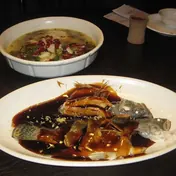
West Lake Fish in Vinegar Gravy (西湖醋鱼) ★ 4.8
A grass carp, first poached or steamed, then drenched in a sauce of vinegar, sugar and soy sauce, so the tender flesh soaks up slightly sweet and sour flavours.
Where to try it: Ru Yuan
One legend sets it in the Song dynasty: a woman of the Song family cooked fish with sugar and vinegar for her husband's younger brother before he fled, meaning do not forget the sour amid the sweet. The written record begins with the vinegar fish in the Qing poet Yuan Mei's recipe book; the late Qing scholar Yu Yue adapted it and wrote of buying Louwailou's vinegar fish to go with wine. Since December 2024 Hangzhou's local standards set detailed rules for the dish, and Ru Yuan keeps it as a signature with a refund policy.
Watch out for: Fish (grass carp), Soy (soy sauce)
-
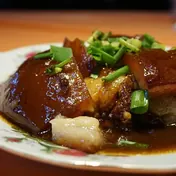
Dongpo Pork (东坡肉) ★ 4.7
Pork belly with an even spread of fat and lean, pan-fried and then red-cooked in soy sauce and rice wine, cut into thick squares of about five centimetres with the skin on.
The dish is named in honour of Su Dongpo, the Song dynasty poet and gastronome. Legend says that in exile in Huangzhou he simmered pork for hours in yellow wine, rock sugar and soy sauce; in Hangzhou, where he had labourers build embankments against the floods, the grateful city gave him pork, which he had cut into cubes, braised and shared with them. The recipe was adopted and developed by the people of the Hangzhou area, capital of the Southern Song, and at Hangzhou Restaurant it still takes up to three hours.
Watch out for: Soy (soy sauce)
-
Longjing Shrimp (龙井虾仁) ★ 4.7
Lake-caught shrimp, lightly fried, then quickly stir-fried with a little hot water infused with Longjing tea leaves, served white and green with a subtle tea scent.
Where to try it: Ru Yuan
Longjing shrimp is made mainly from Longjing tea leaves and shelled river shrimp, joining the city's lake and its best-known tea, and Louwailou is a famous restaurant for it. Zhejiang named it among the 36 famous Hangzhou dishes in 1956. On 4 September 2016 it was served at the welcome banquet of the G20 Hangzhou summit at the Xizi Hotel, and Ru Yuan, ranked 36th on the World's 50 Best Restaurants list in 2026, keeps sautéed shrimps with Longjing tea leaves on its menu.
Watch out for: Crustaceans (shrimp)
Book food experiences in Hangzhou

Check dates and prices
Powered by GetYourGuide-
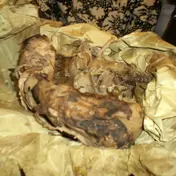
Beggar's Chicken (叫化鸡) ★ 4.4
A chicken stuffed with ingredients such as pork and mushroom, wrapped firmly in lotus leaves and clay, then baked very slowly at low heat over several hours.
Many regions claim it, but most experts agree the dish originated in Hangzhou, and it has long been considered part of Hangzhou cuisine; Zhejiang's 1956 list of 36 famous Hangzhou dishes includes it. The best-known legend tells of a beggar who stole a chicken and, with no pot, packed clay and mud around it and put it in a hole with a fire. Preparing a single portion may take up to six hours, and today it is often baked with dough instead of clay.
Watch out for: Wheat (dough, where it replaces the clay)
-
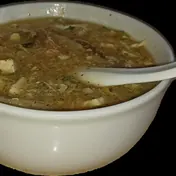
Sister Song's Fish Soup (宋嫂鱼羹) ★ 4.4
A thick soup of mandarin fish or perch with ham, bamboo shoots, shiitake mushrooms and egg in chicken stock, also known in Hangzhou as sai xie geng.
Where to try it: Jie Xiang Lou
Song Wusao came south from the old capital Bianjing and sold fish soup by West Lake outside Qiantang Gate. In 1179 the retired emperor Zhao Gou called her to his boat and rewarded her, after which people rushed to taste her soup. In the Qing and the Republic the name meant the vinegar fish of Wuliuju and Louwailou; the thick soup served today was refined at Louwailou by the chef Tao Haiming, who joined in 1959, and appeared in a 1977 Zhejiang recipe book as sai xie geng.
Watch out for: Fish, Egg
-
Pian'erchuan Noodles (片儿川) ★ 4.6
A Hangzhou noodle soup topped with pickled greens, sliced bamboo shoots and sliced lean pork, stir-fried together before stock and alkaline noodles go into the pan.
Pian'erchuan was first made at Kuiyuanguan, a noodle house founded in 1867. By the late 1940s visitors said that coming to Hangzhou without eating Kuiyuanguan's noodles meant not having visited at all, and pian'erchuan and shrimp and eel noodles are its most famous bowls. The dish appeared in the second season of A Bite of China. Locals eat it on stools outside noodle shops, and in 2026 the Hangzhou bakery SepBakery even put its pork, bamboo shoots and preserved vegetables into a mooncake.
Watch out for: Wheat (noodles)
-
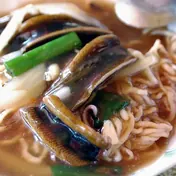
Shrimp and Eel Noodles (虾爆鳝面) ★ 4.5
Noodles cooked in eel broth, topped with crisp-fried swamp eel and white shelled river shrimp; the eel is fried in rapeseed oil, tossed in lard and finished with sesame oil.
Where to try it: Little Pigtail Noodle Shop, Wu Zi Mian Guan, Fang Lao Da (Shangcheng)
Xia bao shan mian traces back to a Southern Song soup of shrimp and eel and was fixed in its present form by Hangzhou chefs in the 1930s. It originated at Kuiyuanguan, where the cook Mo Jinsheng refined it into the house signature, and it has stayed the signature since the noodle house moved to its present site on Jiefang Road in 1959. Eels are at their fattest in summer and autumn, the best time for a bowl.
Watch out for: Fish (eel), Crustaceans (shrimp), Egg (egg white coating), Wheat (noodles), Sesame (sesame oil)
-
Cong Bao Hui (葱包桧) ★ 4.2
A Hangzhou snack of fried dough stick and scallion rolled in a spring pancake and pressed hard on a griddle, seasoned with sweet bean sauce or chilli sauce.
Legend traces the name to the Southern Song: after the chancellor Qin Hui framed the general Yue Fei, who died, angry Hangzhou people treated the fried dough stick as Qin Hui's body and pressed it hard to vent their hatred, calling the snack cong bao hui, scallion wrapped Hui. Because it is made of two spring pancakes, each wrapped round a dough stick, it is counted in pairs, fu, rather than one by one. It is listed among Hangzhou's specialty snacks.
Watch out for: Wheat (pancake and fried dough stick)
-
Ding Sheng Cake (定胜糕) ★ 4.1
A Jiangnan rice cake of coarse glutinous and non-glutinous rice, popular in Suzhou, Hangzhou and Huzhou, made in varieties with lard or with fine bean paste.
Where to try it: Gui Yu Jia Mian
Its shape resembles a mortise joint, dingsun, so it was first called dingsun gao; because dingsun sounds like dingsheng in the Jiangsu and Zhejiang dialects, the name changed over time. Local people make it for birthdays, house building and moving house, and on Zhejiang's streets it bears the propitious meaning of victory. Hangzhou lists it among its specialty snacks, and at Gui Yu Jia Mian a bowl of noodles ends with ding sheng cake with red bean filling.
-
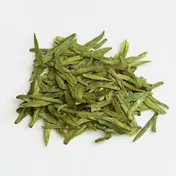
West Lake Longjing Tea (西湖龙井) ★ 4.8
A green tea grown in designated protected areas around West Lake; the first spring leaves, picked to the one bud, one leaf standard before Qingming, are the most prized.
Where to try it: Four Seasons Hangzhou at West Lake Lobby Lounge, Four Seasons Hotel Hangzhou at West Lake Lobby Lounge
Price: Hand-processed leaves over 10,000 yuan per 500 g; machine-processed 4,000 to 6,000 yuan per 500 g (2026)
Longjing tea was granted the status of imperial tea in the Qing dynasty, and legend says the Qianlong Emperor gave imperial status to eighteen tea bushes near West Lake. Meijiawu is the largest Xihu Longjing village, with over 2,380 mu of tea farmland. In Wengjiashan, villagers call to the mountain around Jingzhe to wake the buds, and the first leaves of 2026 were picked there on 17 March; hand-processed Longjing typically sells for more than 10,000 yuan per 500 grams.
Signature Dishes in Hangzhou, FAQ
What food is Hangzhou known for?
Hangzhou's signature dishes include West Lake Fish in Vinegar Gravy (西湖醋鱼), Dongpo Pork (东坡肉), Longjing Shrimp (龙井虾仁), Beggar's Chicken (叫化鸡), Sister Song's Fish Soup (宋嫂鱼羹). See our signature dishes chapter for where to eat each.