

The plates that define Guangzhou: what they are, where they came from, and where to eat the canonical version.
Signature dishes
-
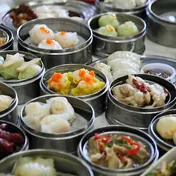
Dim sum and yum cha ★ 4.9
Dim sum are small Cantonese plates, savoury or sweet, eaten with tea at yum cha; the classic rule is 'one bowl with two pieces', two pieces of food to go with the tea.
Where to try it: Hongtu Hall, He Yuan (Tianhe), Imperial Treasure Fine Chinese Cuisine, Tao Tao Ju · Ya Yuan, Beiyuan Cuisine, Wing Lee Restaurant (Yuexiu), Yu Yue Heen, Lingnan House, BingSheng Mansion (Xiancun Road), Delightful House, Ersha No.1, Nan Yuan, Jiang by Chef Fei, Lai Wan A Cantonese Kitchen
Guangzhou saw more commercial travel in the tenth century, and travellers stopped at teahouses for yum cha, small meals with tea. In the 13th century the royal court, fleeing the Mongols, brought a royal influence to the city's dim sum. Har gow, the shrimp dumpling, was first served at Yi Zhen restaurant in Wufeng Village, Guangzhou. Dim sum culture grew fast in the city in the late nineteenth century, and by the late 1930s competition among teahouses was so fierce that new kinds appeared almost daily. Dim sum is traditionally eaten at breakfast and lunch, never at dinner.
Watch out for: Wheat (gluten), Shellfish (shrimp fillings), Soy, Sesame
-
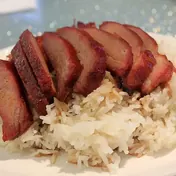
Char siu (barbecued pork) ★ 4.7
Char siu is Cantonese fork-roasted pork, usually boneless shoulder marinated in hoisin, soy, Chinese wine and five-spice and glazed with maltose or honey as it roasts.
Where to try it: Xin Tai Le (Yuexiu), BingSheng Pin Wei (Dongxiao Road), Lai Wan A Cantonese Kitchen, Lao Xiguan Laifen (Wenming Road)
The name is Cantonese for 'fork roasted', and char siu is typically made from a boneless cut of the collar or shoulder, known as mui tau. It is sold in siu mei shops that specialise in Cantonese roast meats. The traditional red colour came from red fermented bean curd and red yeast rice, though red food colouring is now common, and cooks treat the balance of fat and lean as extremely important. Char siu is eaten with rice or noodles and also stuffs buns and pastries.
Watch out for: Soy, Wheat (soy and hoisin sauces), Sesame (in some hoisin sauces)
-
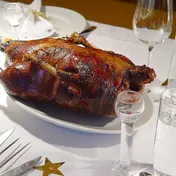
Cantonese roast goose ★ 4.8
Cantonese roast goose is goose roasted with seasoning in a charcoal furnace at high heat until the skin is crisp and the meat juicy and tender, served with plum sauce.
Where to try it: Tongtown, BingSheng Mansion (Xiancun Road), Zhu Zai Ji Shi Fu (Jiangnan Avenue), Lai Wan A Cantonese Kitchen
Roast goose belongs to siu mei, the Cantonese family of roast meats, and the bird is roasted at high temperature in a charcoal furnace; good roast goose has crisp skin over juicy, tender meat. It matters to Guangzhou more than most dishes: in a 2016 survey released by the city government, roast goose came out as the most popular dish, ahead of white cut chicken and roast squab. At BingSheng Mansion in Zhujiang New Town only 15 birds are roasted each day.
Watch out for: Soy (marinade), Wheat (soy sauce)
Book food experiences in Guangzhou


-
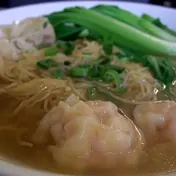
Wonton noodles ★ 4.7
Guangzhou wonton noodles are thin egg noodles cooked al dente in a hot, light brown broth made from dried flounder, with wontons that are mostly shrimp and some minced pork.
Where to try it: Ru Yi Chuan Tong Zhu Sheng Mian, Enning Liu Fu Ji (Donghua East Road), Zhou Men, Xiguan Zhuyuan (Lizhiwan), Rong Yi Fa Niu Za Dian (Yuexiu)
Wontons were given their name, huntun, in the Tang dynasty. In Guangzhou and Hong Kong the wontons are traditionally 70 percent shrimp and 30 percent pork, served in steaming hot soup with leafy greens. The best noodle shops still make jook-sing noodles, a rare Cantonese egg noodle traditionally made with duck egg; the name means bamboo rise noodle, and at Ru Yi Chuan Tong Zhu Sheng Mian the dough is still kneaded by a chef see-sawing on a bamboo pole. Enning Liu Fu Ji traces its duck egg noodles to a shop the founder opened on Enning Street in the 1940s.
Watch out for: Shellfish (shrimp), Fish (dried flounder broth), Egg (noodles), Wheat (gluten)
-
Teng jai congee (sampan congee) ★ 4.5
Teng jai congee is a Cantonese rice congee loaded with fish, shrimp, lean pork, fried dough sticks, peanuts and spring onion, sometimes with jellyfish, beef or squid.
Where to try it: Lai Wan A Cantonese Kitchen
The name means 'small boat congee'. It began in the Xiguan area of Liwan, where families who lived on the water sold it from small boats, teng jai in Cantonese, on the river at Lizhiwan, so it was also called Lizhiwan teng jai congee. Boats still sold congee on the Pearl River in front of the Nanfang Building into the 1970s; they have since closed. Today it is a standard dish in Cantonese congee shops in Guangzhou, Hong Kong, Macau and abroad. The Lai Wan A Cantonese Kitchen at the LN Garden Hotel serves it on a carved boat.
Watch out for: Fish, Shellfish (shrimp), Peanuts, Wheat (fried dough sticks)
-
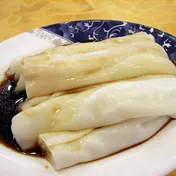
Rice noodle roll (cheung fun) ★ 4.5
Rice noodle rolls are thin sheets of steamed rice batter rolled around shrimp, pork, beef or vegetables; in Guangzhou the dish is called laai cheung, 'pulled intestine'.
Where to try it: Imperial Treasure Fine Chinese Cuisine
Rice noodle rolls are believed to come from Guangdong, where they became part of breakfast and dim sum, and most cookbooks date them to the 1930s. A Guangzhou government page notes that the Qianlong emperor praised them on a visit to Guangdong in the Qing dynasty, and that there are two main styles, Guangzhou and Chaoshan. The batter of rice flour, low gluten flour, starch and water is poured onto a flat pan and steamed into square sheets. Street vendors in Guangzhou long made them fresh to order on portable steamers.
Watch out for: Wheat (low gluten flour), Shellfish (shrimp fillings), Soy (sweet soy sauce)
-
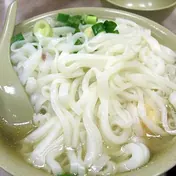
Shahe fen (ho fun rice noodles) ★ 4.4
Shahe fen are wide, flat rice noodles, white, slippery and chewy with a natural rice flavour; at Tongtown they are fried with sliced beef or served plain with a dip.
Where to try it: Tongtown
The noodles take their name from Shahe, a town near Baiyun Mountain in Guangzhou, where they are believed to have originated. They are made by selecting the rice, grinding it and steaming the batter, and the quality of the rice and water decides the result; spring water from Maofeng Mountain and rice from Kaiping are held to be the best. The traditional way of making them joined Guangzhou's list of municipal intangible cultural heritage in 2011 and Guangdong's provincial heritage in 2012. The noodles are popular across Guangdong, Guangxi and Hainan.
Watch out for: Soy (when fried with soy sauce), Wheat (soy sauce)
-
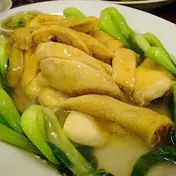
White cut chicken (poached chicken) ★ 4.6
White cut chicken is a whole salt-marinated chicken poached in water or ginger broth, served in pieces with skin and bone and a dip of minced ginger, garlic, spring onion and hot oil.
Where to try it: Hua Ge Si Chu, Wuchuan Hao Wei Lai, Mei Lu Xiao Chu, Wenjian Hainan Cuisine
Unlike most Cantonese siu mei meats, white cut chicken is poached rather than roasted, and it is common across southern China, Guangdong included. The usual condiment is geung yung, ginger paste made from finely minced ginger and garlic, green onion, salt and hot oil. Guangzhou cooks prize particular birds: Hua Ge Si Chu poaches chickens from Qingyuan and serves them with scallion and sand ginger dips, while Wuchuan Hao Wei Lai poaches capons from the owner's farm in Wuchuan. In the city government's 2016 survey it was runner-up to roast goose.
Watch out for: None of the major allergens in the chicken itself; check the dips
-
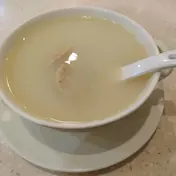
Lou fo tong and double-boiled soups ★ 4.6
Lou fo tong are Cantonese soups of vegetables, fruit, meat or herbs simmered for hours; double-boiled soups are steamed in a covered jar, sometimes for five hours.
Where to try it: Dayang (Wenming Road), Mian Ji (Yuexiu), Chuang Fa, Yushan Soup (Liede Xipu Street), Dr. Xu's Wellbeing Branch (Tianhe), Lei Garden (Yuexiu), Imperial Treasure Fine Chinese Cuisine, BingSheng Mansion (Xiancun Road), Ze 8 (Haizhu), Song Yuan
Lou fo tong means 'old fire soup'. Because the Lingnan region is hot and humid, locals took to drinking it for its nourishing, health-boosting effects. Double steaming, called dun in Cantonese, puts the ingredients with water in a covered ceramic jar that is steamed for several hours, and Cantonese cooking is famous for such slow-cooked soups. In Guangzhou, Dayang on Wenming Road has been known for double-boiled soups since 1983, and Mian Ji lists some 20 tonics grouped by their medicinal properties.
Watch out for: Varies with the soup: fish, shellfish or nuts in some tonics
-
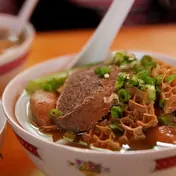
Ngau zap (beef offal) ★ 4.3
Ngau zap is Cantonese beef offal: good beef is stewed with its entrails for a couple of hours, then served as a hot pot, on skewers or in noodle soup.
Where to try it: Rong Yi Fa Niu Za Dian (Yuexiu), Xiguan Zhuyuan (Shiba Fu)
Ngau zap was a popular snack in Guangdong long before it became a Hong Kong street food: migrants from Guangzhou who fled to Hong Kong during the Chinese Civil War made it popular there. In Guangzhou's old town the dish lives on in small shops. Rong Yi Fa Niu Za Dian on Shishu Road makes beef and lamb offal soup with a broth of beef and lamb bones and more than ten Chinese herbs, while Xiguan Zhuyuan on Shiba Fu South Road, open for more than 30 years, slices the organ meats thinly for its beef offal soup.
Watch out for: Varies by recipe; broths may contain soy and wheat
-
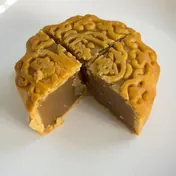
Cantonese lotus seed paste mooncake ★ 4.5
The Cantonese mooncake is a round pastry about 10 cm across with a thin crust around a rich filling, usually lotus seed paste, sometimes with salted egg yolk for the moon.
Where to try it: Lian Xiang Lou
The Cantonese mooncake is the best known style of the Mid-Autumn pastry, and some consider lotus seed paste the original and most luxurious filling. Guangzhou's Lian Xiang Lou began as a wedding cake shop in Xiguan; in 1889 it was renamed and began filling its pastries with lotus seed paste, the form the Cantonese mooncake still takes. It earned the name 'first house of lotus paste', and its Cantonese mooncake making is listed as Guangdong provincial intangible cultural heritage.
Watch out for: Wheat (pastry), Egg (salted yolk, egg wash), Nuts (in mixed nut fillings)
-
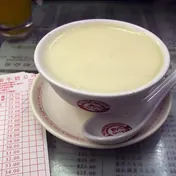
Ginger milk curd (jiang zhuang nai) ★ 4.3
Ginger milk curd is a Cantonese dessert of ginger, milk and sugar: the milk is poured quickly from a height onto ginger juice and sets to a soft, pudding-like curd.
The dessert comes from Shawan Ancient Town in Guangzhou's Panyu District, an 800-year-old town founded in the Song dynasty. Its Chinese name means 'ginger juice collides with milk', after the way the milk is poured onto the juice, a step called zhuang, 'clash'. Water buffalo milk is the traditional milk. It is an essential part of Cantonese desserts, and its history and techniques carry the values of Cantonese food culture and folk customs, including the Cantonese emphasis on eating for wellness.
Watch out for: Milk
Signature Dishes in Guangzhou, FAQ
What food is Guangzhou known for?
Guangzhou's signature dishes include Dim sum and yum cha, Char siu (barbecued pork), Cantonese roast goose, Wonton noodles, Teng jai congee (sampan congee). See our signature dishes chapter for where to eat each.