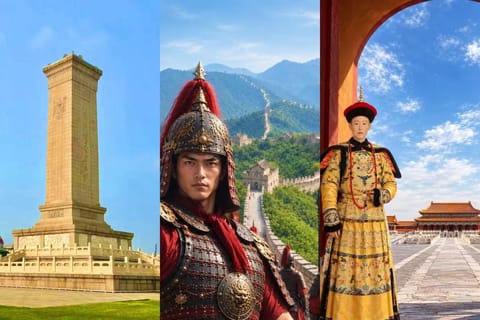
How Beijing came to eat the way it does: the people, migrations and accidents that shaped the plate.

Key eras

Court kitchens (Yuan and Ming, the capital's court kitchens)

Under the Mongol-led Yuan, a 1330 imperial kitchen manual by Hu Sihui already mentions roast duck, and by the later Ming it was a main dish on court menus. Bianyifang opened near Qianmen in 1416 and Liuquanju in 1567, the first of the time-honoured houses that still trade in the city.

Shandong kitchens (Qing dynasty, Shandong kitchens and the Eight Great Restaurants)

Shandong cooks supplied the Qing capital's big dining rooms. Qingyunlou, opened in 1820, was the first to serve Shandong dishes in the city and belongs to the group called the Eight Great Restaurants, with Zhimeilou (1842) and Tai Feng Lou (1876). Quanjude, founded in 1864, built its duck on a Shandong menu.

Palace pastries and banquets (Late Qing, palace recipes reach the street)

Imperial cooks carried palace recipes into the city. Chatang Li, founded in 1858, made the seasoned flour mush that the Empress Dowagers Ci'an and Cixi enjoyed. A retired imperial cook, Wang Xifu, opened Fuhuazhai to keep palace pastry techniques alive, and the Tan family banquet became Tanjiacai.

Time-honoured houses (1900 to the 1940s, the time-honoured houses)

Dongxinglou opened in 1902 and Donglaishun in 1903, then Huaiyangchun in 1916, Jinfang in 1926, and Fengzeyuan, Tongchunyuan and Xilaishun in 1930. Several belong to groups the city names: the Eight Great Restaurants, the Eight Great Residences and the eight houses called Chun.

Joint state-private houses (1950s, state restaurants and regional cooking)

In 1956 Huguosi Snacks was formed by gathering well-known street vendors under one roof, and Huixianju merged with Tianxingju under joint state-private ownership. Regional and foreign kitchens arrived too: Makai, founded in 1953 by 13 Hunanese, Lili for Sichuan food in 1954, and Moscow Restaurant in 1954.

Provincial tables and the Michelin Guide (1979 to 2026, provincial offices and the guide era)

In 1979 the Sichuan provincial office opened Lao Chuan Ban for homesick officials, and it welcomed the public from 1995. The Michelin Guide Beijing 2026, released on 29 October 2025, gave three stars to Chao Shang Chao (Chaoyang) and Xin Rong Ji (Xinyuan South Road), with six two-star and 24 one-star restaurants.
Immigrant influences

  • Shandong cooks: Shandong kitchens ran the Qing capital's Eight Great Restaurants, such as Qingyunlou (1820) and Dongxinglou (1902), and Quanjude and Bianyifang built their duck menus on Shandong dishes.
  • Hui Muslim cooks: Halal houses shaped the winter table: Baikuilaohao (1780) for roast mutton, Yitiaolong (1785) and Donglaishun (1903) for copper-pot mutton, and Huguosi Snacks (1956) for over 100 snacks.
  • Mongol and Inner Mongolian influence: Lamb for the copper pots comes from the grasslands: Donglaishun buys Inner Mongolian mutton and Man Heng Ji uses Sunite lamb. A popular but thinly documented legend ties the method to Kublai Khan.
  • Qing court and Manchu kitchens: Imperial cooks left the hung-oven duck, palace pastries and the Tan family banquet. The name chaogan is believed to come from the Manchu word colambi, which means to cook.
  • Huaiyang and Jiangsu cooks: Huaiyangchun was founded in 1916 by Xia Wanyong of Huai'an and Senlong in 1924 by Zhang Senlong of Dantu; Tongchunyuan (1930) still cooks Jiangsu dishes such as lion's head meatballs.
  • Sichuan and Hunan cooks: Emei (1950) and Lili (1954) brought Sichuan cooking to the capital, and Makai (1953) and Quyuan (1890) brought Hunan cooking. Provincial-office restaurants still cook for visitors from home.
  • Korean and Russian cooks: Huatian Yanji, founded in 1943 by a Korean woman, is known for Yanji cold noodles; Huatian Dadi (1945) and Moscow Restaurant (1954) serve Russian-style cooking.

Signature innovations

  • Hung-oven duck at Quanjude (1864): open-fire roasting developed in the Qing imperial kitchens
  • Closed-oven duck at Bianyifang (1416): roasted without open flame for crisp skin and tender meat
  • Instant-boiled mutton in a charcoal copper pot: Donglaishun (1903) holds it on the national heritage list
  • Zhizi kaorou: meat seared on an iron-bar griddle at Kaorouji (1848), a national heritage technique
  • Tan family cuisine: a late Qing official's family banquet, passed down four generations as Tanjiacai
  • Chaogan: a starch-thickened pork liver and intestine stew, attributed to the Huixianju restaurant
  • Luzhu huoshao: cheap offal stewed in the broth of a court pork dish, with baked flatbread added
  • Nailao: milk set with fermented glutinous rice wine, a court delicacy sold at Nailao Wei since 1888
  • Ma Lianliang Duck at Xilaishun (1930), prepared by a technique on the heritage list
  • Douzhi: fermented mung bean drink, on Beijing's intangible heritage list since 2007

Book food experiences in Beijing

See all 962 bookable experiences in Beijing

← Back to Beijing food guide