How Vienna came to eat the way it does: the people, migrations and accidents that shaped the plate.

Key eras

1683, the first coffee houses after the Turkish siege

Vienna of 1683 found sacks of coffee left by the retreating Ottoman army; the exact provenance is contested but by the late 1680s coffee had entered Viennese public life through small Cafetiers. The cup-and-newspaper room became a fixture of bourgeois Vienna over the following two centuries.

1786 to 1900, the Imperial Konditorei

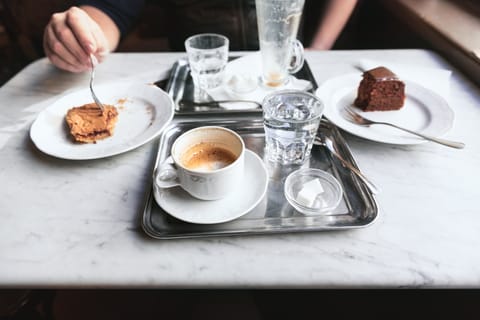
Demel opened on Kohlmarkt in 1786 and became a Hofzuckerbaecker (court confectioner) by 1874 under Emperor Franz Joseph I. The Sachertorte was invented in 1832 by Franz Sacher for Prince Metternich. By the late 19th century Vienna's Konditorei tradition was the most ornate in Europe, with marble counters and silver trays.

1860 to 1914, the Ringstrasse Kaffeehaus

With the Ringstrasse built from 1857, the Wiener Kaffeehaus took its modern form: bentwood Thonet chairs, marble tables, newspapers on wooden frames, a Melange on a silver tray with a small glass of water. Cafe Schwarzenberg (1861), Cafe Landtmann (1873), Cafe Central (1876), Cafe Sperl (1880) all opened in this era and most still operate.

1900 to 1945, the literary coffee house

The early 20th century turned the Kaffeehaus into a literary salon: Sigmund Freud at Cafe Landtmann, Peter Altenberg and Stefan Zweig at Cafe Central. Adolf Loos designed Cafe Museum in 1899 and Loos American Bar in 1908. The 1938 Anschluss and the war devastated the city's Jewish coffee-house culture; many rooms had been Jewish-owned.

1945 to 1990, the post-war Beisl

Post-war Vienna kept the Kaffeehaus alive even as much of the population left. The Beisl, the small neighbourhood Viennese tavern, took on a defensive cultural role: Figlmueller on Wollzeile kept making Wiener Schnitzel, Plachutta started serving Tafelspitz from 1986 onward, the Heuriger taverns of Grinzing and Stammersdorf became a tourist must-do.

1990 to now, the modern Vienna kitchen

Vienna's serious dining room caught up in the 2000s. Heinz Reitbauer took over Steirereck in 2005 and pushed it to its third Michelin star in 2025. Today Vienna holds two three-star rooms (Steirereck and Restaurant Amador), four two-star rooms and around a dozen one-stars, the densest Michelin map in Central Europe outside Munich.
Immigrant influences

  • Ottoman and Turkish: The 1683 siege left coffee beans that the city turned into a tradition. The 20th-century Gastarbeiter wave brought the modern Turkish kitchen: Brunnenmarkt in Ottakring (1160) is one of Europe's longest Turkish street markets.
  • Hungarian and Bohemian: The Austro-Hungarian Empire left a long Bohemian-Czech and Hungarian print on Viennese cooking: Goulasch, Buchteln, Powidltascherl, Palatschinken and Kolatschen all entered the canonical Viennese carte through 19th-century Bohemian and Hungarian cooks.
  • Jewish (Ashkenazi): Pre-war Vienna had one of Europe's largest Jewish communities, centred on Leopoldstadt. Bagels, schmaltz, gefilte fish and a long tradition of cheesecake came through Yiddish-speaking households. The community was destroyed in 1938 to 1945; the renewed kosher quarter around Karmeliterplatz now hosts Bahur Tov.
  • Italian: Italian cooks have been in Vienna since the imperial era; today the Italian kitchen is the dominant non-Viennese cuisine in the city. Pizza Mari in Leopoldstadt fires Neapolitan pizza, and natural-wine bars and trattorias have entered every district.
  • Levantine and Israeli: Haya Molcho's Neni on the Naschmarkt (founded 2009) put Israeli and Levantine cooking on Vienna's editorial map. Tewa, Habibi & Hawara and a long counter list follow; the falafel-and-hummus carte is now a standard alternative to the Schnitzel one.

Signature innovations

  • Wiener Kaffeehaus, the public coffee-house as institution
  • Sachertorte, the chocolate-and-apricot torte invented in 1832
  • Wiener Schnitzel vom Kalb, the breaded veal cutlet that named a category
  • Tafelspitz, the boiled-beef pot served in copper pans at Plachutta
  • Gemischter Satz, the field-blend white wine returned to Heuriger pours
  • Sturm, the half-fermented new wine poured at Heuriger taverns each autumn
  • Apfelstrudel, the paper-thin pastry that travelled with the empire

Food History in Vienna, FAQ

When is the best time to eat in Vienna?

Peak food season in Vienna is year-round.

What time do people eat in Vienna?

Local dining hours: lunch around 12:30, dinner from 19:30.

How does tipping work in Vienna?

service is typically included; small extra is welcome but not expected.

What is the one dish to try in Vienna?

Ask the next local you meet what they would order. Vienna rewards trust.

← Back to Vienna food guide