How Sydney came to eat the way it does: the people, migrations and accidents that shaped the plate.
Key eras
-
Before 1788, Eora and Cadigal food culture
The Eora lived mainly from the produce of the sea, fishing, cooking and eating in the bays and harbours from bark canoes. Summer foods included oyster and netted mullet, and in winter people hunted possum, echidna, fruit bats, wallaby and kangaroo. Radiocarbon dating suggests human activity in and around Sydney for at least 30,000 years.
-
1788 to 1880, colonial rations, gold and the first oyster farms
The early colonial diet is summed up as bread, salted meat and tea with lashings of rum. Chinese immigration increased after the discovery of gold in 1851, and by 1861 Sydney had a Chinese Quarter in The Rocks. Sydney Fish Market calls the Sydney rock oyster Australia's first aquaculture species, with farming beginning in the 1870s.
-
1900 to 1960, Haymarket Chinatown and postwar Europeans
By the 1920s Chinatown had moved from The Rocks to Haymarket. After World War II Italian migration became a mass movement, with 201,428 arrivals from 1949 to 1959, and Leichhardt became Sydney's counterpart to Melbourne's Carlton. Greek immigrants settled in Marrickville after the war, drawn by jobs and cheap housing.
-
1960 to 2000, refugees, Lebanese suburbs and Modern Australian
More than 30,000 Lebanese civil war refugees arrived in Australia between 1975 and 1990, and Vietnam-born refugees were resettled between 1975 and 1985; Sydney's Vietnamese community is concentrated in Cabramatta. Tetsuya's opened in Rozelle in 1989, bills opened in Darlinghurst in 1993, and the 1993 Good Food Guide first printed the term Modern Australian.
Taste it todayModern Australian Tasting Menu -
2000 to 2026, big closures and a new Barangaroo
Tetsuya's moved to a larger city site in November 2000 and closed after its final service on 31 July 2024. Quay closed on 14 February 2026 after Peter Gilmore's tenure from 2001, and Oncore by Clare Smyth, which opened at Crown Sydney in 2021, closed on 28 February 2026. Barangaroo Reserve opened in 2015 and Crown Sydney in December 2020.
Immigrant influences
- Chinese
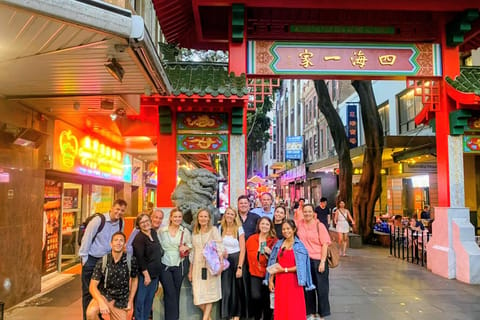
- Chinese immigration increased after gold was found in 1851. Sydney's Chinatown was in The Rocks by 1861 and had moved to Haymarket by the 1920s; Dixon Street was pedestrianised in the 1980s, and authorities encouraged Chinese restaurants to open along it.
- Vietnamese
- Australia resettled Vietnam-born refugees between 1975 and 1985, and in Sydney they are concentrated in Cabramatta and nearby suburbs. In Marrickville, Vietnam is the top birthplace outside Australia, and Vietnamese bakeries and restaurants line Illawarra Road.
- Lebanese
- More than 30,000 Lebanese civil war refugees reached Australia between 1975 and 1990, and about 70 percent of the Lebanese-born lived in Sydney, in suburbs such as Lakemba, Greenacre and Punchbowl. The first El Jannah opened in Granville in 1998.Taste it todayEl Jannah
- Italian
- Italian arrivals in Australia totalled 201,428 from 1949 to 1959. Stanley Street in Darlinghurst is often called Sydney's first Little Italy, and holds an Italian festival each June.
- Greek
- Greek immigrants settled in Marrickville after World War II, drawn by jobs and cheap housing, and opened many shops on Marrickville Road. Greek ancestry and Greek language use there are well above national averages in the 2021 census.
Signature innovations
- Modern Australian, which blends European techniques with Asian flavours and was first listed as a style in the 1993 Good Food GuideTaste it todayModern Australian Tasting Menu
- The flat white, which Alan Preston put on the menu at Moors Espresso Bar in Sydney in 1985, though its origin is disputedTaste it todayFlat White
- Sydney rock oyster farming, Australia's first aquaculture, begun in the 1870sTaste it todaySydney Rock Oyster
- The Tiger pie: a meat pie topped with mash, mushy peas and gravy, from Harry's Cafe de Wheels at WoolloomoolooTaste it todayHarry's Cafe de Wheels
- bills, Bill Granger's all-day restaurant, opened in Darlinghurst in 1993
Book food experiences in Sydney