
The plates that define Glasgow: what they are, where they came from, and where to eat the canonical version.
Signature dishes
-
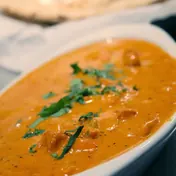
Chicken tikka masala ★ 4.9
Chicken tikka masala is chicken tikka in a creamy, spiced tomato sauce. Shish Mahal, in Glasgow's West End, says it created the dish and calls itself its birthplace.
Where to try it: Shish Mahal, Mister Singh's India
Price: £17.90
Shish Mahal, established in 1964 in Glasgow's West End, calls itself the birthplace of chicken tikka masala and credits its founder, Mr Ali. Wikipedia retells the story of Ali Ahmed Aslam improvising a sauce from a tin of condensed tomato soup and spices for a customer who found his chicken tikka dry. The origin is disputed: the historian Peter Grove notes that the owner of Glasgow's Taj Mahal said he made it in the 1950s. In 2001 Robin Cook, then Foreign Secretary, called it "a true British national dish".
Watch out for: Milk
-
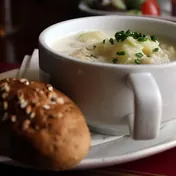
Cullen skink ★ 4.4
Cullen skink is a thick Scottish soup of smoked haddock, potatoes and onions from the town of Cullen in Moray. Cafe Gandolfi and Two Fat Ladies at The Buttery both list it.
Where to try it: Cafe Gandolfi, Two Fat Ladies at The Buttery
Price: £13-14
Cullen skink is a local speciality of the town of Cullen in Moray, on Scotland's north-east coast, and is believed to have been made by local fishermen to use their plentiful catches of haddock. Skink is a Scots word for a shin or knuckle, and here means a broth. An authentic version uses finnan haddie, though any undyed smoked haddock works. Cafe Gandolfi, open since 1979, lists it at £14 and Two Fat Ladies at The Buttery at £13.
Watch out for: Fish, Milk
-
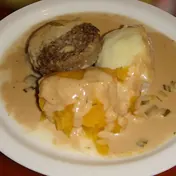
Haggis, neeps and tatties ★ 4.6
Haggis, neeps and tatties is Scotland's national plate: a spiced pudding of sheep's pluck, onion and oatmeal with mashed swede and potato, made in house at Stravaigin and the Chip.
Where to try it: Stravaigin, The Ubiquitous Chip, Cafe Gandolfi
Price: £9-22
Haggis, a savoury pudding of sheep's pluck, onion, oatmeal, suet and spices, was first recorded in England around 1430 and became Scotland's national dish through Robert Burns's 1786 poem Address to a Haggis. It is served with neeps and tatties at Burns suppers on or near 25 January, his birthday. In Glasgow, Stravaigin lists its own haggis, neeps and mash tatties at £9 or £18, the Ubiquitous Chip's Brasserie lists Chip's own haggis with neeps, tatties and pepper sauce at £12, and Cafe Gandolfi lists it at £22.
Watch out for: Gluten
Book food experiences in Glasgow


-
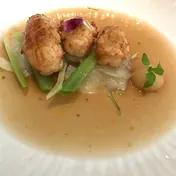
Langoustine ★ 4.5
Langoustine, also called the Dublin Bay prawn or Norway lobster, is a slim coral-coloured shellfish. Crabshakk grills it with garlic butter and The Finnieston lists Loch Fyne langoustines.
Where to try it: Crabshakk, The Finnieston
Price: £14-26 at Loch Fyne; market price at The Finnieston
Nephrops norvegicus, known as the langoustine, Dublin Bay prawn, Norway lobster or scampi, is fished commercially around Scotland. Crabshakk has served Scottish seafood on Argyle Street since 2009, and its August 2026 menu lists grilled langoustines with garlic butter. The Finnieston, at 1125 Argyle Street, lists Loch Fyne langoustines with garlic butter at market price. At the Loch Fyne Oyster Bar in Cairndow they cost £14 or £26 with garlic butter or hollandaise.
Watch out for: Crustaceans
-
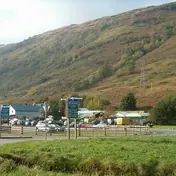
Loch Fyne oysters ★ 4.3
Loch Fyne oysters are Pacific rock oysters grown on the shores of Loch Fyne in Argyll and sold natural at the Loch Fyne Oyster Bar in Cairndow, £4 each or £20 for six.
Price: £4 each, £20 for six
Loch Fyne Oysters was founded in 1978 by Johnny Noble and Andy Lane, who first sold oysters from a shack on the road through Cairndow. The farm grows Pacific rock oysters for two to three years on the loch shore, with its own hatchery and nursery at Morecambe Bay. Its oyster bar, about an hour's drive from Glasgow by its own account, serves them natural or hot. Glasgow's raw bars list oysters from elsewhere: Crabshakk and Gamba serve Lindisfarne oysters.
Watch out for: Molluscs
-
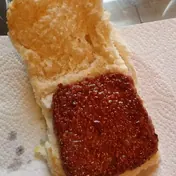
Square (Lorne) sausage ★ 4.4
Square or Lorne sausage is a flat Scottish sausage of minced meat, rusk and spices, sliced from a block. University Cafe lists Lorne sausage in its all-day breakfast.
Where to try it: University Cafe
The Lorne sausage, also called square sausage, is made from minced meat, rusk and spices with no casing, so it is sliced from a formed block. It is thought to be named after the region of Lorne in Argyll: advertisements for Lorne sausage appear in newspapers from 1892, before the comedian Tommy Lorne, born in 1890, was well known. It is eaten in the Scottish full breakfast or a breakfast roll. University Cafe on Byres Road, opened in 1918, listed it in its All Day Breakfast in 2023.
Watch out for: Gluten
-
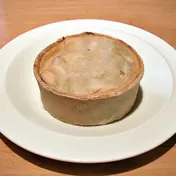
Scotch pie ★ 4.0
The Scotch pie is a meat pie in hot-water-crust pastry, traditionally filled with spiced minced mutton and now usually beef, baked in a straight-sided tin and eaten by hand.
A Scotch pie is a meat pie in hot water crust pastry, traditionally filled with highly spiced minced mutton and now generally beef, sometimes lamb. It is baked in a round, straight-sided tin about 8 cm across, with the top crust set about 1 cm below the rim to hold mashed potato, beans, brown sauce, gravy or an egg. Pies are sold hot at football grounds, traditionally with Bovril, and by takeaways and bakeries. Scottish Bakers has held the World Championship Scotch Pie Awards every year since 1999.
Watch out for: Gluten
-
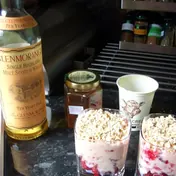
Cranachan ★ 4.2
Cranachan is a traditional Scottish dessert of whipped cream, toasted oatmeal, honey, whisky and raspberries, served all year round though it began as a harvest dish.
Cranachan was originally a celebration of harvest, made after the raspberry harvest in August. Its origin is crowdie, a breakfast of crowdie cheese with lightly toasted oatmeal, cream and local honey, to which raspberries were added when in season. The modern dessert is bolstered with Scottish oats and whisky, and is now served all year round. No Glasgow menu we could read lists it.
Watch out for: Milk, Gluten
-
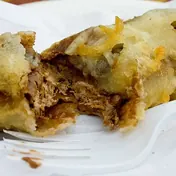
Deep-fried Mars bar ★ 4.1
The deep-fried Mars bar is a Mars bar coated in batter and fried in a chip shop. Its origin is disputed; one claim places it in a Stonehaven chip shop in 1992.
The origins of the deep-fried Mars bar are disputed. John Davie claimed to have invented it in 1992 at the Haven Chip Bar, now the Carron Fish Bar, in Stonehaven near Aberdeen on Scotland's north-east coast. It drew rapid media attention after the Aberdeen Evening Express reported on it on 23 August 1995, and it was often cited in commentary on the Scottish diet. Mars asked the shop to make clear that frying the bars was not authorised or endorsed by the company.
Watch out for: Milk, Gluten
-
Tablet ★ 3.9
Tablet is a medium-hard, grainy Scottish sweet made from sugar, condensed milk and butter, boiled to the soft-ball stage and left to crystallise.
Tablet is usually made from sugar, condensed milk and butter, boiled to the soft-ball stage and allowed to crystallise. It differs from fudge in its brittle, grainy texture. F. Marian McNeill's The Scots Kitchen notes tablet in the Household Book of Lady Grisell Baillie from the early 18th century. The traditional recipe used just sugar and cream; modern recipes swap in condensed milk and butter because cream tends to burn when boiled.
Watch out for: Milk
Signature Dishes in Glasgow, FAQ
What food is Glasgow known for?
Glasgow's signature dishes include Chicken tikka masala, Cullen skink, Haggis, neeps and tatties, Langoustine, Loch Fyne oysters. See our signature dishes chapter for where to eat each.