The plates that define Durban: what they are, where they came from, and where to eat the canonical version.
Signature dishes
-
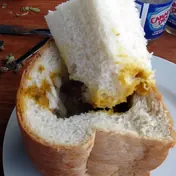
Bunny Chow
A hollowed-out quarter or half loaf of white bread filled with mutton, chicken or beans curry, capped with the bread plug and eaten with the hands, with grated carrot, chilli and onion salad on the side.
Where to try it: CaneCutters, The Oriental Durban North, Kebabish Florida Road, Kebabish Overport, Kebabish North Beach, Hollywood Bunny Bar, Curry And Grill Cartel Morningside
Price: About R80 to R90 for a quarter mutton (2023)
Bunny chow was created among the Indian South Africans of Durban, and its creation is dated to the 1940s. One story credits Kapitan's, a restaurant-café on the corner of Victoria and Albert streets; another says takeaway lunches at the Queen's Tavern were called Bunia Chow after the slang for Gujarati traders. The earliest bunnies were filled with beans, and meat bunnies came about a decade later. Bunnies were once wrapped in the previous day's newspaper and are now sold in bunny boxes; locals simply ask for a quarter mutton.
Watch out for: Gluten (bread)
-
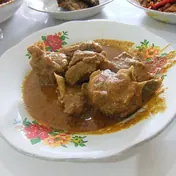
Durban Mutton Curry
Mutton cooked in oil with fresh masala, curry leaves, extra chillies and plenty of tomato, with soft potatoes to soak up the gravy; a Durban curry is known by the glossy slick of red oil on top.
Durban curry grew from the cooking of the South Indian labourers who came from 1860. Cooked with oil rather than butter, it is redder and more fiery than its forebears in India, and fresh curry leaves set it apart from the Cape Malay curries of the west coast. Mutton is the defining meat of the bunny chow. The Britannia Hotel's chops chutney uses bone-on mutton chops smeared with masala, ginger and garlic, and the Seabelle on Tongaat Beach, opened by the Govender family in 1975, served a tender mutton curry on a 2025 visit.
-
Sugar Bean and Broad Bean Curry
A beans curry of red-speckled sugar beans or broad beans, the filling of Durban's first bunnies; beans bunnies are still the speciality at Patel's Vegetarian Refreshment Room on Dr Yusuf Dadoo Street.
The traditional Indian meal of the labourers was roti and beans, and because roti fell apart as a takeaway, the centre of a white loaf was hollowed out and filled with curry instead. The original bunny chow was vegetarian, and Durban's earliest bunnies centred on sugar beans and broad beans. Patel's Vegetarian Refreshment Room, a fixture of the city centre since 1932, still makes beans bunnies its speciality, and at Hollywood Bets in Springfield Park the broad bean curry bunny is one of the winning picks.
-
Trotters and Beans
Sheep trotters cooked with sugar beans in a red curry, a KwaZulu-Natal dish served by Cane Cutters in Glenwood beside its bunny chow, and one of the traditional Durban bunny fillings.
Trotters and beans curry is one of the traditional Durban recipes used to fill bunny chows, alongside mutton, chicken and beans. Sheep head and trotters are among the ingredients that entered Durban Indian cooking and remain in it today. The Victoria Street Market's seafood and meat hall still sells trotters and sheep heads, and the Britannia Hotel's boti is one of its 'exotic' bunnies, made with trotters or tripe.
-
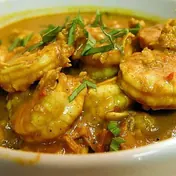
Durban Prawn Curry
Prawns simmered gently in a spicy red tomato gravy with ginger, garlic, mustard seeds, fresh curry leaves and chillies, the luxury dish of the curry houses on the KwaZulu-Natal coast.
Where to try it: The Little India Restaurant
Many indentured labourers worked in the fishing and boating industries, and an abundance of fish is still part of Durban Indian cooking. On the north coast, the Govender family opened the Seabelle on Tongaat Beach in 1975, and Impulse by the Sea at Tinley Manor, whose owner, a Govender, says her family are the crab people, serves the prawn curry on the cover of Erica Platter's Durban Curry cookbook. The rule, says its owner, is to shake the pot, never stir it.
Watch out for: Crustaceans, Mustard
-
Breyani
A rice dish of Durban's Indian kitchen, made beside pilau; in Durban it takes potatoes, which are unheard of in breyani in India, and Cane Cutters in Glenwood draws queues for it.
Where to try it: The Oriental Durban North
Durban Indian food is a mix of South and North Indian dishes, such as breyanis and pilaus, with cooking styles that melded over time and took in local ingredients. Anthropologist Sheetal Bhoola calls it a hybrid of techniques from more than one region of India, combined with local ingredients and local versions of spices. The soft potatoes of Durban curry turn up in breyani too, which is unheard of in India and elsewhere. Cane Cutters in Glenwood serves Durban curries, snacks and breyanis.
-
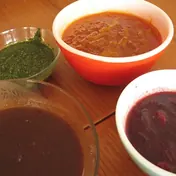
Chops Chutney
Bone-on mutton chops smeared with masala, ginger and garlic and slow-cooked with a double share of tomatoes, served as a bunny filling at the Britannia Hotel and as lamb chops in spicy chutney elsewhere.
Chops chutney is one of the 14 kinds of bunny on the Britannia Hotel's menu. The Moodley family has owned the hotel since 1983, and its fame came from the dishes of Logambal Moodley, who cooked from her own mother's recipes; the masala mixes behind most of its curries are still made to her recipe. The chops are slow-cooked with twice the standard amount of tomatoes. In Glenwood, Cane Cutters serves lamb chops in spicy chutney.
-
Samoosa
Samoosas are fried snacks of the South African Indian kitchen. In Durban they are sold at the markets and by vendors who walk the beaches, with potato and corn among the fillings.
Where to try it: Curry And Grill Cartel Morningside
The Indian labourers who came to South Africa in the 19th century brought many dishes with them, and South African Indian cuisine adapted to local ingredients: curries, rotis, sweetmeats, chutneys and fried snacks such as samoosas. In Durban they are a market staple, eaten alongside curry roti and kofta, and the locals who patrol the beaches sell them to swimmers, with potato and corn samoosas the safer choice than the meat ones.
-
Burfee and Diwali Sweetmeats
Burfee is an Indian confection made with everything from almonds to spiced chickpeas; with banana puri, chana magaj and gulab jamun it fills Durban's Diwali trays, made with ghee and cardamom.
Durban's sweetmeat makers work hardest in the weeks before Diwali: Yudhika & Company turns out three to four tonnes of traditional sweetmeats and confectionery each year. The trays carry banana puri, layered pastries that look like a banana flower but hold no banana, creamy almond burfee, chana magaj, gulab jamun, coconut and almond poli and naan khatay. At Victory Lounge in uMhlanga one counter holds a multitude of burfee, another savouries such as vadde, lentil fritters.
Watch out for: Milk (ghee), Tree nuts (almonds)
-
Kota
Kota, from the word for quarter, is a quarter loaf of bread that grew out of the bunny chow, often filled with chips, polony, cheese and atchar instead of curry; KwaZulu-Natal holds a kota festival.
Across South African communities the bunny chow was adapted into versions that use only a quarter loaf of bread, sometimes called a skhambane, kota (quarter) or shibobo. Fillings moved away from Durban Indian curry: slap chips, a slice of polony, cheese and atchar, a South Asian pickle. In Durban the eThekwini Kota Festival celebrates the kota of KwaZulu-Natal with live music, and its 2026 edition was set for Moses Mabhida Stadium.
Watch out for: Gluten (bread), Milk (cheese)
Signature Dishes in Durban, FAQ
What food is Durban known for?
Durban's signature dishes include Bunny Chow, Durban Mutton Curry, Sugar Bean and Broad Bean Curry, Trotters and Beans, Durban Prawn Curry. See our signature dishes chapter for where to eat each.