How Durban came to eat the way it does: the people, migrations and accidents that shaped the plate.
Key eras
-
Port Natal (1824 to 1860)
In 1824 English traders from the Cape Colony, led by Francis Farewell and Henry Fynn, set up a trading post at Port Natal, and Shaka, the Zulu king, granted them land around the bay. In 1835 the settlement was named after Sir Benjamin D'Urban, and it became a borough in 1854.
-
Indenture and the cane fields (1860 to 1911)
Between 1860 and 1911, 152 184 indentured labourers arrived from India to work the sugar cane plantations, the railways and the fishing boats. A legal notice of 1874 set their rations as dholl, dried fish, oil and rice. When rice was scarce, crushed dried maize became mealie rice, and cheap vegetable oil replaced ghee.
-
Traders and the Victoria Street market (1860 to 1990)
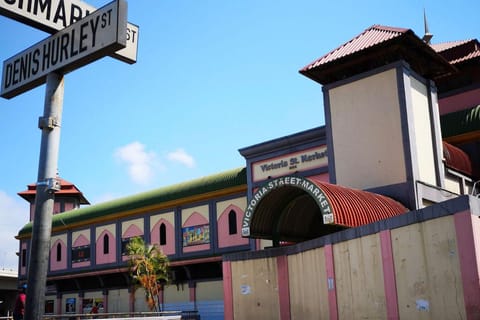
Gujarati merchants who came of their own accord supplied the workers with spices and vegetables. Indian traders sold along Victoria Street from 1860, and in 1910 the municipality created a market for them. A fire destroyed it in 1973, and the traders worked from the Bulk Sales Hall beside the African Market until 1990.
Taste it todayVictoria Street Market -
Grey Street and the bunny chow (1932 to 1950s)
Patel's Vegetarian Refreshment Room opened in Grey Street in 1932, selling beans bunnies. The bunny chow is dated to the 1940s; one account credits Kapitan's on the corner of Victoria and Albert streets, and meat bunnies arrived around a decade after the bean ones, popularised by Kapitan's and Victory Lounge.
Taste it todayBunny Chow -
Apartheid isolation (1948 to 1994)
Repressive regimes after indenture meant that Durban Indian cuisine developed in virtual isolation, into a red-hot, hearty style built on cheap ingredients. Roma Revolving Restaurant opened on top of John Ross House in 1973, and in 1975 the Govender family opened the Seabelle on Tongaat Beach, in an area then reserved for South Africans designated as Indian.
Taste it todayRoma Revolving Restaurant -
Democratic Durban (1994 onwards)
After apartheid ended the city's population grew by an average of 2.34% a year between 1996 and 2001. Victory Lounge left the city centre for Chatsworth and uMhlanga, and in 2026 the Coca-Cola Bunny Chow Barometer Challenge, which crowns KwaZulu-Natal's best bunny, reached its 20th year.
Taste it todayBunny Chow
Immigrant influences
- South Indian indentured labourers
- They brought the curries, rotis, chutneys and fried snacks such as samoosas, and their curry grew red and fiery in Durban, with extra fresh chillies and curry leaves.
- Gujarati traders
- Gujarati merchants travelled home often, kept their own cuisine fairly intact and supplied the labourers with spices, vegetables and conveniences from India.
- Zulu
- Zulu neighbours' ingredients entered Durban Indian cooking and remain today: free-range chickens, madumbis (a local yam) and amasi, a fermented milk.
- British
- The first guests of the Britannia Hotel would have been pink-gin colonials; today its kitchen lists 14 varieties of bunny chow.
- Mauritian
- Ile Maurice mixes grand French and Mauritian Creole flavours with local east coast seafood, such as barracuda vindaye and king prawns in Mauritian curry sauce.
- Italian
- The Italian food scene has always been popular in Durban, shaped by KwaZulu-Natal produce and seafood; Roma Revolving Restaurant opened in 1973.Taste it todayRoma Revolving Restaurant
Signature innovations
- Bunny chow, curry in a hollowed-out loaf of white bread, created in Durban and dated to the 1940sTaste it todayBunny Chow
- Mealie rice, crushed dried maize cooked by indentured workers when rice was scarce
- Potatoes in breyani, unheard of in India, and soft gravy soaker potatoes in Durban curryTaste it todayBreyani
- The Natal pizza at Al Firenze in La Lucia, with ham, prawns, banana and chilli
- Pineapple sprinkled with chilli powder and salt, sold by vendors on the beachfront
Book food experiences in Durban