
The plates that define Marrakech: what they are, where they came from, and where to eat the canonical version.
Signature dishes
-
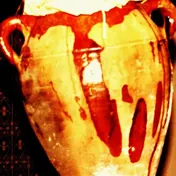
Tangia ★ 4.9
Tangia is Marrakech's bachelor dish: lamb or beef sealed in a tall clay urn with preserved lemon, saffron, garlic, cumin and olive oil, then buried in the hammam's wood-fired furnace coals for seven hours.
Where to try it: Chez Lamine Hadj Mustapha, Le Trou au Mur, Le Jardin
Price: 80 to 150 MAD per portion
Tangia emerged in the Marrakech medina as the working man's lunch. Craftsmen and merchants would assemble the urn at home, drop it at the neighbourhood hammam furnace on the way to work, paying the fire-tender (mul farnatchi) about a dirham to bury it in the coals. After a morning's labour they would collect the finished urn for lunch. The dish is uniquely Marrakchi; you find it almost nowhere else in Morocco.
-
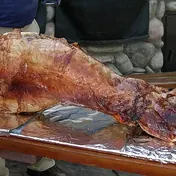
Mechoui ★ 4.9
Mechoui is whole lamb slow-roasted in an underground wood-fired pit oven for four hours until the meat pulls apart at the touch; served by weight on paper, seasoned at the table with cumin and salt.
Where to try it: Chez Lamine Hadj Mustapha, Mechoui Alley, Jemaa el-Fna Snail Stalls
Price: 120 to 200 MAD per half-kilo
Mechoui (Arabic: roasted) descends from the nomadic Bedouin and Berber tradition of pit-roasting whole sheep for tribal feasts. In Marrakech the dish concentrated in the alley off Sidi Bouchakour, just north of Jemaa el-Fna, where eight to nine specialist counters now run the same coal-fired pits dug centuries deep into the ground. Mechoui is the canonical Marrakech feast meat, central to Eid al-Adha (the June 16-18 sheep-slaughter holiday in 2026).
-
Tagine ★ 4.9
Tagine is the conical clay pot and the dish cooked in it: meat or fish slow-simmered with vegetables, preserved lemon, olives, spices and dried fruit, the cone returning evaporated steam to keep the broth concentrated.
Where to try it: Al Fassia Gueliz, Le Foundouk, Dar Yacout
Price: 80 to 180 MAD per portion
The tagine pot is a North African Berber invention dating to at least the 8th century. Two basic styles dominate Marrakech menus: chicken with preserved lemon and green olives (the Fassi classic), and lamb with prunes, dried apricots and toasted almonds (the wedding-day showpiece). A vegetable tagine khodra rounds out vegetarian-friendly menus. Friday remains the traditional couscous-and-tagine family lunch across Morocco.
Watch out for: Nuts
Book food experiences in Marrakech
-
Couscous ★ 4.9
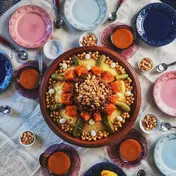
Couscous is steamed semolina pearls served under a stew of seven vegetables (carrot, turnip, courgette, cabbage, pumpkin, chickpea, raisin) and lamb or chicken; the Friday family lunch across Morocco.
Where to try it: Al Fassia Gueliz, Dar Yacout, Amal Center Gueliz
Price: 80 to 150 MAD per portion
Couscous is the Berber base grain across North Africa, mentioned in 13th-century Andalusian cookbooks. The Marrakech version follows the canonical seven-vegetable formula and remains the Friday family meal in every Moroccan home. UNESCO inscribed couscous on its Intangible Cultural Heritage list in 2020.
Watch out for: Gluten
-
Pastilla ★ 4.8
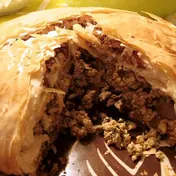
Pastilla is the phyllo-pastry pie of pigeon or chicken, scrambled eggs and toasted almonds, dusted with cinnamon and powdered sugar; the sweet-savoury Moroccan showpiece.
Where to try it: Le Tobsil, Dar Yacout, Al Fassia Gueliz
Price: 120 to 250 MAD per portion
Pastilla (also bastilla, b'stilla) descended from the Andalusian Moorish tradition. Historians trace recipes resembling modern pastilla to 13th-century Andalusi cookbooks; the dish travelled to Morocco with Sephardic Jews and Muslim exiles after the 1492 Spanish Reconquista. Fes claims the authentic pigeon original; modern versions in Marrakech typically use chicken, with seafood pastilla a 20th-century coastal variant.
Watch out for: Gluten, Nuts, Egg
-

Harira ★ 4.8
Harira is the brick-red Moroccan broth of chickpeas, lentils, tomato, onion and lamb, thickened with tadouira (flour-water slurry), traditionally broken with a date to end the Ramadan fast.
Where to try it: Jemaa el-Fna Harira Stalls, Amal Center Gueliz, Le Tobsil
Price: 10 to 30 MAD per bowl
Harira is the canonical iftar (fast-breaking) soup of Ramadan across Morocco, served the moment the sundown call to prayer sounds. The dish is medieval; references appear in the 13th-century Hispano-Maghrebi cookbook Kitab al-Tabikh. Outside Ramadan, harira shifts to the streets: bowls for 10 to 15 MAD at Jemaa el-Fna are year-round Marrakech budget food, especially on cold winter nights.
Watch out for: Gluten
-

Atay Nana (Mint Tea) ★ 4.9
Atay nana, Morocco's national drink: green gunpowder tea steeped with fresh spearmint and lump sugar, poured ceremonially from height to aerate the brew; offered to every guest.
Where to try it: Cafe des Epices, Le Jardin, Bacha Coffee
Price: 10 to 40 MAD per pot
Mint tea arrived in Morocco in the 18th century through British and European trade networks via Tangier; the leaf is Chinese green gunpowder tea, the technique was added locally. The hospitality ritual of pouring from height (to create the prized foam) became codified through the 19th century. Today every Moroccan home and shop offers tea to guests; refusing is impolite.
-
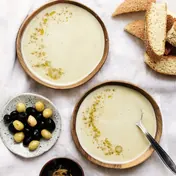
Bissara ★ 4.5
Bissara is the Moroccan winter-morning soup of pureed dried fava beans with olive oil, cumin and paprika; thick, almost a porridge, served with khobz bread for dunking.
Where to try it: Msemen Counters Bab Doukkala, Jemaa el-Fna Harira Stalls, Cafe Clock
Price: 5 to 15 MAD per bowl
Bissara is the working-class Moroccan breakfast, especially across the north and central Atlas region. Originally a dried-fava preparation for the poor and farm labourers, it became a city staple in cool months. In Marrakech, Bab Doukkala's counters run bissara from dawn through morning, particularly through November to February when overnight temperatures drop.
-

Msemen ★ 4.6
Msemen is the square layered Moroccan flatbread: dough rolled paper-thin, brushed with butter and semolina, folded into a square, then griddled to crisp golden layers. Served with honey or amlou.
Where to try it: Msemen Counters Bab Doukkala, Patisserie des Princes, Cafe Clock
Price: 5 to 10 MAD each
Msemen is the Maghreb's morning griddle bread, made across Morocco, Algeria and Tunisia. The folding technique creates the layered laminated structure that defines the bread, eaten plain with butter and honey, or stuffed with onions and tomatoes (msemen mahchi). Marrakech's Bab Doukkala counters run msemen daily from dawn, when bakers fold and griddle the squares on cast-iron skillets street-side.
Watch out for: Gluten
-
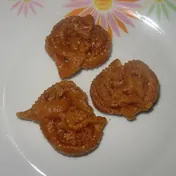
Chebakia ★ 4.5
Chebakia is the rose-shaped sesame-and-honey pastry of Ramadan: strips of orange-blossom-spiced dough folded into flowers, deep-fried, then dunked in warm honey and finished with toasted sesame.
Where to try it: Patisserie des Princes, Patisserie Amandine, Bacha Coffee
Price: 5 to 15 MAD each
Chebakia is the canonical Ramadan sweet across Morocco. Families fold thousands of pastries in the weeks before the holy month, sealed in tins for the iftar table; the pastry traditionally accompanies the harira-and-date opening of each fast. Outside Ramadan, chebakia turns up at weddings and the larger pastry shops year-round.
Watch out for: Gluten, Sesame
-

Kaab el Ghazal (Cornes de Gazelle) ★ 4.5
Kaab el ghazal are crescent-shaped Moroccan pastries filled with almond paste, ground cinnamon and orange-blossom water; the dough wrapped paper-thin around the filling and baked till pale.
Where to try it: Patisserie Amandine, Patisserie des Princes, Le Tobsil
Price: 5 to 15 MAD each
Kaab el ghazal (gazelle horns), called cornes de gazelle in French, is the Fassi pastry classic adopted across Morocco. The name refers to the crescent shape, said to evoke a gazelle's antler. Traditionally a wedding and Eid sweet; today, almond pastries sit on every Moroccan pastry-shop counter year-round and especially at Eid al-Fitr (March 20 to 22, 2026).
Watch out for: Gluten, Nuts
-
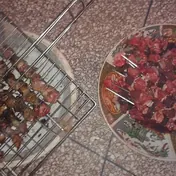
Boulfaf ★ 4.4
Boulfaf is grilled lamb liver wrapped in caul fat, threaded onto skewers and charred over coals; served with cumin, salt and khobz, four sticks for 30 to 50 MAD.
Where to try it: Jemaa el-Fna Boulfaf Grills, Chez Lamine Hadj Mustapha, Mechoui Alley
Price: 30 to 50 MAD for four skewers
Boulfaf is the Eid al-Adha specialty: the morning after the family sheep slaughter, the liver and lungs are skewered in caul fat and grilled over an outdoor brazier as the first meal of the holiday. Outside Eid, Jemaa el-Fna evening grills run boulfaf year-round. The dish is shared from a single platter; you tear bread, dip in cumin, lift a skewer.
Signature Dishes in Marrakech, FAQ
What food is Marrakech known for?
Marrakech's signature dishes include Tangia, Mechoui, Tagine, Couscous, Pastilla. See our signature dishes chapter for where to eat each.