
How Hamburg came to eat the way it does: the people, migrations and accidents that shaped the plate.
Key eras
-
Hanseatic founding, 1189 to 1500
Hamburg was founded by Charlemagne in 808 and granted free-port status by Friedrich Barbarossa in 1189, becoming a charter member of the Hanseatic League by 1300. The early Hamburg kitchen was shaped by the Baltic-North Sea trade in herring, salt, beer and grain; the city ran an enormous herring-curing industry by the 14th century.
-
Trade and exploration, 1500 to 1750
Hamburg's rise as a North Atlantic port brought coffee, sugar, spices and tropical fruit through the 17th and 18th centuries. The city's coffee culture began with the first Hamburg coffee house in 1672 on Gaensemarkt. Sugar refining became a major Hamburg industry; the city's first sugar refinery opened on Steinstrasse in 1684.
-
Industrial Hamburg and the great fire, 1800 to 1900
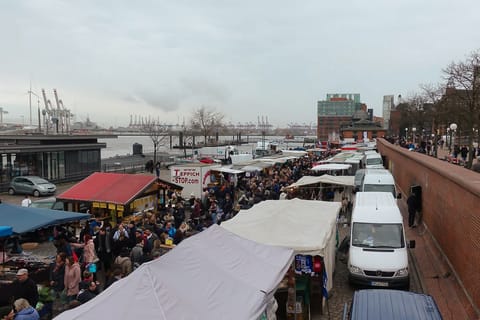
The 1842 Hamburg fire destroyed a quarter of the medieval city, including most of the central food markets and tavern district. The rebuilt city institutionalised the Sunday Fischmarkt, the working-class Imbiss culture, and harbour-front kiosks selling Fischbroetchen and Rundstueck Warm to dock workers.
-
Hamburg steak to hamburger, 1850 to 1950
The Rundstueck Warm and the Hamburger Beefsteak (a chopped-beef cake) became canonical 19th-century working-class Hamburg dishes. German emigrants carried both to New York via the Hamburg-Amerika Line steamship route after 1847; the Hamburger Beefsteak in a bread bun appeared in US menus by the 1870s and became the modern hamburger.
Taste it todayRundstueck Warm -
Modern Hanseatic and the Reeperbahn era, 1950 to present
Post-war Hamburg rebuilt around the Reeperbahn entertainment quarter, the harbour and a fine-dining scene that grew through the 1980s. Christoph Rueffer took over Haerlin's kitchen in 2002; by 2026 Hamburg holds two three-Michelin-star rooms (The Table Kevin Fehling and Haerlin) and over a dozen one- and two-star kitchens.
Immigrant influences
- French Huguenots (arrived 1685 to 1700)
- Huguenot refugees brought laminated pastry and butter-rich baking technique; the Franzbroetchen began as a Hamburg-Huguenot adaptation of the French Croissant in the Napoleonic occupation between 1806 and 1814.
- Portuguese-Jewish community (arrived 1590s)
- Portuguese Sephardic Jews fleeing the Inquisition brought citrus, chocolate and Iberian sugar-trade knowledge to Hamburg's 17th-century sugar-refining industry, and codified the early Hamburg sweets tradition.
- Turkish Gastarbeiter (arrived 1960s onwards)
- Turkish workers recruited for West German post-war labour built Hamburg's St Georg, Altona and Wilhelmsburg doener and grill counter network, with the Steindamm quarter and Hamburger Berg now anchoring the city's Turkish kebab and grill culture.
- Greek and Italian post-war migrants (1950s to 1970s)
- Greek and Italian Gastarbeiter codified the city's pizzeria, gelato and taverna economy through the 1960s and 1970s, with Eppendorf and Schanzenviertel Italian rooms now anchoring the city's pasta culture.
- Vietnamese refugees and contract workers (arrived 1970s to 1990s)
- Vietnamese refugees and former GDR contract workers built Hamburg's pho and banh mi corridor along Stresemannstrasse and in St Georg, with bao buns and ramen reaching the Schanze through MOMO Ramen and the wave of bun and bowl rooms that followed from 2014.Taste it todayMOMO Ramen
Signature innovations
- Fischbroetchen: harbour-worker lunch institutionalised on the Landungsbruecken from 1870, the city's lunch defining todayTaste it todayFischbroetchen
- Labskaus: the Hanseatic sailor's hash codified at Old Commercial Room since 1795Taste it todayLabskaus
- Franzbroetchen: Hamburg's own cinnamon pastry, the Huguenot-French Croissant rolled flat and pressedTaste it todayFranzbroetchen
- Hamburger Beefsteak: chopped beef cake that became the modern hamburger via Hamburg-Amerika emigrants to New York
- The Hanseatic harbour Sunday Fischmarkt at Altona (1703 to present), the world's oldest continuously-running Sunday market
- Aalsuppe: the Plattdeutsch "all-bits" soup misnamed across centuries as eel soup, with the sweet-sour balance the Hanseatic signature