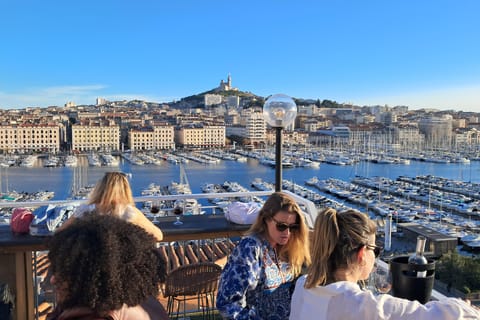
Guided tour · 3 hours
Marseille: Old Town Food Tour by Food Lover Tour
From breakfast to lunch, enjoy the food and drinks tour through Marseille's old towns: must-sees, must-eats, and must-drinks included!
from€84 Check dates
How Marseille came to eat the way it does: the people, migrations and accidents that shaped the plate.
How Marseille came to eat the way it does: the people, migrations and accidents that shaped the plate.
Phocaean Greek sailors from Asia Minor founded Marseille (Massalia) around 600 BC, planting olive trees, vines and fig orchards in the hinterland. They built the first quays on what became the Vieux Port, and the daily fish-and-shellfish market they ran from the harbour shaped the city's food culture from the first day.
Four des Navettes opened at 136 Rue Sainte in 1781, baking the orange-blossom navette biscuit in a Roman-model oven that still works. The bakery's boat-shaped biscuit comes from one of two legends about the Saintes Maries reaching the Provencal coast, and the archbishop has blessed the oven and the biscuits every Chandeleur since.
Marseille fishermen had cooked the leftover rock-fish stew for centuries, but Le Miramar and a handful of other rooms codified the recipe and the Charte de la Bouillabaisse into the 20th century. Rascasse, galinette, conger and saint-pierre cooked in a saffron-and-fennel broth, served as broth then carved fish, set the standard cuisine the city still holds.
Algerian, Moroccan and Tunisian Jews and Muslims arrived in Marseille across the 1947-1962 period, settling around Noailles and Rue d'Aubagne. Le Femina (Algerian Berber) had already been cooking on Rue du Musee since 1921, La Kahena (Tunisian) added in 1978, and the daily Marche des Capucins crystallised Noailles as the Maghrebi belly of the city by the 1970s.
The Passedat family had run Le Petit Nice on the Anse de Maldorme since 1917 and Gerald earned the third Michelin star in 2008, the first three-star room in the city. The cuisine reads as Mediterranean and bouillabaisse-derived; Alexandre Mazzia joined Gerald at three stars in 2021 with a more African-spiced sister kitchen.
Guided tour · 3 hours
From breakfast to lunch, enjoy the food and drinks tour through Marseille's old towns: must-sees, must-eats, and must-drinks included!

4 hours
Discover the elegance of French haute cuisine in a remarkable château setting. Enjoy an exclusive chef’s table experience featuring a multi-course menu, exceptional wi...

Day trip · 11h 30m
Discover the highlights of Provence on a tour exploring Les Baux-de-Provence, the Pont du Gard, and the city of Avignon. Finish with a wine tasting in the famous wine ...