History

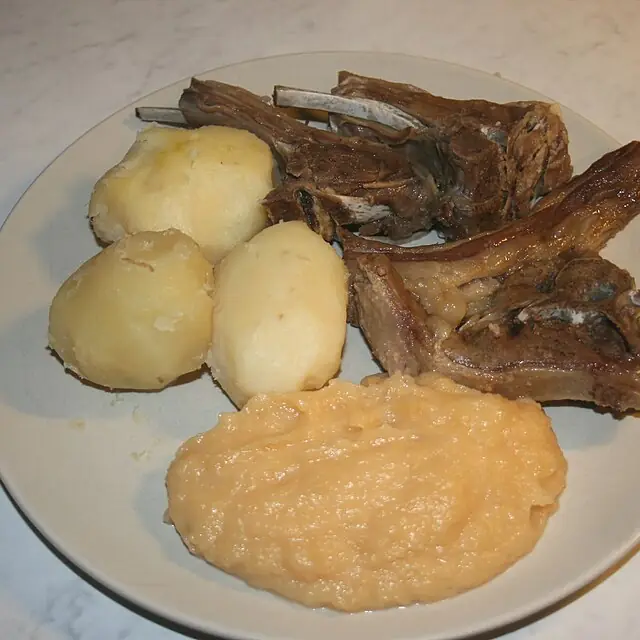
Pinnekjøtt (stick meat) is the Christmas Eve centrepiece across most of Western Norway, the steaming method named for the birch sticks that hold the salt-cured lamb ribs above the pot's water. The dish became a national Christmas table standard through the 20th century; surveys put it on roughly three in four Norwegian Christmas Eve tables today. Oslo's traditional kitchens at Engebret Café, Stortorvets Gjæstgiveri and Asylet all run a defensible version through Advent.

Make it at home

Yield 4Hands-on 30 minTotal 4 hrDifficulty Intermediate

Ingredients

  • 1.6kg salt-cured pinnekjøtt (Scandinavian deli or specialist butcher)
  • Birch twigs, bark stripped, or a metal steaming rack
  • 1.5 litres cold water (for steaming)
  • 800g rutabaga (swede), peeled and cubed
  • 200ml lamb cooking liquor or stock
  • 60g unsalted butter
  • 1/4 tsp ground white pepper
  • 1/2 tsp freshly grated nutmeg
  • Salt to taste
  • 800g boiled almond potatoes, to serve
  • Aquavit, to serve

Method

  1. Cut the rack between the bones. Submerge the ribs in a large bowl of cold water and soak for 24 to 30 hours at cool room temperature, changing the water once halfway through.
  2. Drain the ribs and pat dry. Line the bottom of a wide deep pot with stripped birch twigs (or a metal steaming rack) and pour in water to just below the level of the sticks.
  3. Arrange the ribs in two or three layers above the water. Cover tightly and bring the water to a strong simmer over medium heat.
  4. Reduce to the lowest heat that keeps steam rising and cook for 2 1/2 to 3 hours, topping up the water if it falls below the rack. The meat is done when it pulls cleanly from the bone.
  5. While the ribs steam, simmer the rutabaga in salted water for 25 minutes until very tender. Drain.
  6. Mash the rutabaga with the butter, 100ml of the lamb cooking liquor from the steaming pot, white pepper, nutmeg and a pinch of salt. The texture should be loose, not stiff.
  7. Lift the ribs onto a warm platter, brush with the cooking liquor and serve with the rutabaga mash, boiled potatoes and a chilled glass of aquavit.

Tip from the editors. Look for pinnekjøtt cured but not yet smoked if you can find it; smoked versions need less soaking. Never boil; the steam is what makes the texture.

Where to eat pinnekjøtt

Pinnekjøtt in Oslo

Engebret Café ★ 4.8

Traditional Norwegian$$$kvadraturenMon-Fri 11:30-23:00, Sat 17:00-23:00, Sun closed

Engebret Café at Bankplassen 1 is Oslo's oldest continuously operating restaurant, founded 1857 by Engebret Christoffersen, in a 1760s listed building.

Signature: Lutefisk in season, Reindeer fillet

Order: Lutefisk in the November-December season; reindeer fillet year-round.

Tip: Open from 17:00 weekdays; the lutefisk season runs through Advent and books out by mid-November.

Stortorvets Gjæstgiveri ★ 4.0

Traditional Norwegian$$$sentrumMon-Sat 11:00-23:00, Sun closed

Stortorvets Gjæstgiveri at Grensen 1 occupies a 1699 listed building one corner from Stortorvet square, with a la carte Norwegian classics, a courtyard.

Signature: Lutefisk in winter, Smorbrod platter

Order: Lutefisk plate October to Christmas; smorbrod at the cafe in summer.

Tip: The courtyard runs May to September; lutefisk season books out by November.

Asylet ★ 4.1

Traditional Norwegian$$gronlandMon 11:00-22:00, Tue-Fri 11:00-00:00, Sat 12:00-00:00, Sun 12:00-22:00

Asylet on Grønland in Oslo's old town is the wood-panelled 1730 merchant-yard timber building, one of the city's oldest, serving kjottkaker.

Signature: Kjottkaker with mash, Reindeer stew

Order: Kjottkaker with brown sauce and lingonberry; reindeer stew in winter.

Tip: The courtyard runs late spring through summer; the back-bar fireplace is the winter seat.

More cities are in research. Want pinnekjøtt covered somewhere specific? Tell us where you want to eat.

Browse all dishes →