


History
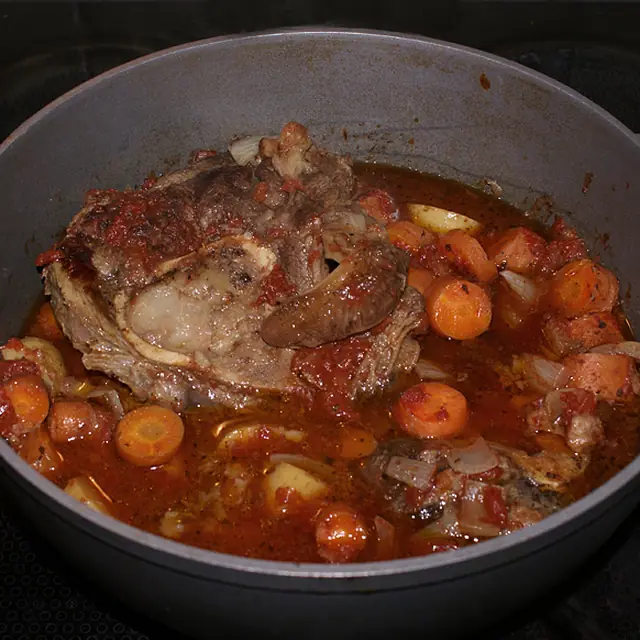
The oldest written recipe is dated 1839, when Francesco Cherubini recorded oss-buss in his Vocabolario milanese-italiano; Pellegrino Artusi's 1891 cookbook helped spread it abroad, and it won De.C.O. status in 2007. The slices come from the calf's shank, about 3 to 4 cm thick. The gremolata of lemon, garlic and parsley is part of the recipe, and the shank usually comes with saffron risotto as a single dish. Antica Trattoria della Pesa, Boeucc, Giannino, Savini and Testina list it.
Book a food experience
Tours, tastings and classes that match this page, bookable on GetYourGuide.
Make it at home
Ingredients
- 4 veal shank cross-cuts, 4 to 5cm thick, 300g each
- Plain flour, for dredging
- 60g unsalted butter
- 2 tablespoons olive oil
- 1 medium onion, finely diced
- 1 carrot, finely diced
- 1 celery stick, finely diced
- 250ml dry white wine
- 300ml veal or beef stock, hot
- 200g peeled plum tomatoes, hand-crushed (optional, the purist version omits)
- Sea salt, black pepper
- For the gremolata: zest of 1 lemon
- 1 garlic clove minced fine
- a small bunch of flat-leaf parsley chopped
Method
- Tie a length of butcher's twine around each shank to hold it together during the braise.
- Dredge each shank in flour. Heat the butter and olive oil in a heavy casserole; brown the shanks on all sides over medium-high heat, 5 minutes per side. Remove.
- In the same pan, sweat the onion, carrot and celery over low heat for 8 minutes until soft.
- Pour in the wine and reduce by half. Add the tomatoes if using, then the hot stock. Return the shanks to the pan. Season.
- Cover and braise in a 160C oven for 1 hour 45 minutes to 2 hours, turning the shanks once at the halfway point. The meat should be falling-tender; the marrow still in the bone.
- While the braise rests, make the gremolata: combine the lemon zest, minced garlic and parsley.
- Lift the shanks onto warm plates. Spoon the sauce over. Scatter the gremolata on top at the table. Serve with risotto giallo or polenta.
Tip from the editors. The marrow inside the bone is the prize. Eat it with a small spoon (a marrow scoop if you have one); spread on the gremolata, then on bread, then in the mouth.
Where to eat ossobuco alla milanese
Ossobuco alla milanese in Milan
Antica Trattoria della Pesa ★ 4.2
Antica Trattoria della Pesa, at Viale Pasubio 10, is one of the oldest restaurants in Milan, serving typical Lombard cuisine in a refined setting since 1880.
TipThe owners have kept the furnishings unchanged, with majolica stoves and old plaques, and Ho Chi Minh worked here in the 1930s.
Boeucc ★ 4.0
Boeucc, at Corso Monforte 16, has been the Antico Ristorante della Tradizione Milanese since 1696, an icon where tradition and refinement meet.
TipElegant attire is appreciated; the restaurant is closed Saturday for lunch and all day Sunday.
Giannino ★ 4.3
Giannino has served Milan since 1899, born in the belle époque and for over a century a reference point for the city's most reserved circles.
OrderRisotto alla milanese, and panettone to finish, both on the table during Oh Bej! from 7 December.
TipGroups can book a private room for 8 guests up to the whole restaurant for 100 covers, in the period rooms of Via Vittor Pisani.
Savini ★ 4.1
Testina Milano ★ 4.2
Testina is a Lombard trattoria on Via Abbadesse whose menu always carries the classics: riso al salto, costoletta alla milanese and risotto with ossobuco.
OrderThe risotto with ossobuco, riso al salto, mondeghili and the costoletta alla milanese.
TipClosed Monday and Saturday lunch. Lunch is a business lunch; the traditional menu is for the evening and the weekend.
More cities are in research. Want ossobuco alla milanese covered somewhere specific? Tell us where you want to eat.