Cornstore ★ 3.9
A converted Victorian corn market housing one of Cork's most reliably-executed steak and seafood rooms. The baked crab mornay and dry-aged Irish beef cuts.
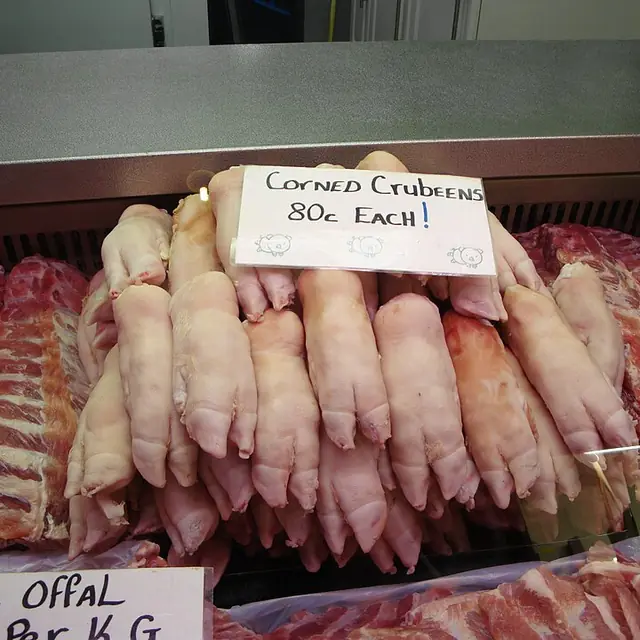
Cork's most stubborn old-pub dish: brined pig's trotters simmered long, then either eaten straight from the cooking liquor or split, breadcrumbed, and crisped under the grill.
Where to eat it: 3 restaurants across 1 city.
Crubeens (from the Irish crubin, meaning hoof) were sold by street vendors outside Cork pubs from the late 19th century until the 1960s as a working-class pub snack: the trotter slow-boiled in a stock pot of allspice and bay, served in the hand with a glass of stout. The Coal Quay markets ran the trade until the 1950s, when refrigeration changed butcher-shop economics. Today only a handful of Cork city kitchens still preserve the dish, notably Cornstore on Cornmarket Street and the Mutton Lane Inn during traditional autumn months; the Coal Quay revival markets occasionally bring back a vendor running the original boil. Pat O'Connell at the English Market still supplies the raw trotters.
Tip from the editors. Split trotters cook in half the time of whole ones; ask the butcher to do it, because the saw cut at home is rarely clean.
A converted Victorian corn market housing one of Cork's most reliably-executed steak and seafood rooms. The baked crab mornay and dry-aged Irish beef cuts.
Cork's most photogenic traditional pub, reached down a laneway off Patrick Street that the English Market guidebooks barely mention. The dark, fire-warmed.
Why locals love it: Mutton Lane is a narrow passage off Patrick Street that leads into the English Market complex.
The most dramatic dining room in Cork, inside the vaulted former Turkish baths on South Mall. A 130-seat restaurant with a private room, serving broadly.
More cities are in research. Want crubeens (cork pig's trotters) covered somewhere specific? Tell us where you want to eat.