History

The dessert predates the French creme brulee; written recipes go back to medieval Catalan kitchens of the 14th century, when monks at Sant Cugat del Vallès cooked a version flavoured with lemon zest, cinnamon and a hard-caramel sugar lid. The earliest version was eaten with bread on Saint Joseph's day in March; by the 19th century it had spread to every Catalan kitchen as the canonical sweet course. Barcelona's restaurants today serve it from December to August; the trick is the careful baking of the cream and then the burn-pass with a salamander iron rather than a torch. Casa Leopoldo runs the classic version; Disfrutar deconstructs and reassembles it as a modernist tasting course.
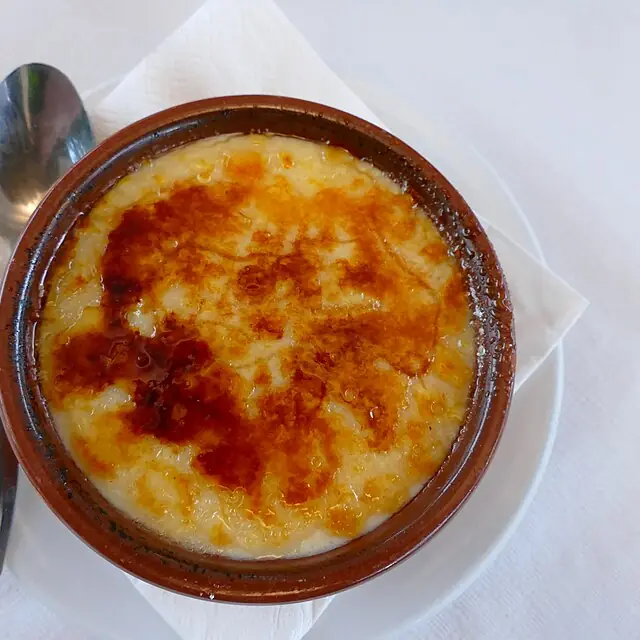

Common allergens: Dairy, Egg

Make it at home

Yield Serves 4Hands-on 20 minTotal PT3H (with chill)Difficulty Easy

Ingredients

  • 500ml whole milk
  • Zest of 1 unwaxed lemon (peeled in strips)
  • 1 cinnamon stick
  • 5 large egg yolks
  • 100g caster sugar
  • 30g cornflour
  • Extra caster sugar for the brittle top

Method

  1. Heat the milk with the lemon zest strips and cinnamon stick. Bring to just below boiling, then turn off heat. Steep 20 minutes. Strain.
  2. Whisk the egg yolks with sugar and cornflour until pale and thick.
  3. Slowly pour the warm infused milk into the egg mix, whisking constantly.
  4. Return to a clean pan; cook over low heat, stirring with a wooden spoon, until the cream thickens to coat the back of the spoon (about 5 minutes).
  5. Pour into four shallow ramekins. Chill in the fridge for at least 2 hours, ideally overnight.
  6. Before serving, sprinkle a thin even layer of caster sugar over each cream. Torch the surface (or run under a hot grill) until the sugar caramelises and forms a hard brittle lid.
  7. Tap with a teaspoon to crack the lid. Serve immediately.

Tip from the editors. Cornflour gives it the proper Catalan texture; do not substitute with double cream like the French brulee. Burn the sugar at the table for full theatre.

This is the TableJourney editorial recipe, modelled on the canonical bistro / counter version. The first place to try the dish in its city of origin is below.

Where to eat crema catalana

Crema catalana in Barcelona

Casa Leopoldo ★ 4.4

Catalan classic€€€raval

Casa Leopoldo in Barcelona's Raval, founded 1929 and revived by Romain Fornell, holds the canonical version of cap i pota and the Catalan suquet.

Signature: Cap i pota, Suquet de peix

Order: The cap i pota with chickpeas and the fish suquet for two.

Tip: Closed Sunday dinner and all Monday. Lunch menu del dia is the easier price point.

7 Portes ★ 4.3

Catalan classic€€€born

7 Portes in Barcelona's Born has run since 1836: arched rooms, brass plaques on regulars' tables, a paella for each day of the week.

Signature: Parellada paella, Catalan cream

Order: The Thursday paella Parellada and the crema catalana to finish.

Tip: Lunch is easier than dinner; the noon paella is held on the menu every day of the week.

Semproniana ★ 4.1

Catalan creative€€eixample

Semproniana in Barcelona's Eixample is Ada Parellada's family-run Catalan creative room since 1993: the crema catalana sandwich and Iberian carpaccio are signature.

Signature: Crema catalana sandwich, Iberian carpaccio

Order: The crema catalana sandwich for dessert; Iberian carpaccio to start.

Tip: Lunch carte is the price point; book Friday or Saturday a week ahead.

Bar del Pla ★ 4.5

Modern Catalan tapas€€born

Bar del Pla in Barcelona's Born is the locals' counter on Montcada that draws the chef trade for the modernised tapas and natural-wine pours.

Signature: Beef carpaccio with truffle, Iberico pork cheeks

Order: The beef carpaccio with truffle and the slow-cooked Iberico cheeks.

Tip: Open daily lunch and dinner; book the bar over the back room. Walk-up after 22:30 is the easier slot.

More cities are in research. Want crema catalana covered somewhere specific? Tell us where you want to eat.

Browse all dishes →