History

Paling in 't Groen (called anguilles au vert in French-speaking Belgium) is a 19th-century Flemish freshwater dish from the Scheldt and the polders, where eel was once the dominant river catch. The dish was working-class summer cooking: chefs gathered wild herbs of early spring (sorrel, chervil, watercress, lemon balm), poached eel fillets in white wine, and blended the herbs into the cooking liquid to make a brilliant green sauce. Today most restaurants use farm-raised European eel. Bruges Michelin-starred kitchens like De Jonkman run refined versions; brasseries like Den Amand serve the canonical version.
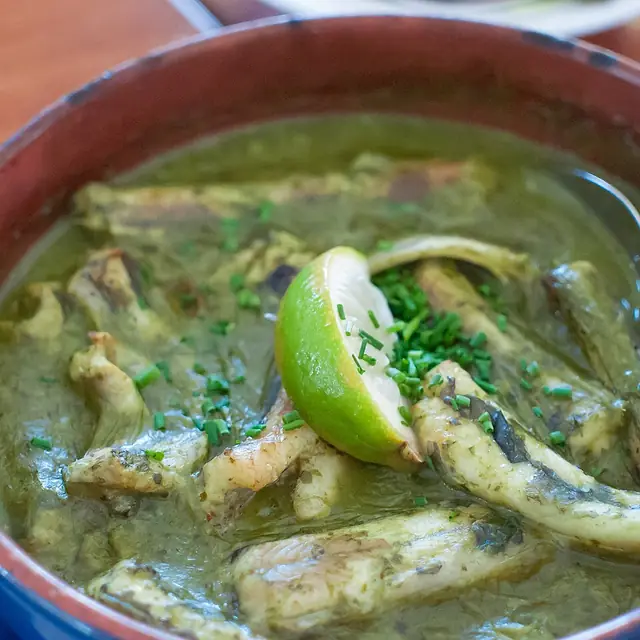
Common allergens: Fish, Dairy, Sulphites

Make it at home

Yield 4Hands-on 45 minTotal 1 hrDifficulty Intermediate

Ingredients

  • 800g fresh European eel fillets, skinned and cut into 6cm pieces (sold at quality fishmongers; substitute with monkfish, hake or thick whiting if eel is unavailable)
  • 60g unsalted butter
  • 2 large shallots, finely diced
  • 300ml dry white wine (a crisp Belgian or Alsatian Riesling)
  • 200ml fish stock or chicken stock
  • 2 large bunches fresh flat-leaf parsley (about 80g leaves)
  • 1 large bunch fresh chervil (40g leaves; if unavailable, double the parsley)
  • 1 small bunch fresh sorrel (30g leaves; substitute with 2 tbsp lemon juice plus 30g extra spinach)
  • 1 small bunch watercress (30g)
  • 100g young spinach leaves
  • 1 tbsp finely chopped tarragon
  • 2 tbsp fresh chives, snipped
  • 200ml double cream
  • 2 large egg yolks
  • Sea salt and freshly ground white pepper
  • 1 tbsp lemon juice
  • To serve: fresh crusty bread or boiled new potatoes

Method

  1. Melt the butter in a wide heavy pan over medium heat. Add the shallots and cook 4 minutes until soft and translucent.
  2. Pour in the white wine and the fish stock. Bring to a low simmer.
  3. Lay the eel pieces gently in the simmering liquid; poach 6 to 8 minutes (depending on thickness) until just opaque and tender. Lift the eel out and keep warm.
  4. Blanch the parsley, chervil, sorrel, watercress, spinach, tarragon and chives in a separate pot of boiling water for 30 seconds; immediately refresh in iced water and drain (this is the structural step that locks in the brilliant green colour).
  5. Transfer all the blanched herbs and 200ml of the eel poaching liquid into a powerful blender; blend to a vivid emerald puree.
  6. Reduce the remaining poaching liquid in the pan over medium heat for 5 minutes until concentrated.
  7. Whisk the egg yolks and cream together in a bowl; temper by streaming in a ladle of the hot reduced liquid while whisking.
  8. Return the cream mixture to the pan with the herb puree; warm over very low heat, whisking constantly, until the sauce thickens slightly to coat a spoon (about 78 degrees Celsius). Do not boil; the sauce will split.
  9. Off the heat, stir in the lemon juice, salt and white pepper.
  10. Return the eel to the warm sauce just to reheat for 60 seconds.
  11. Plate immediately in shallow bowls with crusty bread or boiled new potatoes. The sauce should be emerald and glossy; the dish is at its visual peak in the first 5 minutes after plating.

Tip from the editors. Blanch the herbs only briefly and shock immediately in iced water; the green colour fades fast in a hot sauce. Do not let the sauce boil after the egg yolks are in; it will split. Sorrel is the canonical sour note; if unavailable, replace with extra spinach and a generous squeeze of lemon.

Where to eat paling in 't groen (anguilles au vert)

Paling in 't Groen (Anguilles au Vert) in Bruges

De Jonkman 2 ★ ★ 4.8

Modern Flemish, North Sea SeafoodChef Filip Claeys€€€€€185 to €245sint-kruisWed-Sat 12:00-13:30, 19:00-20:30; Sun-Tue closedBook 6 weeks ahead

De Jonkman in Bruges holds two Michelin stars under Filip Claeys, who builds menus around lesser-known North Sea fish from his room in Sint-Kruis.

Signature: North Sea bycatch courses, Seasonal tasting menu

Order: The full tasting menu; Claeys structures it around bycatch and West Flemish produce of the week.

Tip: Closed Sunday through Tuesday. Lunch is the more accessible entry; book six weeks out for a Friday or Saturday dinner.

Sans Cravate 1 ★ ★ 4.6

InternationalChef Henk Van Oudenhove€€€€€95 to €165langestraatMon-Tue 12:00-13:30, 19:00-20:30; Fri-Sat 12:00-13:30, 19:00-20:30; Wed-Thu, Sun closedBook 3 weeks ahead

Sans Cravate in Bruges holds one Michelin star on Langestraat, where Henk Van Oudenhove cooks known dishes in a contemporary register from an open kitchen.

Signature: Open-kitchen tasting menu, Classic dishes worked contemporary

Order: The tasting menu from the open pass; the kitchen leans on regional produce and North Sea fish.

Tip: Open Monday, Tuesday, Friday and Saturday only; closed Wednesday, Thursday and Sunday. Lunch is the better-value entry point.

Den Amand ★ 4.5

Belgian-french Bistro€€marktTue-Sat 12:00-14:00, 18:00-21:00; Sun-Mon closed

Den Amand is a small family bistro off the Markt in Bruges, on car-free Sint-Amandsstraat, where Ann Vissers cooks seasonal vegetable, fish and meat dishes.

Signature: Seasonal vegetable plates, Fish and meat of the day

Order: Whatever the monthly menu is built around; vegetables get a generous hand here.

Tip: Closed Wednesday and Sunday. The room is tiny, so reserve, especially in summer.

Bistro Refter ★ 4.7

Contemporary Belgian€€€sint-annaTue-Sat 12:00-14:00, 18:30-22:00; Sun-Mon closed

Bistro Refter in Bruges is Geert Van Hecke's contemporary bistro on Molenmeers, the relaxed counterpart to his fine-dining room. Good food at fair prices.

Signature: Daily bistro menu, Regional plates

Order: The daily three-course menu; it is the value way into Van Hecke's cooking.

Tip: Book ahead, the dining room fills fast at lunch. It sits near the Sint-Anna quarter.

More cities are in research. Want paling in 't groen (anguilles au vert) covered somewhere specific? Tell us where you want to eat.

Browse all dishes →