
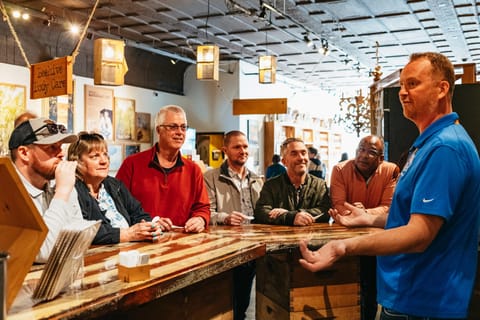
Savannah
Guided tour · 3 hours
Savannah: Historic District Foodie Walking Tour
Discover historic Savannah on a guided foodie tour. Learn about the city's fascinating history, elegant architecture, and unique culture, with food...
from$97Check dates
22 editor-picked lowcountry restaurants across 4 cities.
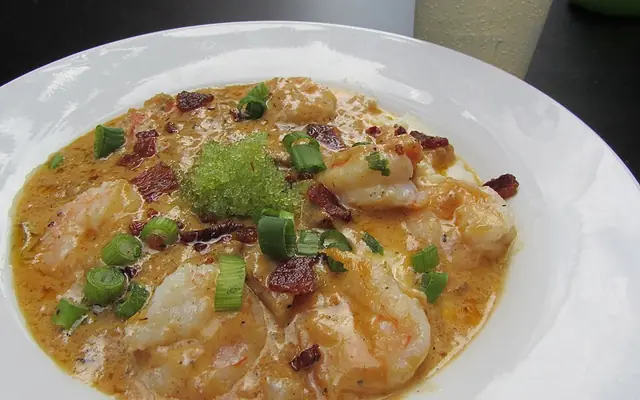
Lowcountry cuisine is the cooking of the coastal plain of South Carolina and Georgia (and parts of North Carolina), a region defined by tidal rivers, sea islands, and the Gullah-Geechee community of African Americans who descend from enslaved West Africans, particularly from the rice-growing region of Senegambia. The cuisine takes its name from the geographic 'low country' (the flat, low-elevation coastal plain) and is distinct from Southern food broadly and from soul food. Its center is Charleston, with strong satellites in Savannah, Beaufort, and the sea islands (St. Helena, Edisto, Sapelo, Daufuskie).
The defining grammar is rice. Carolina Gold rice (the heritage long-grain variety that built Charleston's antebellum wealth and was nearly extinct before being revived by Glenn Roberts of Anson Mills) is the foundation of the cuisine. Around the rice are shellfish (shrimp, oysters, blue crab, clams), pork (the country ham and bacon tradition, plus fresh and smoked sausage), benne seed (sesame, brought by enslaved Africans, used in benne wafers and brittle), sea island red peas, okra (also West African in origin), and the tidal vegetables of the coastal gardens (collards, butterbeans, field peas, summer tomatoes).
Lowcountry cooking shares with West African foodways the rice-and-stew structure (think jollof and West African one-pot rice dishes), the use of okra as both vegetable and thickener (gumbo's grandparent), and the peanut and benne seed pantry. The Gullah-Geechee community on the sea islands preserved these traditions through 200 years of geographic and cultural isolation, and the recent revival of Lowcountry as a serious culinary identity (led by Sean Brock at Husk in Charleston, Mashama Bailey at The Grey in Savannah, BJ Dennis as Gullah-Geechee ambassador) has finally brought it the recognition it has long deserved.
Tours, tastings and classes from the cities on this page, bookable on GetYourGuide.
Guided tour · 3 hours
Discover historic Savannah on a guided foodie tour. Learn about the city's fascinating history, elegant architecture, and unique culture, with food...

Guided tour · 2 hours
Choose a 2-hour express or 3-hour full Boston food tour. Taste clam chowder, arancini, brick oven pizza, cannoli, and more while exploring the North...
Guided tour · 2 hours
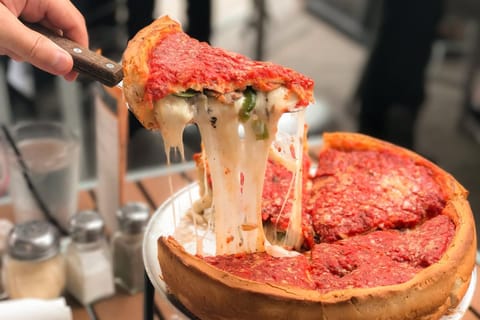
Taste some of Chicago's most iconic foods while walking through one of the Prohibition Era’s most fashionable and notorious gangster-ridden...
Guided tour · 2.5 hours
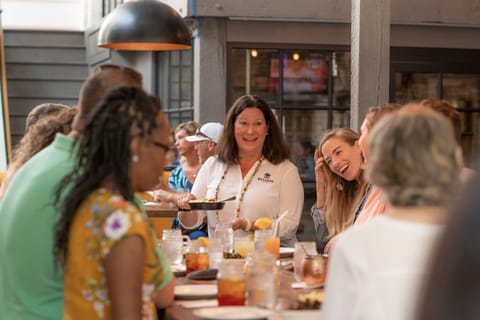
Experience the flavors of Charleston with the help of local guides. Delve into over 300 years of culinary history as you taste your way through the...
The best-scored lowcountry place in each of 4 cities.
Mike Lata and Jason Stanhope's FIG in Charleston has been the neighbourhood-scaled dining benchmark since 2003. Kitchen leans lowcountry, seasonal.
OrderThe fish stew with house-cut potatoes and aioli; rotates by season.
TipBook 30 days ahead on Resy. Bar seats are first-come Booking recommended for weekends.
Heritage-grain Lowcountry on Oglethorpe, opened January 2018 as the fourth Husk from Sean Brock's group. Wood-grilled coastal Georgia fish, Anson Mills grits.
Book2 weeks ahead
Automatic Seafood and Oysters in Lakeview Birmingham won Adam Evans the 2022 James Beard Best Chef South, with a Gulf-anchored menu and a half-shell raw bar.
SignatureGulf oysters, Whole fried fish, Shrimp and grits
The Jones Oyster Co. runs a walk-in oyster bar on East Court Street: a half-dozen East Coast varieties, lobster rolls, hush puppies, no reservations.
SignatureEast coast oysters, Lobster roll, Hush puppies
Mike Lata and Jason Stanhope's FIG in Charleston has been the neighbourhood-scaled dining benchmark since 2003. Kitchen leans lowcountry, seasonal.
OrderThe fish stew with house-cut potatoes and aioli; rotates by season.
TipBook 30 days ahead on Resy. Bar seats are first-come Booking recommended for weekends.
Heritage-grain Lowcountry on Oglethorpe, opened January 2018 as the fourth Husk from Sean Brock's group. Wood-grilled coastal Georgia fish, Anson Mills grits.
Book2 weeks ahead
Automatic Seafood and Oysters in Lakeview Birmingham won Adam Evans the 2022 James Beard Best Chef South, with a Gulf-anchored menu and a half-shell raw bar.
SignatureGulf oysters, Whole fried fish, Shrimp and grits
Classical Lowcountry tasting in a 1900s Victorian mansion opened by Elizabeth Terry in 1981; Terry won James Beard Best Chef Southeast 1995. Special-occasion.
Book2 weeks ahead
Leopold's ice cream cones, root beer floats and banana splits come in under $10 each at the working soda fountain. Walk-up Broughton open until midnight.
TryIce cream sundaes and floats
Bayonet on 2nd Avenue North in Birmingham is Rob and Emily McDaniel's spring 2025 seafood and raw bar sibling to Helen, in the NYT 50 Best Restaurants 2025.
SignatureOysters on the half shell, Tableside martini, Crudo
Slightly North of Broad in Charleston has run on East Bay Street since 1993. Brunch and lunch are easier seats than dinner. Bar seats are walk-in only.
OrderThe shrimp and grits with stone-ground grits and house kielbasa, on the menu since the 90s.
TipBrunch and lunch are easier seats than dinner. Bar seats are walk-in only.
Jason Stanhope and partners reopened Sullivan's Fish Camp on Middle Street in Sullivan's Island in 2022. Located in Sullivans Island. Priced at $$$.
OrderA half-dozen oysters from the daily list, then the wood-grilled whole fish.
TipBook on Resy. The bar serves the full menu and turns faster than the dining room.
The Jones Oyster Co. runs a walk-in oyster bar on East Court Street: a half-dozen East Coast varieties, lobster rolls, hush puppies, no reservations.
SignatureEast coast oysters, Lobster roll, Hush puppies
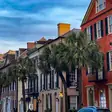 Charleston13 places
FIG, Slightly North of Broad
Charleston13 places
FIG, Slightly North of Broad
 Savannah6 places
Husk Savannah, Elizabeth on 37th
Savannah6 places
Husk Savannah, Elizabeth on 37th
 Birmingham2 places
Automatic Seafood and Oysters, Bayonet
Birmingham2 places
Automatic Seafood and Oysters, Bayonet
 Greenville1 place
The Jones Oyster Co.
Greenville1 place
The Jones Oyster Co.
The center of Lowcountry fine dining and the modern revival. Husk, FIG, The Ordinary, Rodney Scott's (BBQ adjacent), and the heritage institutions like Hominy Grill. The cuisine's most refined contemporary expression.
Slightly less refined, more home-style, with Mashama Bailey's The Grey as the modern reference point. Strong influence from Liberty County and the historic Geechee community.
St. Helena, Edisto, Sapelo, Daufuskie. The most directly West-African-rooted cooking in the United States. One-pot rice perloos, red rice, okra soup, hoppin' john, smoked-pork-and-bean stews. Saltwater Geechee cooking is its own specific subregion.
Overlap with Lowcountry, with stronger pork BBQ and lighter rice emphasis. Wilmington and the Cape Fear delta share the coastal-shellfish base but cook with a North Carolina Coastal Plain inflection.
A Lowcountry meal often starts with a shrimp or crab starter (pickled shrimp, she-crab soup, crab cakes) or boiled peanuts at a bar. The main is rice-led (shrimp and grits, red rice with sausage, hoppin' john) or shellfish-led (lowcountry boil, fried oysters, soft-shell crab in season). Sides are stewed vegetables (okra, butterbeans, field peas, collards) and cornbread or biscuits. Benne wafers or peach cobbler closes the meal. At a serious Lowcountry restaurant, the wine and beer list will include local Charleston and Savannah breweries and a thoughtful Southern wine selection.
The rookie mistakes: ordering shrimp and grits at every meal (it is one of many great dishes, not the only one), expecting the rice to be plain (Carolina Gold and red rice are the dish, not a side), ignoring the boiled peanuts at the gas station (they are the regional snack), and missing the soft-shell crab season (May into early summer, with the best examples in coastal Carolina and Georgia). Tipping is 20 percent.
Sweet tea is the table drink, though Charleston has the strongest cocktail program in the South (sazerac, mint julep, gin-and-tonic with garden herbs). With shrimp and grits, a crisp white (Albarino, Vermentino, a dry Riesling) works. With country ham, a sherry or madeira. With lowcountry boil and shellfish, ice-cold beer (Westbrook IPA, Holy City lager). The South Carolina wine industry is small; the local pairing strength is in beer and cocktails, plus an increasingly serious selection of Old World whites and roses on the better Charleston wine lists.
Charleston is the center: Husk, FIG, The Ordinary, Hominy Grill, Rodney Scott's BBQ, Bertha's Kitchen (the Gullah-Geechee soul food anchor in North Charleston), Hannibal's Kitchen. Savannah for The Grey, Mrs. Wilkes Dining Room, and the Geechee-influenced cooking of the Georgia coast. Beaufort and the sea islands for the most directly Gullah-Geechee experience (Gullah Grub on St. Helena Island). Outside the region, the cuisine has not really exported, which makes a Charleston-Savannah trip the essential way to encounter it.
Lowcountry cuisine emerged from the rice plantations of coastal South Carolina and Georgia from the late 17th century, where enslaved West Africans, particularly from the rice-growing region of Senegambia, built one of the wealthiest plantation economies in the antebellum United States while preserving and adapting their own foodways. The Gullah-Geechee community on the sea islands maintained these traditions through Reconstruction, the Great Migration, and the 20th century. The modern Lowcountry culinary revival began in the 1990s and accelerated through the 2000s and 2010s with the chefs (Sean Brock, Mashama Bailey, BJ Dennis) who recentered Carolina Gold rice, benne, and Gullah-Geechee cooking in fine dining.
The descendants of enslaved West Africans, primarily from the rice-growing region of Senegambia (modern Senegal, Gambia, Sierra Leone), who were brought to the sea islands of South Carolina and Georgia to work the rice plantations. They preserved a distinct creole language (Gullah, related to West African Krio) and a foodway that retained more direct West African elements than any other Black American community.
Lowcountry. The dish originated as a coastal Carolina fisherman's breakfast (shrimp dressed simply over grits) and became a restaurant standard via Bill Neal at Crook's Corner in Chapel Hill in the 1980s. It has since spread to Southern menus nationally, but the original is Lowcountry.
A heritage long-grain rice variety, with a slight golden hue when ripe, that was the cornerstone of the South Carolina antebellum rice economy. It nearly went extinct in the 20th century after rice production moved to other states. Glenn Roberts of Anson Mills led a revival starting in the 1990s, and it is now the rice of choice for any serious Lowcountry restaurant.
More cities are in research. Want lowcountry covered somewhere specific? Tell us where you want to eat.