

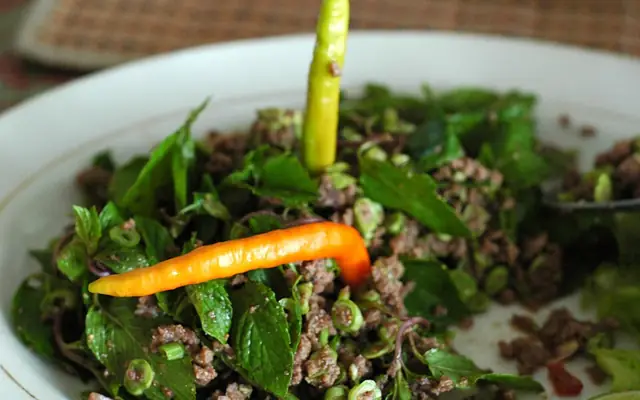
Lao cuisine is the food of Laos, the landlocked country between Thailand, Vietnam, Cambodia, Myanmar, and China, and the cultural source of the Isaan tradition of northeastern Thailand. The defining grammar is sticky rice (khao niao) as the staple eaten by hand from a bamboo basket, fermented fish paste (padaek, the Lao equivalent of Thai pla ra), fresh herbs in enormous quantities (mint, cilantro, dill, sawtooth coriander), grilled meats (especially river fish and chicken), and the multi-dimensional salads (larb, koi, namtok) that exist nowhere else in their original form. Lao cooking uses less coconut and less sweetness than Thai cooking; it is leaner, sharper, and more herb-forward.
Sticky rice is non-negotiable. Lao people eat more sticky rice per capita than any other nation (over 150 kilograms per person per year), and the bamboo steamer basket (tip khao) is the universal serving vessel. Diners pinch a ball of rice with the right hand, dip it into a sauce or scoop up a piece of meat or vegetable, and eat. Cutlery is used for noodle soups and a few other dishes; sticky rice meals are entirely hands-on. The Lao meal arrives all at once in shared platters; the rice is the constant, and the dishes (one or two protein, one or two salad, one or two soup, multiple jaew dipping sauces) are accompaniments.
Jaew is the family of Lao dipping sauces, conceptually similar to Mexican salsa or Korean ssamjang. Jaew bong (caramelized chile paste with dried buffalo skin, the most famous), jaew som (sour fish sauce), jaew makheua (charred eggplant dip), and dozens of regional variations sit alongside any Lao meal as the seasoning the diner controls. The cuisine assumes the diner is actively involved in shaping each bite. The diaspora following the Lao Civil War and the 1975 socialist takeover scattered Lao cooking across Thailand, France, the US (especially Minnesota and Tennessee), Canada, and Australia, where it is often labeled and sold as Thai by restaurateurs hoping for wider recognition.
Book a food experience
Tours, tastings and classes from the cities on this page, bookable on GetYourGuide.


Top picks
The best-scored Laotian place in each of 8 cities.
Ahan ★ 4.8
Ahan on Williamson Street, the Brown-Soukaseume family's Asian-inspired room, brings Laotian and Southeast-Asian dishes to the Willy Street corridor.
OrderA Laotian curry preparation plus the spring rolls and a rotating special.
TipReservations via the operator's site; takeout runs faster than dine-in at peak weekend hours.
Ma Der Lao Kitchen ★ 4.7
Ma Der Lao Kitchen in Oklahoma City brings James Beard-nominated Lao cooking: papaya salad, laab gai, and sticky rice from chef Jeff Chanchaleune.
Bida Manda ★ 4.6
Bida Manda serves Lao cuisine at 222 S Blount St, with each dish inspired by what you might find on the streets of Luang Prabang or in a Laotian home.
SignatureGreen papaya salad, Khao poon noodle soup
Champa Garden ★ 4.5
Champa Garden on 8th Avenue cooks Lao and Thai family recipes since 2006. The room sits ten minutes from Lake Merritt, daily lunch and dinner.
SignatureNam khao, Lao sausage
Thip Khao ★ 4.5
Thip Khao in Washington DC is Seng Luangrath's Columbia Heights Laotian dining room on 14th Street, the city's anchor Laotian kitchen with a separate.
OrderThe Laotian-style beef larb from the jungle menu; ask for the off-menu insert by name.
TipThe crispy rice salad and Lao sausage are the second-meal must-orders; bring a wine you don't mind opening (BYO).
Kiin Lao & Thai Eatery ★ 4.5
Kiin Lao & Thai Eatery is a small squirrel hill room serving Laotian dishes most pittsburgh menus skip, hiding behind a more familiar thai list.
Why locals goA small Squirrel Hill room serving Laotian dishes most Pittsburgh menus skip, hiding behind a more familiar Thai list.
TipAsk for the Laotian larb and sticky rice, not just the Thai standards. Small room; reserve at weekends.
Snackboxe Bistro ★ 4.4
Snackboxe Bistro re-opened in Duluth in 2024 as Atlanta's only full-menu Laotian kitchen: larb gai, khao soi and sticky rice from owner Thip Athakhanh.
OrderLarb gai with sticky rice and khao soi.
Why locals goAfter closing the original Doraville room in 2024, owner Thip Athakhanh re-opened in Duluth in a strip mall; only Atlanta-area Laotian kitchen serving full Lao menus.
TipOrder the larb and the khao soi; share a sticky rice basket. Beer-and-wine only, no liquor.
Tip Khao ★ 4.3
Tip Khao is a Laotian family restaurant on Rue de Vesle in Reims, serving laab, banana-leaf fish and pad kra pao, with mains between €12 and €18.
OrderThe laab beef tartare with sticky rice, then the banana-leaf mok pa fish or the pad kra pao.
TipClosed Sunday and Monday; the menu lists starters from €8 and mains from €12, with sticky rice at €3.50.
Find a place
Ahan ★ 4.8
Ahan on Williamson Street, the Brown-Soukaseume family's Asian-inspired room, brings Laotian and Southeast-Asian dishes to the Willy Street corridor.
OrderA Laotian curry preparation plus the spring rolls and a rotating special.
TipReservations via the operator's site; takeout runs faster than dine-in at peak weekend hours.
Ma Der Lao Kitchen ★ 4.7
Ma Der Lao Kitchen in Oklahoma City brings James Beard-nominated Lao cooking: papaya salad, laab gai, and sticky rice from chef Jeff Chanchaleune.
Bida Manda ★ 4.6
Bida Manda serves Lao cuisine at 222 S Blount St, with each dish inspired by what you might find on the streets of Luang Prabang or in a Laotian home.
SignatureGreen papaya salad, Khao poon noodle soup
Champa Garden ★ 4.5
Champa Garden on 8th Avenue cooks Lao and Thai family recipes since 2006. The room sits ten minutes from Lake Merritt, daily lunch and dinner.
SignatureNam khao, Lao sausage
Thip Khao ★ 4.5
Thip Khao in Washington DC is Seng Luangrath's Columbia Heights Laotian dining room on 14th Street, the city's anchor Laotian kitchen with a separate.
OrderThe Laotian-style beef larb from the jungle menu; ask for the off-menu insert by name.
TipThe crispy rice salad and Lao sausage are the second-meal must-orders; bring a wine you don't mind opening (BYO).
Kiin Lao & Thai Eatery ★ 4.5
Kiin Lao & Thai Eatery is a small squirrel hill room serving Laotian dishes most pittsburgh menus skip, hiding behind a more familiar thai list.
Why locals goA small Squirrel Hill room serving Laotian dishes most Pittsburgh menus skip, hiding behind a more familiar Thai list.
TipAsk for the Laotian larb and sticky rice, not just the Thai standards. Small room; reserve at weekends.
Thip Khao (late night) ★ 4.4
Thip Khao in Washington DC is Seng Luangrath's Columbia Heights Laotian dining room with late-night service until 23:00 Friday and Saturday.
TryLaotian larb and sticky rice
TipAsk for the off-menu jungle insert by name; the bartender pulls the BYO wine for any party that brings a bottle.
Snackboxe Bistro ★ 4.4
Snackboxe Bistro re-opened in Duluth in 2024 as Atlanta's only full-menu Laotian kitchen: larb gai, khao soi and sticky rice from owner Thip Athakhanh.
OrderLarb gai with sticky rice and khao soi.
Why locals goAfter closing the original Doraville room in 2024, owner Thip Athakhanh re-opened in Duluth in a strip mall; only Atlanta-area Laotian kitchen serving full Lao menus.
TipOrder the larb and the khao soi; share a sticky rice basket. Beer-and-wine only, no liquor.
Vientian Cafe ★ 4.3
Vientian Cafe in Oakland's Allendale neighborhood runs a Lao-Thai-Vietnamese counter that locals have voted into a regional Lao standard for two decades.
SignatureLarb, Papaya salad, Lao sausage
Tip Khao ★ 4.3
Tip Khao is a Laotian family restaurant on Rue de Vesle in Reims, serving laab, banana-leaf fish and pad kra pao, with mains between €12 and €18.
OrderThe laab beef tartare with sticky rice, then the banana-leaf mok pa fish or the pad kra pao.
TipClosed Sunday and Monday; the menu lists starters from €8 and mains from €12, with sticky rice at €3.50.
Laotian by city









Regional variations
Vientiane and central Laos
The most cosmopolitan Lao food scene. French colonial influence visible in baguettes (khao jee), patisserie, and coffee. Larb, ping kai (grilled chicken), or lam (Luang Prabang stew, though present in Vientiane). The modern Lao restaurant scene leads here.
Luang Prabang and the north
The deepest traditional Lao cuisine. Or lam (buffalo stew with eggplant and dill), khao soi (the Lao version with fermented bean paste, distinct from the Thai), jeow bong, and a strong river-fish tradition from the Mekong. The royal Lao court tradition originated here.
Southern Laos (Pakse, Champasak)
Closer to Cambodian Khmer cuisine. Stronger prahok-like use of fermented fish, river-fish dishes from the southern Mekong, and the influence of the 4000 Islands area. Heat levels approach Cambodian Khmer.
Lao diaspora (Isaan in Thailand, France, US)
Northeastern Thailand (Isaan) is functionally the same culinary region as Laos and is often considered Lao cuisine politically separated by national border. Diaspora Lao restaurants in France (Paris) and the US (Minnesota, Tennessee, California) preserve the cuisine in less-modified form than diaspora Thai.
Defining Laotian dishes
- Larb (Laap)
- Minced meat salad with toasted rice powder, lime juice, fish sauce, mint, sawtooth coriander, and shallot. Larb mu (pork), larb gai (chicken), larb pa (fish), larb sin (beef), and the raw larb (laap dip) for the brave. The Lao national dish.
- Tam Mak Hoong (Som Tam Lao)
- Green papaya salad pounded in a clay mortar with fermented fish (padaek), lime, garlic, chile, palm sugar, and tomato. Saltier and more pungent than Thai som tam; the Lao original. Eaten with sticky rice.
- Khao Niao (Sticky Rice)
- Glutinous rice soaked overnight, then steamed in a bamboo basket. Eaten by hand, in balls pinched from the basket and used as scoops. The Lao staple at every meal.
- Ping Kai
- Marinated grilled chicken (often half a chicken butterflied) cooked over charcoal, eaten with sticky rice and jaew dipping sauces. The Lao street-grill standard.
- Or Lam
- Luang Prabang lamb stew with eggplant, sakhan (a peppery wood from the local pepper tree), dill, and water buffalo or chicken. The Luang Prabang signature.
- Khao Soi Lao
- Lao-style noodle soup with rice noodles, fermented soybean paste, ground pork, and pickled mustard greens. Distinct from Thai khao soi (which has coconut and curry). Found mostly in northern Laos.
- Khao Jee
- Lao baguette sandwich with pâté, sliced ham, pickled vegetable, herbs, and chile. The French colonial inheritance, similar to Vietnamese banh mi but with Lao seasoning grammar.
- Jaew Bong
- Caramelized red chile paste with dried buffalo skin or jerky, garlic, shallot, ginger, and palm sugar. The Lao chile relish, served with sticky rice. The Luang Prabang regional specialty.
- Mok Pa
- Steamed river fish in banana leaf with kroeung-like paste of lemongrass, kaffir lime, garlic, chile, and dill. The Lao counterpart to Cambodian amok.
- Sai Oua
- Lao herbed sausage with pork, lemongrass, kaffir lime leaf, galangal, chile, and shallot, grilled and sliced. The same sausage exists in northern Thailand under the same name.
How to order
At a Lao restaurant, sticky rice is the staple; order it explicitly if it does not arrive automatically. The standard order is sticky rice plus one or two protein dishes (ping kai, mok pa, larb), one salad (tam mak hoong or larb counts as a salad), one soup (kaeng or tom), and an assortment of jaew dipping sauces. Use the right hand: pinch sticky rice into a small ball, use it to scoop or wrap a piece of meat or vegetable. The bamboo basket of sticky rice should be kept closed when not in use to prevent the rice drying out. At a restaurant, multiple baskets are common for a group. Beer is the standard drink. Tipping 5-10% in tourist areas; less common in non-tourist places. Bills are paid at the counter. The rookie mistakes are using a fork as primary utensil (sticky rice is a finger food), refusing padaek-based dishes (the fermentation is intense but the dishes are deeply savory), and treating Lao as Thai (the two cuisines are related but distinct; tam mak hoong is sharper than som tam, larb is less sweet, the dishes are bolder).
What to drink with it
Beerlao (the national beer) is the universal Lao pair, available in lager, dark, and gold versions. Sugarcane juice and coconut water as non-alcoholic options. Lao coffee (drunk strong with condensed milk, similar to Vietnamese but distinct in roast and ratio) is the everyday drink. Lao-Lao (the rice spirit, around 40-50% ABV) is the traditional alcoholic drink for celebrations. Coconut water and tropical fruit juices in tourist contexts. Wine pairing is rare; off-dry whites work with the herb-forward cuisine.
Where to eat it
Luang Prabang holds the deepest traditional Lao food scene, with the night market, the Tamarind cooking school, and Manda de Laos restaurant setting the regional standard. Vientiane for the cosmopolitan and modern Lao scene (Doi Ka Noi, Kualao Restaurant). The southern town of Pakse for the southern Lao regional cuisine. Outside Laos, the most concentrated Lao food culture sits in Isaan northeastern Thailand (Khon Kaen, Udon Thani, Nong Khai are all functionally Lao food cities). Among diaspora communities, the US's Minnesota, Tennessee, and California Bay Area hold strong Lao scenes. Paris (the largest Lao diaspora in Europe), Sydney, and Toronto also have Lao restaurants. Many diaspora Lao restaurants in the US label themselves as Thai for marketing reasons.
A short history
Lao cuisine took shape across centuries of Tai-Kadai migration from southern China, with sticky rice domesticated in the upper Mekong region as early as 4000 BCE. The Lan Xang Kingdom (1353-1707) consolidated the Lao cultural identity, including its cuisine. The French colonial period (1893-1953) added baguette, coffee, and patisserie. The Lao Civil War (1959-1975) and the subsequent communist takeover scattered the Lao population; the diaspora carried the cuisine to Thailand (Isaan), France, the US, and Australia. UNESCO listed Lao cuisine's khao niao tradition as Intangible Cultural Heritage in 2021.
Frequently asked
Is Lao food the same as Isaan Thai food?
They are essentially the same regional cuisine. The political border between Thailand and Laos cuts through one culinary tradition. Isaan dishes (som tam, larb, sticky rice, gai yang, sai oua) are Lao. Isaan Thai cuisine has been somewhat refined by influence from central Bangkok kitchens, but the foundation is Lao.
Why is sticky rice eaten with the hands?
Sticky rice has a high glutinous starch content that makes it cohesive when steamed; it forms a ball naturally when pinched. The texture works best as a finger food, used to scoop other dishes. Using cutlery breaks the ball apart and makes the rice harder to handle. The bamboo steamer basket keeps the rice warm and soft.
What is the difference between Lao larb and Thai larb?
Lao larb is the original; Thai larb is the adaptation. Lao larb leans on padaek (fermented fish), more fresh herb (mint, dill, sawtooth coriander), and less sugar. Thai larb (sometimes called larb Isan, recognizing the Lao origin) is similar but generally sweeter and uses pla ra or fish sauce instead of padaek. Central Thai larb has further drifted toward sweet-and-sour.
More cities are in research. Want Laotian covered somewhere specific? Tell us where you want to eat.