32 editor-picked ethiopian restaurants across 15 cities.
Photo: Richard from kansas city, united states · CC BY 2.0
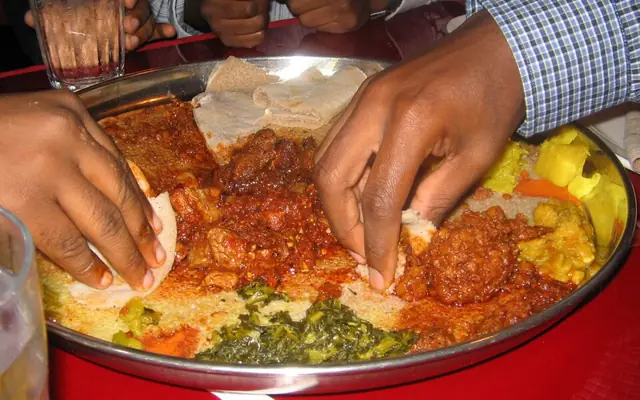
Ethiopian cuisine is one of the most distinctive food traditions on earth, with a flavor profile, eating method, and ingredient base that share almost nothing with neighboring cuisines. The foundation is injera, the spongy sourdough flatbread made from teff (a tiny indigenous grain) that serves simultaneously as plate, scoop, and bite. On top of the injera, the meal is built from wats (the slow-cooked stews) and tibs (sauteed meats), eaten by hand from a communal platter that is the cuisine's defining presentation.
The spice cabinet centers on berbere (the chile-and-warm-spice blend that defines the red, fiery wats), mitmita (a hotter blend used for raw meat dishes like kitfo), and niter kibbeh (the spiced clarified butter that perfumes nearly every cooked dish with cardamom, fenugreek, cumin, ginger, and garlic). The two great wats are doro wat (chicken in berbere with a hard-boiled egg, the celebration dish) and key wat (beef in berbere). On Wednesdays and Fridays and during the long fasting periods of the Ethiopian Orthodox calendar, the meal becomes vegan: lentil wats, split pea wats, collard greens, cabbage and carrot, served on injera with no meat or dairy in sight. This fasting tradition produces some of the most varied vegan cooking in the world.
Coffee, the country's other gift to global food, originated in Ethiopia and the traditional ceremony (jebena, beans roasted and ground in front of the guest, three rounds poured) is still central to hospitality. A meal often ends with a coffee ceremony that takes longer than the meal itself.
Book a food experience
Tours, tastings and classes from the cities on this page, bookable on GetYourGuide.
Explore the iconic sites, rich history, and flavors of Brussels on this guided small-group tour. Discover historical sites like Manneken Pis and try...
Chercher Ethiopian Restaurant in Washington DC is the second-floor 9th Street rowhouse Ethiopian dining room in Shaw's Little Ethiopia, a no-reservations.
OrderThe shiro chickpea stew with extra injera; the menu's editorial signature.
TipNo reservations; the staircase line moves fastest at 17:30 on weeknights and crowds outside the door by 19:00. Cash and card both accepted.
Natural Oasis on Monroe Ave is Ethiopian, known to South Wedge regulars, with injera combination platters rivaling the best Ethiopian kitchens in the region.
TipFew visitors find it; most customers come from the immediate neighborhood. Wednesday through Friday lunch specials are the best entry point. The vegetarian combination is the broadest overview of the kitchen.
Nile Ethiopian Restaurant (Ethiopian) in Denver: Order the vegetarian combination on injera for the table; the kitchen is closed Wednesdays so plan around it.
Why locals goSouth Aurora Ethiopian dining room on the Havana Street East African corridor, a community-led kitchen most Denver guides skip in favor of LoDo names.
TipOrder the vegetarian combination on injera for the table; the kitchen is closed Wednesdays so plan around it.
Lalibela Ethiopian serves a seven-dish injera platter that rivals spots in much larger cities, on a South 13th side street most Old Market tourists skip.
Why locals goSits on a side street that most Old Market visitors never turn down, invisible from the main cobblestone strip that draws the tourists.
Durham's most comprehensive Ethiopian menu: tibs, sambusa and vegetarian spread on injera. A strong group-dining value on W Main Street in the Triangle.
Why locals goW Main Street location is often overlooked for the trendier spots; the largest Ethiopian menu in the Triangle
Lucy on Derech Menachem Begin in Tel Aviv serves Ethiopian stews over injera from a small family-run dining room in south Tel Aviv, with vegan plates too.
TryEthiopian meat and vegetable stews over injera
TipOrder the vegan combination plate: five stews of chickpeas, green beans, carrots, potato and peas on one injera.
Chercher Ethiopian Restaurant in Washington DC is the second-floor 9th Street rowhouse Ethiopian dining room in Shaw's Little Ethiopia, a no-reservations.
OrderThe shiro chickpea stew with extra injera; the menu's editorial signature.
TipNo reservations; the staircase line moves fastest at 17:30 on weeknights and crowds outside the door by 19:00. Cash and card both accepted.
Natural Oasis on Monroe Ave is Ethiopian, known to South Wedge regulars, with injera combination platters rivaling the best Ethiopian kitchens in the region.
TipFew visitors find it; most customers come from the immediate neighborhood. Wednesday through Friday lunch specials are the best entry point. The vegetarian combination is the broadest overview of the kitchen.
Nile Ethiopian Restaurant (Ethiopian) in Denver: Order the vegetarian combination on injera for the table; the kitchen is closed Wednesdays so plan around it.
Why locals goSouth Aurora Ethiopian dining room on the Havana Street East African corridor, a community-led kitchen most Denver guides skip in favor of LoDo names.
TipOrder the vegetarian combination on injera for the table; the kitchen is closed Wednesdays so plan around it.
Lalibela Ethiopian serves a seven-dish injera platter that rivals spots in much larger cities, on a South 13th side street most Old Market tourists skip.
Why locals goSits on a side street that most Old Market visitors never turn down, invisible from the main cobblestone strip that draws the tourists.
Durham's most comprehensive Ethiopian menu: tibs, sambusa and vegetarian spread on injera. A strong group-dining value on W Main Street in the Triangle.
Why locals goW Main Street location is often overlooked for the trendier spots; the largest Ethiopian menu in the Triangle
Lucy on Derech Menachem Begin in Tel Aviv serves Ethiopian stews over injera from a small family-run dining room in south Tel Aviv, with vegan plates too.
TryEthiopian meat and vegetable stews over injera
TipOrder the vegan combination plate: five stews of chickpeas, green beans, carrots, potato and peas on one injera.
One of the few Ethiopian restaurants in the Netherlands. Injera and slow-cooked stews, vegetarian-friendly throughout. Open evenings Tuesday to Saturday.
Balinjera in Kerem HaTeimanim is chef-owner Fanta Prada's kosher Ethiopian dining room in Tel Aviv, plating home recipes learned from her mother onto injera.
OrderThe Tibs Balinjera, diced beef sauteed with black pepper, onion and rosemary.
TipKosher hours apply: closed Saturday and shut by mid afternoon on Friday.
The Pizitz Food Hall counters on 2nd Avenue North Birmingham serve more than a dozen vendors at $8 to $15 per plate, from ramen to peaux boys to Ethiopian.
Dukem Restaurant has served Ethiopian doro wat and kitfo around the clock from inside a budget hotel on Omar Bin Al Khattab Road in Deira, Dubai.
Why locals goSet on the ground floor of the Paloma Blanca Hotel Apartments, it is easy to mistake for hotel lobby seating rather than a full Ethiopian kitchen open all day and night.
TipOrder the kitfo raw if you want it traditional, or ask the kitchen to sear it lightly.
The cooking that defines Ethiopian food internationally: injera, doro wat, key wat, kitfo, tibs, the full vegan platter. Berbere-forward. The most exported regional style.
Tigray (northern)
Flatter, drier injera, more bread varieties (himbasha, ambasha), goat-led cooking, and the tsebhi shiro chickpea stew. Eritrean cuisine shares much of this regional vocabulary.
Gurage
The home of kitfo (the raw spiced beef dish that is Ethiopia's tartare), enset (false-banana root used as a starch staple), and a deeper vegetable repertoire than the highland average.
Harari (eastern, Muslim)
Less injera, more rice and bread, more cardamom and clove (closer to Arabian and Indian Ocean trade-route flavors), and a heavier seafood and lamb base.
Defining ethiopian dishes
Doro wat
The celebration chicken stew: chicken legs and hard-boiled eggs in a deep, slow-cooked berbere-onion-garlic-ginger sauce, perfumed with niter kibbeh. Served on injera with a side of ayib (fresh cheese).
Injera
Sourdough flatbread made from teff flour, fermented for several days, cooked on a clay griddle (mitad) into a large, spongy, bubble-pocked round. Serves as plate, utensil, and bread.
Kitfo
Raw minced beef, dressed warm in niter kibbeh and mitmita (the hotter chile blend), served with ayib cheese and gomen (collards). Gurage origin, eaten leb-leb (just-warmed) or fully raw (tere).
Tibs
Sauteed meat: lamb, beef, or goat with onion, garlic, rosemary, and chile, cooked hot and fast. Several styles: awaze tibs (with awaze sauce), shekla tibs (served sizzling on a clay platter).
Shiro
Spiced chickpea-flour stew, the everyday wat, especially for fasting days. Smooth, deep, satisfying, served bubbling with injera.
Key wat
Beef in berbere, slow-cooked until the meat falls apart. The red wat that anchors a meat-eating Ethiopian table.
Misir wat
Red lentil stew with berbere, garlic, ginger, and niter kibbeh. The most common fasting wat and the one that converts skeptics to Ethiopian food.
Gomen
Collards or kale slow-cooked with onion, garlic, ginger. The leafy-green anchor of the vegan platter.
Ater kik alicha
Yellow split pea stew with turmeric (alicha means 'mild,' i.e., not made with berbere). The yellow counterpoint to the red wats on the platter.
Berbere
The Ethiopian spice blend: dried chiles, garlic, ginger, basil, korarima (Ethiopian cardamom), rue, ajwain, nigella seed, fenugreek. Used in nearly every red wat.
Niter kibbeh
Clarified butter slow-cooked with garlic, ginger, cardamom, cinnamon, fenugreek, and cumin. The aromatic fat that perfumes Ethiopian cooking.
Yetsom beyaynetu
The fasting (vegan) platter: a circle of vegetable and lentil wats arranged on injera, eaten communally. Possibly the best plant-based meal in any cuisine.
How to order
An Ethiopian meal is ordered as a platter, not as courses. The standard order for a group is a meat platter (doro wat, key wat, tibs, kitfo) or a vegan platter (yetsom beyaynetu) for the table, with extra injera on the side. You eat with the right hand only, tearing injera and using it to pinch a bite of wat. A gesture of affection called gursha is feeding someone a bite directly with your hand; it is a hospitality act, not a flirtation, and refusing it is rude.
The rookie mistakes: ordering individual plates (the meal is communal), using the left hand to eat (cultural taboo), trying to eat injera with a knife and fork (the injera is the utensil), missing the coffee ceremony (it is half the meal's social value), and skipping the vegan platter because you eat meat (yetsom beyaynetu is one of the best dishes in the cuisine regardless of diet).
What to drink with it
Tej, the honey wine fermented with gesho (a wild hops cousin), is the traditional Ethiopian alcohol, served in distinctive round-bottomed berele flasks. Tella is the country's homemade beer. Bottled Ethiopian beers (St. George, Bedele, Habesha) are widely available. The non-alcoholic essential is buna (coffee), prepared via the ceremony of green beans roasted, ground, brewed in a jebena clay pot, and poured in three rounds. Spris (a layered fruit juice) is the popular Addis Ababa cafe drink. With kitfo, tej is the classical match.
Where to eat it
Addis Ababa is the only major Ethiopian-food city in the world and holds dozens of serious traditional kitchens, from the iconic Yod Abyssinia and Habesha 2000 to neighborhood injera-and-wat spots throughout Bole and Kazanchis. Outside Ethiopia, Washington DC has the largest Ethiopian diaspora in the West and the strongest restaurant scene (Little Ethiopia on 9th Street NW). Los Angeles also has a Little Ethiopia district. Toronto, London, Stockholm, Frankfurt, and Minneapolis all hold strong diaspora scenes.
A short history
Ethiopian cuisine descends from one of the oldest continuous agricultural traditions in Africa, with teff cultivation and injera-style fermented flatbread documented for over 2,000 years. The country's Christian Orthodox tradition (one of the oldest in the world) established the long fasting calendar that produced the deep vegan cuisine. Coffee originated in the Kaffa region of southwestern Ethiopia and spread through the Arab world from the 15th century onward.
Frequently asked
Is Ethiopian food spicy?
Some dishes are: doro wat and key wat use a generous hand of berbere and can be properly hot. Many others (alicha stews, gomen, ayib cheese) are mild. The mitmita that comes on the side, used with kitfo, is the hottest element on the table.
What is teff?
A tiny grain native to Ethiopia and Eritrea, used to make injera. Gluten-free, high in protein and iron, and one of the smallest grains in the world (a thousand grains weigh about a gram).
Is Eritrean food the same as Ethiopian?
Largely overlapping. Eritrea was part of Ethiopia until 1991 and shares injera, berbere, wats, and tibs with the highland Ethiopian tradition. Eritrean food has a stronger Italian colonial layer (pasta, espresso culture) and the cuisine identifies separately for political reasons, though the kitchens are functionally cousins.