

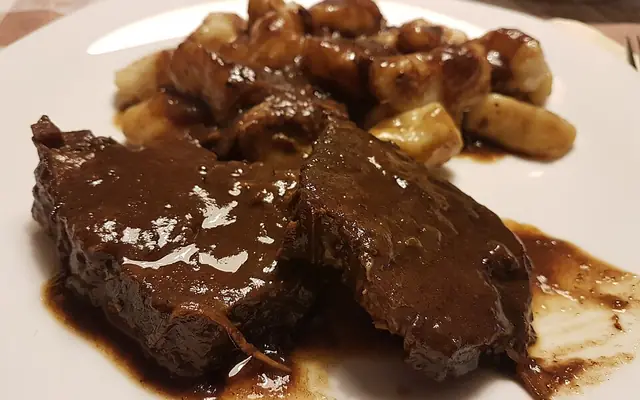
Dalmatian cuisine is the food of the Croatian Adriatic coast, from Zadar in the north to Dubrovnik in the south, including the islands (Brac, Hvar, Korcula, Vis, Lastovo, Mljet). The cooking is a Mediterranean variant with Italian, Ottoman, and Slavic accents: olive oil, garlic, parsley, fresh seafood, lamb from the Karst hills, prsut (cured ham, the Dalmatian relative of Italian prosciutto), pag cheese (the EU-protected sheep cheese from the bora-wind-swept island of Pag), and the Plavac Mali grape that anchors Dalmatian red wine.
The defining preparations are peka (the cast-iron-bell roasting technique, where meat and vegetables are covered with a heavy lid and embers piled on top; the resulting slow-roast is the heart of the Dalmatian tavern), brudet (the Adriatic fish stew, varying by town but always with white wine, olive oil, garlic, and a soft polenta side), pasticada (the slow-braised beef in prune-and-red-wine sauce, the festive dish), soparnik (the Poljica swiss-chard pie, EU-protected), and crni rizot (squid-ink risotto). The konoba (the traditional Dalmatian tavern, with a long communal table, an open hearth, and a strictly seasonal menu) is the format you want to find.
The islands have their own micro-traditions: Hvar for lavender and rosemary-scented lamb, Vis for the simplest fresh fish, Korcula for old-vine Posip white and Grk, Brac for vitalac (lamb offal wrapped in caul fat), Pag for the famous sheep cheese. Wine is taken seriously: Plavac Mali (the parent of California Zinfandel and Italian Primitivo, distantly) for reds, Posip for whites, Prosek and the heavier sweet wines, plus rakija (the universal fruit brandy) and travarica (herb-infused rakija) as the standard after-meal pour.
Book a food experience
Tours, tastings and classes that match this page, bookable on GetYourGuide.
Top picks
The best-scored Dalmatian place in each of 2 cities.
Konoba Matejuska ★ 4.7
Konoba Matejuska is a Dalmatian seafood restaurant at Tomica Stine 3 in Split.
Joso's ★ 4.6
Joso's on Davenport has run Dalmatian Adriatic seafood in Yorkville since 1967, founded by Joso Spralja and now operated by Leo and Shirley Spralja.
OrderThe black risotto with squid and the grilled prawns with garlic butter.
TipClosed Sunday and Monday. The painting on Drake's Take Care album hangs upstairs; book a Saturday table for the full room.
Find a place
Konoba Matejuska ★ 4.7
Konoba Matejuska is a Dalmatian seafood restaurant at Tomica Stine 3 in Split.
Joso's ★ 4.6
Joso's on Davenport has run Dalmatian Adriatic seafood in Yorkville since 1967, founded by Joso Spralja and now operated by Leo and Shirley Spralja.
OrderThe black risotto with squid and the grilled prawns with garlic butter.
TipClosed Sunday and Monday. The painting on Drake's Take Care album hangs upstairs; book a Saturday table for the full room.
Zinfandel Food & Wine ★ 4.4
Zinfandel Food & Wine is a bistro inside Diocletian's palace walls in Split, with over 100 bottles of Croatian wine and 30 wines by the glass.
OrderThe pašticada croquettes or the pan-fried Adriatic sea bass.
TipBook ahead, as the narrow alley outside is busy with passers-by; wine tastings take about 1.5 hours.
Konoba Korta ★ 4.4
Konoba Korta is an authentic Dalmatian konoba in Diocletian's Palace in the centre of Split, with vegetarian, vegan and gluten-free options.
OrderThe peka, the brudet or the black risotto.
TipReserve a table online, or contact the konoba by phone or e-mail for reservations, enquiries or special occasions.
Dalmatian by city


Regional variations
Northern Dalmatia (Zadar, Sibenik)
The lighter Dalmatian cooking. Pag cheese, lamb from the Velebit foothills, sokol (cured ham of the Velebit region), Maraska maraschino liqueur (the Zadar cherry liqueur), Sibenski rizot. Roman-era olive oil production survives.
Central Dalmatia (Split, Trogir, Makarska, the islands)
The classic Dalmatian heartland. Peka, brudet, pasticada, soparnik (the Poljica swiss-chard pie), crni rizot, fresh tuna and swordfish, prsut from the Karst, the Plavac Mali wine zones (Postup, Dingac on the Peljesac peninsula). Split's Pazar fish market is the regional center.
Southern Dalmatia (Dubrovnik, Konavle, the Peljesac peninsula)
Italian-influenced. Pasticada (often called Dubrovacka pasticada, the regional flagship), zelena manestra (kale-and-pork soup), Konavoska torta (the Konavle layered cake), oysters from Mali Ston, the Dingac and Postup wine appellations. The Republic of Ragusa's Venetian-trade-era legacy.
Defining Dalmatian dishes
- Peka
- Meat (lamb, veal, octopus, or chicken) and vegetables roasted under a heavy cast-iron bell with embers piled on top. Cooks for 2 to 3 hours; the meat falls off the bone and the potatoes absorb the meat juices. Order 24 hours ahead at a konoba; the technique cannot be rushed.
- Brudet
- Adriatic fish stew with mixed white-fish, olive oil, white wine, garlic, parsley, and tomato, served with soft polenta (palenta) to soak up the broth. Varies by town; Komiza on Vis and Trogir have their own canonical versions.
- Pasticada
- Beef topside slow-braised in red wine, prosecco vinegar, prunes, carrot, onion, and spices for several hours, served with gnocchi or polenta. The festive Dalmatian dish; takes two days to make properly. Pre-marinated in vinegar overnight, then slow-cooked the following day.
- Soparnik
- Thin pastry (two paper-thin layers of dough) sandwiching swiss chard, garlic, olive oil, and parsley, baked on hot embers under ash. The EU-protected Poljica regional specialty. Often eaten as a snack or appetizer.
- Crni Rizot
- Squid-ink risotto with cuttlefish, white wine, garlic, parsley, and Parmesan. The Adriatic version (Croatian, Italian, Spanish) of the dish; Dalmatia's coastal kitchens lean tomato-light.
- Prsut
- Cured ham, the Dalmatian relative of Italian prosciutto, cured in the bora wind of the Karst plateau. The Drnis prsut (from the Drnis region) is EU-protected. Sliced thin, served with pag cheese and olives as a starter.
- Pag Cheese (Paski Sir)
- Hard sheep cheese from the island of Pag, where bora-wind-blown sea salt seasons the sage and the sheep that eat it. EU-protected. Aged 3 to 24 months; eaten with olive oil, prsut, and a glass of Posip white.
- Vitalac
- Lamb offal (heart, liver, kidney, lung) wrapped in caul fat and skewered, grilled over open fire. Brac island specialty, EU-protected. The deepest local lamb tradition.
- Fritule
- Small fried doughnuts with citrus zest, rakija, and raisins, dusted with sugar. The Dalmatian Christmas sweet, sold year-round at konobas and pastry shops.
- Octopus Salad (Salata od Hobotnice)
- Boiled octopus with boiled potatoes, red onion, parsley, olive oil, vinegar, capers, and olives. The universal Adriatic appetizer; almost every konoba does its own version.
How to order
At a konoba (Dalmatian tavern), start with a cold platter (prsut, pag cheese, olives, anchovies, salted sardines), then a primi (crni rizot, brudet, or a fresh-fish risotto), then a peka (ordered 24 hours ahead) or a fresh-fish secondi sold by weight at the table (gilthead bream, sea bass, dentex, scorpionfish). Fresh fish is priced by the kilogram and the waiter brings the fish to your table for selection before cooking. House wine (carafe of Plavac Mali red or Posip white) is the right call. Bread and olive oil are usually served automatically.
The rookie mistakes: ordering peka without 24 hours' notice (the technique cannot be rushed; the cast-iron-bell roast needs the slow embers), expecting Dalmatian food to be Italian (it shares some grammar but the peka, brudet, and pasticada are Dalmatian-specific), refusing the house wine (Dalmatian wine programs are typically Plavac-Mali-strong and far more interesting than the imports), and assuming all Croatian food is the same as Dalmatian (the inland kitchen, Zagorje and Slavonia, is paprika-and-lard heavier, more Hungarian than Mediterranean). Tip 10 percent.
What to drink with it
Plavac Mali is the defining red, with the Dingac and Postup appellations on the Peljesac peninsula the prestige zones. Posip and Grk are the indigenous whites of Korcula. Malvazija from Istria (the neighboring region) shows up widely. Prosek is the traditional Dalmatian sweet wine (not to be confused with Italian Prosecco; the legal dispute over the name continues). Travarica (herb-infused rakija) and orahovac (walnut-infused rakija) are the standard digestifs. Mareska maraschino liqueur from Zadar is the regional cherry liqueur. Karlovacko and Ozujsko are the domestic beers; craft brewing is growing in Split and Zadar.
Where to eat it
Split is the central Dalmatian capital, with Konoba Matejuska (the harbor classic), Bokeria (the modern), Boban (the elder fine-dining room), and Zoi (the Split rooftop fine-dining). Dubrovnik holds Restaurant 360 (the Michelin-starred fine dining inside the old city walls), Proto (the seafood lineage room), and Posat. The islands run their own konobas: Hvar (Lola, Giaxa), Korcula (Filippi, Konoba Maslina), Trogir (Konoba Trs), Brac (Konoba Tinel for the famous vitalac). Zadar in the north has Restaurant Pet Bunara and 4 Kantuna. The island konobas are typically family-run, seasonal (closed November to March), and book ahead in summer. Outside Croatia, Toronto and Sydney's Croatian-diaspora restaurants and the Italian-Friuli rooms that share the Adriatic cooking grammar.
A short history
Dalmatian cuisine took its modern shape under the Republic of Venice (which ruled the Dalmatian coast for four centuries until 1797) and the subsequent Habsburg administration. The cooking absorbed Venetian techniques (rizot, brudet, the pasta tradition) while keeping its Slavic ingredient base (lamb, sheep cheese, prsut) and its Karst-and-island microclimate. The post-1991 Croatian republic has rebuilt the konoba tradition publicly, and the Michelin Guide arrived in 2022 (with stars in Zagreb, Dubrovnik, Split, and Rovinj).
Frequently asked
What is the difference between Dalmatian and Istrian cooking?
Both are Croatian Adriatic regional cuisines, but Istria (the northern peninsula bordering Italy and Slovenia) leans more Italian-influenced (truffles, Malvazija white, fuzi pasta) while Dalmatia (the long southern coast) leans more Karst-and-island, with peka, brudet, pasticada, and Plavac Mali wine. The two cuisines share the Adriatic seafood base but diverge in technique.
Is prsut the same as prosciutto?
Both are dry-cured hams from the eastern Adriatic, made by closely related techniques. Italian prosciutto di San Daniele (just across the border in Friuli) and Dalmatian Drnis prsut are cured in similar bora-wind conditions; the difference is subtle. Dalmatian prsut is typically smoked lightly (the Italian is not), giving it a slightly deeper color and a smokier note.
What is Plavac Mali wine?
An indigenous red grape of Dalmatia, the parent variety of California Zinfandel and Italian Primitivo (the relationship was confirmed by DNA testing in the 2000s). The Dingac and Postup appellations on the Peljesac peninsula produce the most concentrated, prestigious Plavac Mali wines. Younger Plavac is bright and fruit-forward; older bottlings deepen into leather and dried fig.
More cities are in research. Want Dalmatian covered somewhere specific? Tell us where you want to eat.