
Prague
Guided tour · 1h 30m
Prague: Czech Beer-Tasting Experience with Snacks
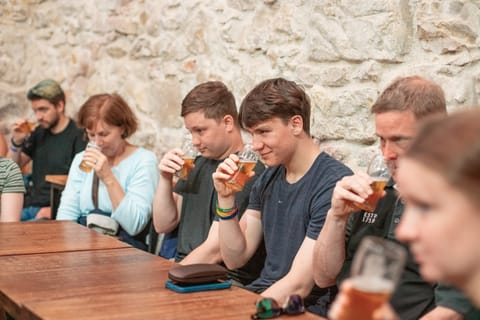
Become an expert on Czech beer in Prague and learn about the complexities of beer through the fundamental rules of tasting. Sample 7 varieties of...
fromKč 732Check dates
41 editor-picked czech restaurants across 4 cities.
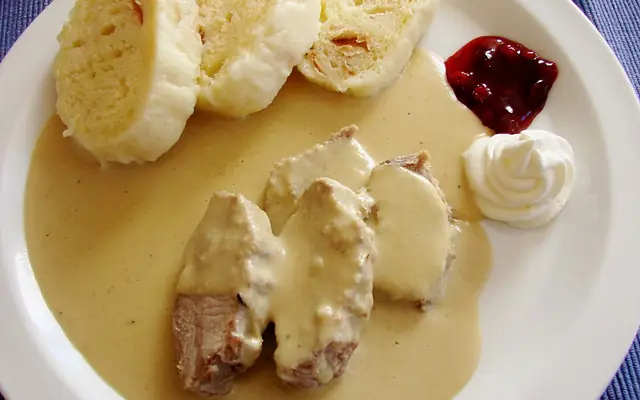
Czech cuisine is the food of a small Central European country with an outsized beer culture: the world's highest beer consumption per capita, the original Pilsner (1842, in the western Bohemian city of Plzen), and a tavern (hospoda) tradition where pork, dumplings, sauerkraut, and a half-liter pilsner are the daily working lunch. The cooking shares its grammar with neighboring Slovak, Austrian, Polish, and southern German kitchens, but the Czech accent leans heavier on knedliky (bread or potato dumplings) as the starch, on pilsner as the universal accompaniment, and on the slow-braised meat dishes that define the Bohemian tavern.
The defining dishes are veprzo-knedlo-zelo (the trinity of roast pork, knedliky, and sauerkraut, considered the national dish), svickova (beef sirloin in a root-vegetable cream sauce, the Sunday dish), Czech-style goulash (the thicker stew version of the Hungarian original, served with bread dumplings), and roast duck or goose with red cabbage. The deeper canon includes utopenci (pickled sausage), nakladany hermelin (pickled Camembert-style cheese), bramboracky (potato pancakes), kulajda (a creamy dill-and-mushroom soup), and a long catalogue of beer-friendly snacks (utopenci, syrove kuliky, smazak).
The drinking culture is inseparable from the food. Czechs invented the pilsner style; Pilsner Urquell from Plzen and Budvar from Ceske Budejovice are the lineage rooms, plus a tavern tradition of unpasteurized tank-fresh beer that has now spread back into Western Europe. A Czech meal is, almost universally, accompanied by pivo (beer), poured from the tap with a fresh head, drunk at room temperature on the bottom and cool at the top. Wine country exists in Moravia (the eastern Czech region), but Bohemia is beer territory.
Tours, tastings and classes that match this page, bookable on GetYourGuide.
Guided tour · 1h 30m
Become an expert on Czech beer in Prague and learn about the complexities of beer through the fundamental rules of tasting. Sample 7 varieties of...
30 - 100 minutes
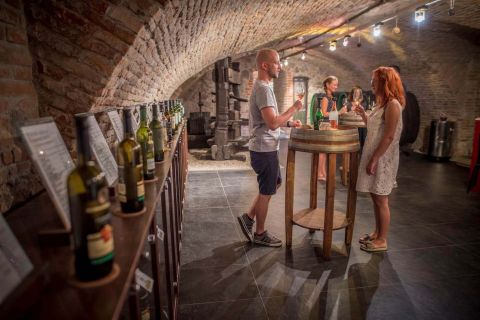
Visit the Slovak National Collection of Wines where the top 100 wines of Slovakia are showcased. Choose the best program for you and taste...

Guided tour · 3 hours
Savor the soul of Music City on this East Nashville food tour. Explore Five Points and Historic East Edgefield with 6 tastings including Hot...

Private tour · 1 hour
Hop on our Wroclaw party cart! Explore the city, enjoy unlimited beer, great music, and good vibes, all in one ride. Book now and make it epic!
The best-scored czech place in each of 4 cities.
La Degustation Boheme Bourgeoise has held its Michelin star since 2012 in a quiet Old Town room, building eleven-course tastings from 19th-century Czech.
OrderThe eleven-course tasting with the Moravian wine flight.
Yeast Nashville's Woodland Street counter in East Nashville bakes Czech-style kolaches with sausage, cheese and fruit fillings since 2014; closes by noon.
Why locals goCzech-style kolaches baked at dawn on Woodland Street, closed by noon every day. Tourists rarely find it; locals know the cherry kolache cult.
TipSausage and cheese kolache plus a cherry kolache and coffee is the canonical lunch order for $8.
Cafe Verne on Hviezdoslavovo 18 holds the late-kitchen anchor in the Old Town, pouring Czech tank beer with student crowds past midnight on weekend nights.
TrySlovak and international plates, Czech beer
TipThe kitchen runs to closing; one of the few late kitchens in the Old Town for a proper meal.
Bernard Piwiarnia Restauracja on Wrocław's Rynek pours unpasteurised Czech Bernard beer over three floors, with Czech and Lower Silesian cooking.
OrderA tankard of unpasteurised Bernard lager with the house dumplings.
TipThe townhouse faces the Town Hall; ask for a first-floor window table for the Rynek view and book ahead at weekends.
La Degustation Boheme Bourgeoise has held its Michelin star since 2012 in a quiet Old Town room, building eleven-course tastings from 19th-century Czech.
OrderThe eleven-course tasting with the Moravian wine flight.
Field is Prague's tightest Michelin one-star kitchen, an Old Town room where Radek Kasparek has been cooking Czech terroir on tasting menus since 2015.
OrderThe seasonal tasting menu with wine pairing.
The Eatery is the Holesovice Bib Gourmand from chef Pavel Bycek (formerly of Alcron), an industrial-style room with an open kitchen turning out contemporary.
OrderThe duck if it is on the daily card; the house-baked bread.
Yeast Nashville's Woodland Street counter in East Nashville bakes Czech-style kolaches with sausage, cheese and fruit fillings since 2014; closes by noon.
Why locals goCzech-style kolaches baked at dawn on Woodland Street, closed by noon every day. Tourists rarely find it; locals know the cherry kolache cult.
TipSausage and cheese kolache plus a cherry kolache and coffee is the canonical lunch order for $8.
Cafe Verne on Hviezdoslavovo 18 holds the late-kitchen anchor in the Old Town, pouring Czech tank beer with student crowds past midnight on weekend nights.
TrySlovak and international plates, Czech beer
TipThe kitchen runs to closing; one of the few late kitchens in the Old Town for a proper meal.
Bernard Piwiarnia Restauracja on Wrocław's Rynek pours unpasteurised Czech Bernard beer over three floors, with Czech and Lower Silesian cooking.
OrderA tankard of unpasteurised Bernard lager with the house dumplings.
TipThe townhouse faces the Town Hall; ask for a first-floor window table for the Rynek view and book ahead at weekends.
 Prague38 places
La Degustation Boheme Bourgeoise, Field
Prague38 places
La Degustation Boheme Bourgeoise, Field
 Bratislava1 place
Cafe Verne
Bratislava1 place
Cafe Verne
 Nashville1 place
Yeast Nashville
Nashville1 place
Yeast Nashville
 Wrocław1 place
Bernard Piwiarnia Restauracja
Wrocław1 place
Bernard Piwiarnia Restauracja
The pilsner heartland. Roast pork with knedliky, svickova, Czech-style goulash with bread dumplings, utopenci, smazak (fried cheese), bramboraky. The defining Czech tavern cooking. Prague's old-town hospody and Plzen's brewery restaurants are the lineage rooms.
Wine country, lighter cooking. Moravian sparrows (vepřové ze zadního), slow-roasted pork in caraway with bread dumplings, vegetable sauerkraut, Moravian-style goulash. Slivovice (plum brandy) and Moravian Riesling, Pinot Blanc, and Pinot Gris.
Polish-influenced cooking with more potato dumplings (less bread dumplings), more sauerkraut variations, and a deeper game tradition from the Bohemian forests. Boar and venison are regional specialties.
At a Czech hospoda (tavern), order a pilsner first; it usually shows up automatically. Order a starter (utopenci, smazak, or nakladany hermelin), then a main with knedliky. Portions are large; expect 600 to 800 grams of protein. The standard Czech meal pattern is starter, then main, then maybe a small sweet (palacinky, the thin pancakes with jam and quark). Tip 10 to 15 percent. Cash and card both work in Prague; smaller towns lean cash.
The rookie mistakes: ordering Czech goulash expecting the Hungarian soup (different dish), expecting tap water (almost never served; order sparkling or still bottled), trying to drink the beer foam separately (the foam is part of the beer and signals freshness from the tap), and tipping like an American (15 percent is generous; rounding up is the minimum). One pilsner is half a liter unless you ask for malé pivo (small, 0.3 liter). Knedliky are eaten with a fork pressed into the meat juices, not separately. Don't ask for ketchup on dumplings.
Pilsner is the universal pour. Pilsner Urquell on tap is the Czech tradition; Budvar (Budweiser Budvar, the original Budweiser before the American trademark dispute) runs a close second. The unpasteurized tank-fresh pilsner from the brewery taprooms (U Pinkasu in Prague, the Plzen brewery) is the deepest expression. Czech dark lager (the Polotmavy and Cerne styles) handles the heavier braised meats. Moravian wine (Riesling, Pinot Blanc, Pinot Gris, Frankovka, Modry Portugal) for the eastern Czech menus. Slivovice (plum brandy) after the meal; Becherovka (the herbal liqueur from Karlovy Vary) is the country's signature digestif.
Prague holds the most concentrated Czech-restaurant density: U Modre Kachnicky (the duck restaurant), Lokal (the modern updated-hospoda chain with multiple branches), U Medvidku (with its in-house Budweiser-not-Budvar brewery), Cestr (the modern Czech meat-focused room), Field (the Michelin-starred modern Czech room), La Degustation Boheme Bourgeoise (the most ambitious modern Czech tasting menu), and U Zlateho Tygra (the most famous classic hospoda, where Vaclav Havel drank). Plzen is the pilsner pilgrimage city, with the Plzensky Prazdroj brewery restaurant. Brno runs Pavillon and the Moravian-leaning modern rooms. Cesky Krumlov has the deeper Bohemian taverns. Outside Czechia, Vienna's Czech-influenced rooms, Berlin (a long Czech expatriate tradition), and the Chicago Czech-American restaurants (Klas, Bohemian Crystal) hold the diaspora line.
Czech cuisine took its modern shape during the Habsburg empire, when Bohemian and Moravian cooking absorbed Austrian and Hungarian influences while keeping its dumpling-and-beer character. Pilsner was invented in Plzen in 1842 (Pilsner Urquell, the original pale lager that defines the worldwide pilsner style today). The post-1989 Czech kitchen has rebuilt the tavern tradition publicly, and a small but real modern-Czech scene (Field, Cestr, La Degustation Boheme Bourgeoise) now sits alongside the classic hospoda.
Hungarian gulyas is a soup (a thin paprika-and-beef broth with potato), traditionally cooked outdoors in a cauldron. Czech goulash is a thicker stew (cubed beef in paprika gravy), served with bread dumplings. They share a name (and a Habsburg-era ancestor) but are now different dishes.
No. Trdelnik (the rolled cinnamon-sugar pastry sold in tourist alleys in Prague) is a Hungarian-Slovak Transylvanian invention that arrived in Prague in the 2000s and was marketed as Czech for tourists. Czechs themselves do not consider it part of the canon. The genuinely Czech sweet is medovnik (honey cake) or vetrnik (the chou-pastry cream wheel).
Czechs drink the most beer per capita in the world (around 140 liters per person annually) and the country's brewing industry runs at scale. A half-liter of pilsner at a hospoda is often cheaper than a soft drink. The quality is also exceptionally high for the price; Czech pilsner is the global benchmark for the style.
More cities are in research. Want czech covered somewhere specific? Tell us where you want to eat.