

The plates that define Chengdu: what they are, where they came from, and where to eat the canonical version.
Signature dishes
-
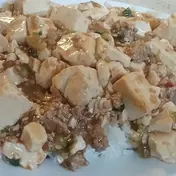
Mapo Tofu (麻婆豆腐) ★ 4.9
Mapo tofu is tofu in a thin, oily, bright red sauce of douban chilli bean paste and douchi fermented black beans with minced meat, traditionally beef, both hot and numbing.
Where to try it: Chen Mapo Tofu (Qinghua Road), Fang Xiang Jing, Fu Rong Chuan, Mi Xun Teahouse
Mapo tofu probably began at a Chengdu restaurant in the 1860s, a Fanpu eatery called Chenxingsheng run by a couple named Chen near the Wanfu bridge. Mrs Chen, nicknamed Chen Mapo, made a simple dish of chilli, pork, tofu and Sichuan pepper; in the 1920s her chef Xue Xiangshun switched to beef and added douchi. Mapo means an old woman with a pockmarked face, so the name is sometimes given as pockmarked grandma's beancurd. Its chilli broad bean paste comes from Pixian, now Chengdu's Pidu District.
Watch out for: Soy (tofu, douchi and the bean paste), Wheat (flour in the bean paste)
-
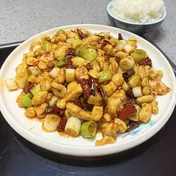
Kung Pao Chicken (宫保鸡丁) ★ 4.6
Kung pao, or gong bao, chicken is diced chicken stir-fried with peanuts, chilli peppers and Sichuan peppercorns; in Sichuan cooks reach for facing heaven or seven stars chillies.
The dish's origins are uncertain, but it is believed to be named after Ding Baozhen, a late Qing dynasty official and governor of Sichuan Province, whose title, Taizi Shaobao, was one of the Gongbao. The ding of the dish's name puns on his surname, which can also mean a small cube, like the diced chicken. During the Cultural Revolution the name became politically incorrect because of its link with the imperial system, and the dish was renamed spicy chicken. In Sichuan the peanuts go in fresh and unroasted, deep-fried in the wok until golden brown.
Watch out for: Peanuts
-
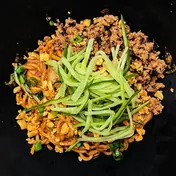
Dan Dan Noodles (担担面) ★ 4.8
Dan dan noodles are wheat noodles served with no soup in a small bowl, covered in a mala sauce of chilli oil, Sichuan pepper and minced pork, with pickled vegetables, peanuts and scallions.
Where to try it: Mi Xun Teahouse
Dan dan noodles originated in Chengdu. Dan is a carrying pole: walking street vendors sold the dish to passers-by with the pole over a shoulder and two baskets, noodles at one end and sauce at the other, so the name may be better translated as peddler's noodles. The soup version comes from Hong Kong, which tones down the spice and sometimes adds sesame paste or peanut butter; it is uncommon in Sichuan, where the traditional style dominates. The same sauce is often served over bang bang chicken.
Watch out for: Wheat (noodles), Peanuts
Book food experiences in Chengdu


-
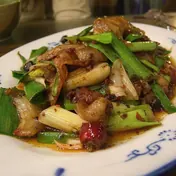
Twice-Cooked Pork (回锅肉) ★ 4.6
Twice-cooked pork, huiguo rou, is pork belly simmered, sliced and returned to the wok with garlic sprouts or baby leeks, in a sauce that can hold chilli bean paste and sweet wheat paste.
In western Sichuan the dish is called aoguo rou. Hui guo means cooked again: the pork is first boiled in water, then stir-fried with vegetables. Sichuan people traditionally made offerings of boiled pork on the first and fifteenth of each month, and the poor, who could not afford the dearest cut, used pork belly and stir-fried it once the rite was done; the dish then spread to other places. Pixian chilli bean paste, called the soul of Sichuan cuisine, is indispensable to it.
Watch out for: Soy and wheat (chilli bean paste, sweet wheat paste)
-
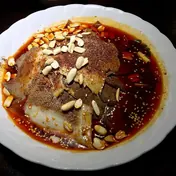
Fuqi Feipian (夫妻肺片) ★ 4.5
Fuqi feipian, husband and wife lung slices, is thinly sliced beef and offal such as heart, tongue and tripe, served cold with chilli and Sichuan pepper; actual lung is rarely used.
Where to try it: Fu Rong Huang
As early as the late Qing dynasty, vendors in Chengdu sold cold beef slices in the streets, using offal because it was cheap, and the dish was popular with rickshaw pullers and poor students. In the 1930s a Chengdu couple, Guo Zhaohua and Zhang Tianzheng, became famous for their slices; children stuck paper notes reading fuqi feipian on their backs, and a merchant later gave them a gold-lettered plaque with the name. Fei first meant waste parts and was later changed to the character for lung so the dish sounded less repulsive.
Watch out for: Soy (soy sauce), Sesame (sesame powder)
-
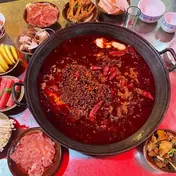
Chengdu Hot Pot (成都火锅) ★ 4.8
Chengdu hot pot is vegetables, fish and meat cooked at the table in a boiling spicy broth; the mala base is built on Sichuan peppercorns, dried chillies and beef tallow.
Where to try it: Long Sen Yuan (Qingyang), China Samite - Hot Pot (Wuhouci Street), Young Art · Yong Ya He Xian (Tongzilin East Road)
Mala hot pot goes back to riverside workers along the Yangtze in Sichuan in the early 20th century, who wanted cheap, warming meals they could suit to their taste: vendors boiled cheap cuts such as beef tripe in a spiced broth, and the peppercorns and chilli oil masked strong meat flavours. Over time it grew from street food into a restaurant dish. Doubanjiang is a key ingredient of Sichuan hotpot. In Chengdu it suits a gathering of friends, draws locals and tourists alike, and hot pot restaurants can be found throughout the city.
Watch out for: Soy and wheat (doubanjiang in the base)
-
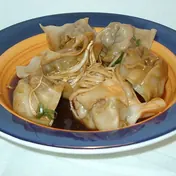
Chaoshou, Chengdu Wontons (抄手) ★ 4.6
Chaoshou is the Sichuan name for wontons. Long Chaoshou made its name with wrappers so thin they turn translucent, and spicy versions come tossed in chilli bean or red oil sauce.
Where to try it: Mosnack, Mind (Wuhou), No.37 Lao Yuan Ba Chao Shou
Chaoshou is what Sichuan calls the wonton, which Guangzhou calls yuntun. Zhang Guangwu founded Long Chaoshou in 1941 at Yuelaichang in Chengdu, taking the name long as a pun on the nong of the Nonghua Teahouse, where he planned the shop. In the 1960s it moved to the south section of Chunxi Road and added other Chengdu snacks, and in 1995 China's Ministry of Internal Trade named it a China Time-honored Brand. A related Sichuan dish, suanla chaoshou, dresses the dumplings in the same sauce as dan dan noodles.
-
Tianshui Mian, Sweet Water Noodles (甜水面) ★ 4.3
Tianshui mian are chopstick-thick, firm noodles with no soup and no toppings, dressed in chilli oil, mashed garlic, sesame paste, soy sauce, ground Sichuan pepper and sweet red soy sauce.
Where to try it: No.37 Lao Yuan Ba Chao Shou
Tianshui mian is a Chengdu snack named for the sweetness of its sauce. A bowl holds only noodles and the dressing, with no soup and no vegetable toppings, and the noodles are few, about as thick as chopsticks and springy, even a little hard, to the bite. The taste is sweet with heat, and it can be eaten hot or cold. Shops that sell sweet water noodles usually also sell liangfen, a starch jelly, and cold noodles.
Watch out for: Sesame (sesame paste), Soy (soy sauce)
-
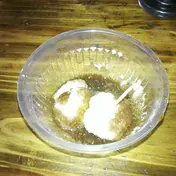
San Da Pao (三大炮) ★ 4.3
San da pao, three big cannons, are balls of steamed glutinous rice thrown hard at a board so they bang and bounce into roasted soybean flour, made with brown sugar and sesame.
San da pao is a Sichuan snack similar to Beijing's lü da gun. Glutinous rice is soaked overnight, steamed soft over a fierce flame and rolled on an oiled board until mostly broken down. The seller pulls off pieces the size of a ping-pong ball and throws them hard at a small table fitted with brass tea trays, so each lands with a bang and bounces into a large bamboo tray of roasted soybean flour. On Jinli, the old street beside the Wuhou Shrine, it is sold alongside Zhang Fei beef and feichang fen.
Watch out for: Soy (soybean flour), Sesame
-
Rabbit Head (兔头) ★ 4.2
Tu tou, rabbit head, also called tu naoke, is a traditional Chengdu snack, and rabbit is far more popular in Sichuan than anywhere else in China.
Where to try it: Tan Jia
Rabbit meat is much more popular in Sichuan than elsewhere in China, and the Sichuan Basin and Chongqing are estimated to eat about 70 percent of all the rabbit meat consumed in China. The rabbit head is a traditional snack in Chengdu, as it is in Datong in Shanxi and Quzhou in Zhejiang. A 2018 article estimated that China eats close to 500 million rabbit heads a year, at least 200 to 300 million of them in Sichuan.
Signature Dishes in Chengdu, FAQ
What food is Chengdu known for?
Chengdu's signature dishes include Mapo Tofu (麻婆豆腐), Kung Pao Chicken (宫保鸡丁), Dan Dan Noodles (担担面), Twice-Cooked Pork (回锅肉), Fuqi Feipian (夫妻肺片). See our signature dishes chapter for where to eat each.