
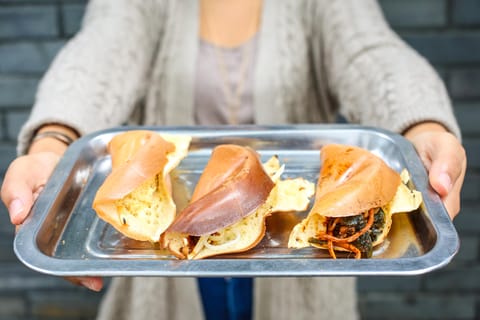
How Chengdu came to eat the way it does: the people, migrations and accidents that shaped the plate.
Key eras
-
Han and Jin dynasties, the classical cuisine
Sichuan cuisine took its classical form in the Han and Jin dynasties. Jinli, the old street beside the Wuhou Shrine, was one of the oldest and most commercial streets of the Shu state, known throughout the country in the Qin, Han and Three Kingdoms periods.
-
Tang and Song dynasties, Sichuan restaurants travel
In the Tang and Song dynasties Sichuan cuisine developed further, and Sichuan restaurants spread to Kaifeng and Lin'an. During the Song dynasty Sichuan cuisine became a distinct cuisine, and in the Middle Ages Sichuan took in broad beans, sesame and walnuts from the Middle East.
-
Kangxi era, chillies and Pixian bean paste
Chili peppers came into wide use in Sichuan cooking in the Kangxi period, the watershed between ancient and modern Sichuan cuisine. In the same reign Chen Shouxin of Pixian, now Chengdu's Pidu District, created Pixian chilli bean paste, and in 1718 the Qing built the Manchu city whose lanes are today's Kuanzhai Alley.
-
Late Qing, mapo tofu and street vendors
Mapo tofu probably began in the 1860s at Chenxingsheng, a Chengdu eatery run by a couple named Chen near the Wanfu bridge; Mrs Chen, nicknamed Chen Mapo, made it with chilli, pork, tofu and Sichuan pepper. By the late Qing, vendors were already selling cold sliced beef in the city's streets.
Taste it todayMapo Tofu (麻婆豆腐) -
1920s to 1940s, the snack makers
In the 1920s Chen Mapo hired the chef Xue Xiangshun, who cooked the tofu with beef and added douchi. In the 1930s Guo Zhaohua and Zhang Tianzheng became famous for the beef slices nicknamed fuqi feipian, and in 1941 Zhang Guangwu opened Long Chaoshou at Yuelaichang.
Taste it todayFuqi Feipian (夫妻肺片) -
1949 to 1998, state shops and old brands
After 1949 the fuqi feipian business was merged into a state catering company. In the 1960s Long Chaoshou moved to the south section of Chunxi Road, and in 1995 it was named a China Time-honored Brand; in October 1998 Guo Ruiqiu, the couple's daughter, reopened a family fuqi feipian shop.
Taste it todayFuqi Feipian (夫妻肺片) -
2003 onwards, City of Gastronomy
In 2003 the city began turning the Kuanzhai lanes into a strip of restaurants, teahouses and bars, opened on 14 June 2008. Chengdu joined UNESCO's Creative Cities Network in 2010 as Asia's first City of Gastronomy, and the first Michelin Guide Chengdu, in January 2022, named 1 two-star, 8 one-star and 13 Bib Gourmand restaurants.
Immigrant influences
- Hunan settlers after the Ming and Qing wars
- The wars from the Ming to the Qing cut Sichuan's population by about 75%, and settlers from neighbouring Hunan brought their cooking styles with them.
- Crops from the New World
- From the 16th century the chili pepper, native to Mexico, likely reached Sichuan from India or Macau, and corn, sweet potatoes and white potatoes, brought by Catholic missions, followed.
- Chengdu's Hui Muslim quarter
- In the late Qing, many vendors in Chengdu's Hui Muslim quarter carried poles and baskets of cold dressed beef offal through the streets, the dish that became fuqi feipian.
- Cooks from Chongqing, Leshan and Zigong
- Gong Zhou has cooked Chongqing dishes by Taikoo Li since 1998, Xiao You Shao Mai serves Leshan small bites, and Gui Tian Yuan Zi has ingredients shipped from Zigong daily.Taste it todayGui Tian Yuan Zi
Signature innovations
- Mapo tofu, first cooked by Mrs Chen, Chen Mapo, at a Chengdu eatery in the 1860sTaste it todayMapo Tofu (麻婆豆腐)
- Pixian chilli bean paste, created by Chen Shouxin in the Kangxi era and called the soul of Sichuan cuisine
- Fuqi feipian, the cold beef slices that a Chengdu couple made famous in the 1930sTaste it todayFuqi Feipian (夫妻肺片)
- Long Chaoshou's translucent wontons, first wrapped by Zhang Guangwu in 1941
- Dan dan noodles, named for the carrying poles of Chengdu's street vendorsTaste it todayDan Dan Noodles (担担面)
Book food experiences in Chengdu

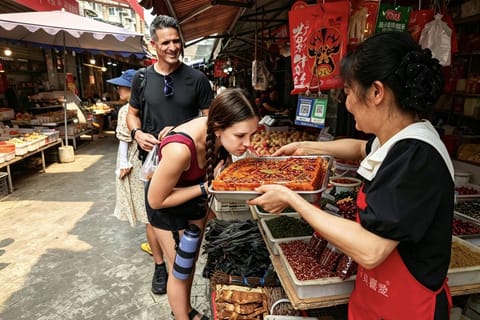
Check dates and prices
Powered by GetYourGuide